

Official websites use .gov
A .gov website belongs to an official government organization in the United States.

Secure .gov websites use HTTPS
A lock (
) or https:// means you’ve safely connected to the .gov website. Share sensitive information only on official, secure websites.


Exhaust Flow Calibration – S-probe Traverse
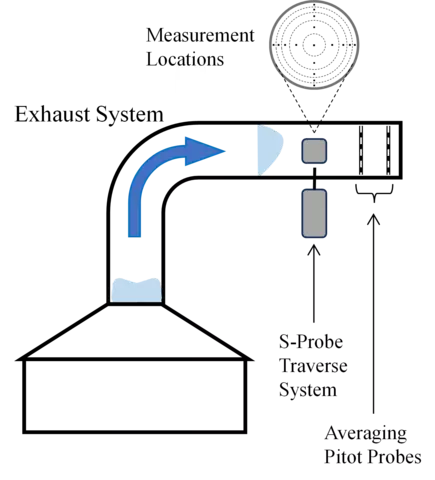
Accurate flow measurements in large fire experiments are essential for producing reliable data to characterize fire behavior and evaluate its hazard potential. For example, quantitative measurements of toxic emissions from fire are the product of accurate flow and concentration measurements. Measurements of the rate of heat released by a fire, one of the most important metrics for predicting how likely a fire will spread, also require accurate flow measurements. Large-fire research facilities, like the NFRL, often require large and complex duct geometries to remove smoke and toxic emissions. Less-than-ideal flow characteristics such as lack of symmetry (flow is faster on one side of the duct than the other), swirl (flow that twists and turns instead of moving in a straight line), and turbulence (eddies or rotating packets of flow) that cause fluctuations in flow speed, are typical of large exhaust systems. These complexities make it difficult to choose the right location(s) for flow monitoring devices and therefore difficult to achieve accurate flow measurements. Hence the exhaust flow measurement has been frequently cited as a significant source of uncertainty for data of heat release and fire emissions.
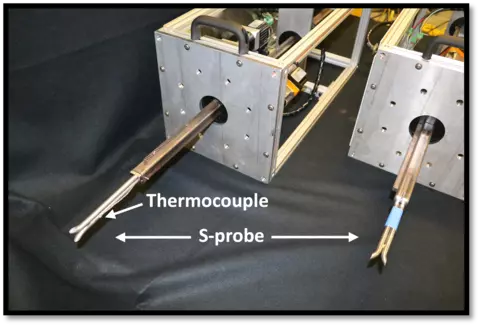
To reduce measurement uncertainty, it is best practice to conduct an in-situ calibration of flow monitoring devices for their specific application. One calibration method involves using S-probes to measure the flow distribution across multiple chords of the exhaust duct. It is a standard test method for determining average flow in exhaust ducts and stacks. An automated system was developed to apply the calibration method and characterize the flow in detail. The S-probes feature large symmetric openings that resist clogging from particulates generated by the fire, and the automated traverse system features two robotic actuators that precisely position the S-probes at prescribed locations across the duct.
The S-probe traverse method provides a tool for fire researchers to characterize their exhaust systems and verify that fire experiments have negligible impact on their exhaust flow measurements. |
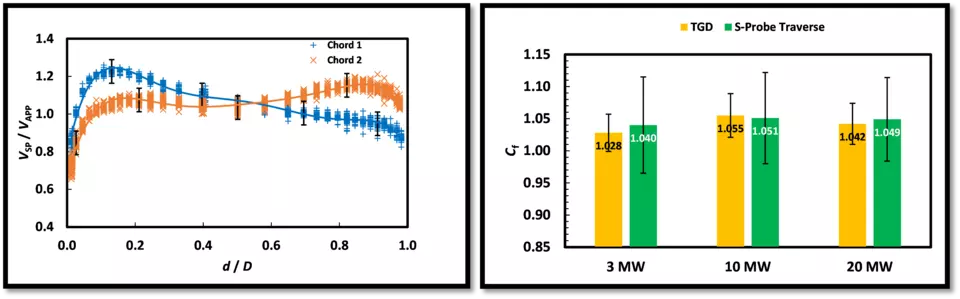
An in-situ calibration of NFRL’s exhaust flow measurement devices, averaging pitot probes, was conducted using the S-probe traverse method. Flow constants determined by the calibration have estimated expanded uncertainty ranging from ±6% to ±7%. They agree with previous flow constants determined using the independent calibration method, tracer gas dilution (TGD), therefore confirming the accuracy of both calibration techniques. The detailed characterizations of exhaust flow confirmed specific cases of flow being skewed to one side of the duct. Local flow could be as much as 70% to 125% of the flow speed monitored by the averaging pitot probes. The skewed flow conditions were repeatable over a 24-month period, indicating that flow conditions were stable. Experiments were conducted with and without fire to evaluate its impact on the flow measurement. The presence of fire did not alter the flow distribution at the 3 MW and 10 MW calorimeters, although it showed potential to impact the distribution at the larger 20 MW calorimeter. Application of this method has provided documented benchmarks for the system’s behavior and performance.
Despite having a larger measurement uncertainty, the S-probe traverse method provides an alternative to TGD for in-situ calibration of flow measurement devices in large ducts. The benefit of the S-probe traverse is the capability to provide detailed flow characterizations under realistic operating conditions, therefore with the presence of fire. This investigation has demonstrated that exhaust configurations with flow measurements insensitive to fire are possible, however it is good practice to confirm that the fire induces negligible impact, especially for large-scale systems. The S-probe traverse method provides a tool for researchers to gain a better understanding of their system, allowing them to optimize overall measurement performance.
Related Publications
- Bryant RA, Chernovsky AA, (2025). Detailed Characterizations of Exhaust Flow for a System of Large-Fire Calorimeters. Fire Safety Journal, 156, 104453. doi:10.1016/j.firesaf.2025.104453
- Bryant RA, Chernovsky AA, (2025). The NIST 20 MW Calorimetry Measurement System – Exhaust Flow Characterization and Calibration. NIST Technical Note 2325. doi:10.6028/NIST.TN.2325
- Bryant RA, Chernovsky, AA, Falco JA, Shinder II, (2023). An Automated System for Flow Characterization at Exhaust Ducts and Smokestacks. NIST Technical Note 2247. doi:10.6028/NIST.TN.2247
Contacts
-
(301) 975-6487
-
(301) 975-5988