

Official websites use .gov
A .gov website belongs to an official government organization in the United States.

Secure .gov websites use HTTPS
A lock (
) or https:// means you’ve safely connected to the .gov website. Share sensitive information only on official, secure websites.


Modeling toehold mediated strand exchange circuits across environments and applications
Summary
Originally developed for DNA nanotechnology, toehold-mediated strand exchange (TMSE) circuits are now gaining traction in synthetic biology. The Cellular Engineering Group is working to bridge the gap between DNA nanotechnology and synthetic biology through unified computational modeling tools.
Description
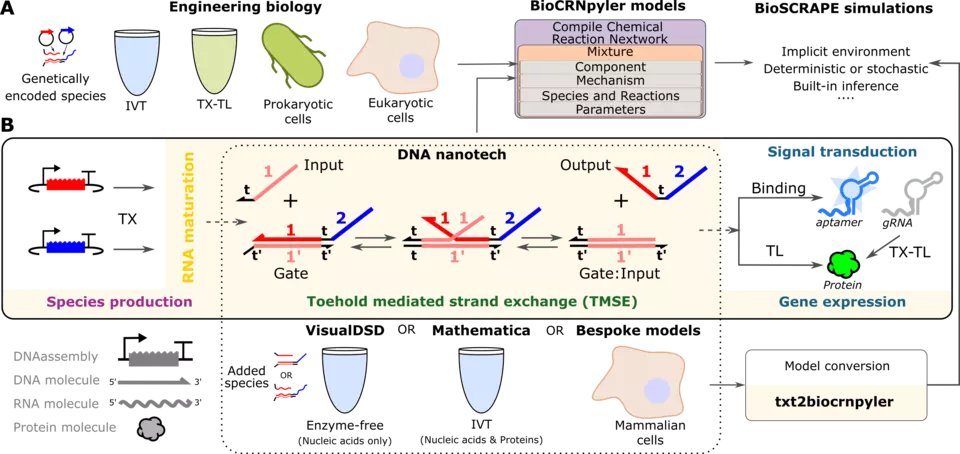
Figure 1: BioCRNpyler modeling workflow and TMSE circuit integration. (A) Standard engineering biology models compiled in BioCRNpyler. (B) The new TMSE-BioCRNpyler Library (yellow highlights) and the txt2biocrnpyler, a tool that translates text-based networks directly into BioCRNpyler Python scripts. Schematics differentiate DNA (straight lines) and RNA (wavy lines), demonstrating how TMSE reactions apply to both direct-addition and expressed nucleic acids.
A major goal of engineering biology is the ability to use first principles to rationally design genetic circuits that process molecular information. Toehold-mediated strand exchange (TMSE) circuits act as highly programmable molecular computers made of DNA and RNA, and they are gaining traction due to their robust operation across diverse environments.
However, integrating TMSE circuits with standard synthetic biology components has been hindered by a lack of unified modeling software. Existing tools are typically tailored either to non-biological contexts (like DNA nanotechnology) or strictly to transcription-factor-based genetic circuits. This gap hinders the rapid prototyping and forward-engineering of next-generation biotechnologies. To overcome these limitations, we have developed a unified, open-source modeling workflow that bridges both fields (Figure 1).
IMPACT
By converting simple text inputs into validated computational formats and providing a common modeling framework, these tools significantly lower the barrier to designing, sharing, and validating molecular information processing systems. Our software has been successfully validated against published TMSE applications spanning in vitro reactions, cell-free biosensors, and in vivo microbial and mammalian systems, achieving < 0.2% relative error compared to existing models. Ultimately, this interoperable modeling framework directly accelerates the Design-Build-Test-Learn (DBTL) cycle for synthetic biology.
PUBLICATIONS
- Jurado, Z., Taghon, G., Schaffter, S.W., Towards interoperable modeling of toehold-mediated strand exchange circuits across DNA nanotechnology and engineering biology. BioRxiv. 2026. DOI: https://www.biorxiv.org/content/10.64898/2026.07.22.739222v1.full
Major Accomplishments
- The TMSE-BioCRNpyler Library: A flexible software suite that allows researchers to model TMSE molecules as transcribed RNAs or fixed-concentration nucleic acids. This library seamlessly leverages existing BioCRNpyler features, allowing users to couple TMSE circuits with upstream transcription regulation and downstream gene expression models. The TMSE-BioCRNpyler Library can model a wide array of applications, including:
- In vitro, enzyme-free DNA computing circuits
- Cell-free biosensors and transcription-translation (TX-TL) systems
- Cotranscriptionally encoded RNA strand displacement (ctRSD) circuits in living cells
- Spatial compartmentalization of TMSE circuits in mammalian cells
- txt2biocrnpyler: An automated text-to-code translation tool designed to facilitate model interoperability and enable researchers to reuse existing computational models from literature. This tool converts text-based chemical reaction lists from the literature into BioCRNpyler-ready Python scripts and standardized Systems Biology Markup Language (SBML) XML files. These files can then be directly imported into BioSCRAPE or other SBML-capable simulators for execution and expansion.