

Official websites use .gov
A .gov website belongs to an official government organization in the United States.

Secure .gov websites use HTTPS
A lock (
) or https:// means you’ve safely connected to the .gov website. Share sensitive information only on official, secure websites.


Emerging Hardware for Super Intelligence
Summary
Designing Super intelligence (SI) from the device up could unlock improvements in critical metrics such as energy delay product and enable unique networks that would potentially be too cumbersome to train using an algorithmic approach. We are investigating (fabricating, measuring, and modeling) novel devices for this biologically inspired approach to computing. Devices of interest include hybrid magnetic-superconducting devices, which have many properties that make them a natural choice for bio-inspired computing. For example, Josephson junctions can produce a voltage spike that is analogous to the action potential produced by a neuron in the brain, except at a time scale that is nearly 8 orders of magnitude faster. Another set of devices of interest are magnetic tunnel junctions. These devices could potentially exploit the thermal energy present in the system to aid in probabilistic style computations. The underlying goal of this effort is to find a way to let the physics of the devices do the work of the computation.
Description
Here is a brief description of our work with links to recent papers from our investigations, broadly classified as experimental and modeling. A brief overview of Josephson junction-based bio-inspired computing can be found in our review article.
Experimental
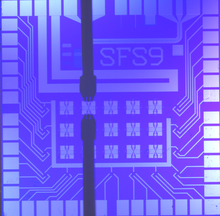
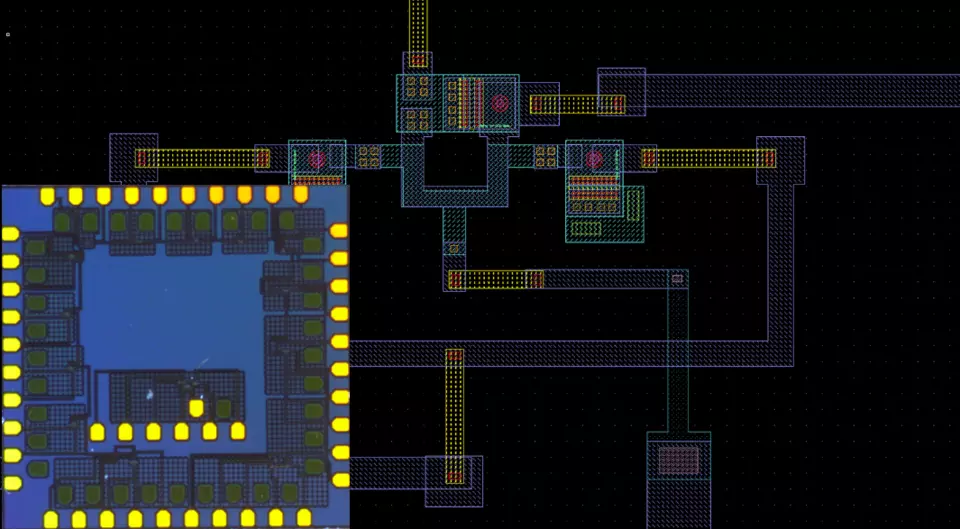
We have facilities to develop our devices from the materials level up. These include ingroup superconducting and magnetic depositions systems. The Boulder Microfabrication Facility (clean room) where we can fabricate sub 50 nm devices. As well as the high speed (50 GHz) electrical test measurement facilities for both room temperature and cryogenic devices.
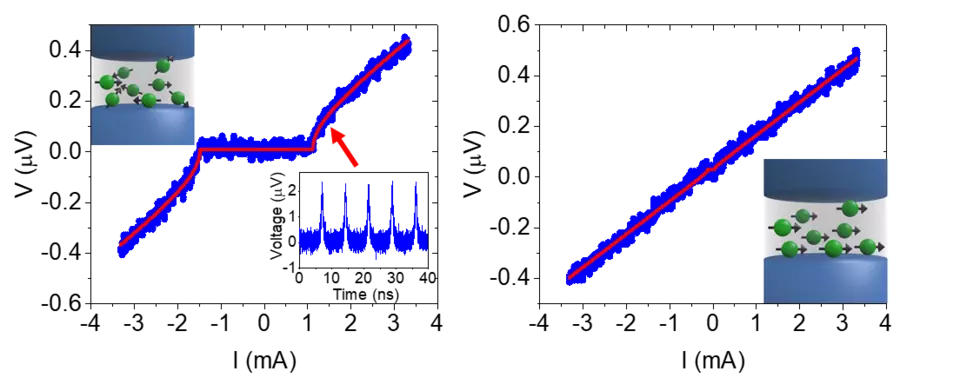
We recently demonstrated hybrid magnetic-superconducting devices that can be used as artificial synapses in a superconducting bio-inspired computational system. These devices are able to provide a near analog weight for superconducting circuits that is both trainable and non-volatile while working at an extremely low energy scale (sub-attojoule).
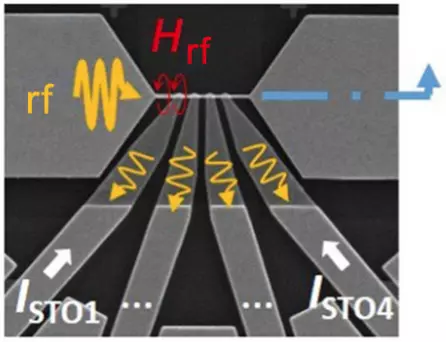
We have also investigated computation using magnetic tunnel junctions as spin-torque oscillators. The measurements from these coupled oscillator devices was used to construct the computational primitives for image recognition, such as convolution operations and distance approximation.
Modeling
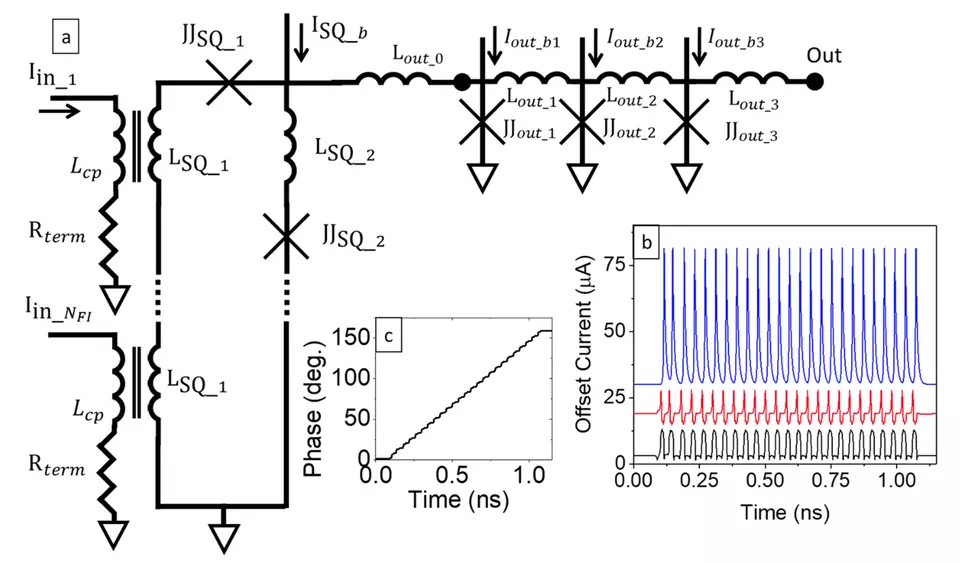
We have confirmed that the SPICE models we are using accurately predict the performance of synaptic circuits that we developed, giving us greater confidence in using these modeling tools to explore new architectures.
Recently, we have extended these simulations into a fully self-training spiking neural network. Using circuit optimized local learning rules inspired by reinforcement learning, we have developed a network architecture that is fast and tolerant to process variations.
We have performed SPICE simulations to investigate scaling limits of superconducting architectures. We find no fundamental limitation on the fan-out level and digital communications, meaning that any limitations there will likely result from size considerations and can scale with Josephson junction fabrication advances.
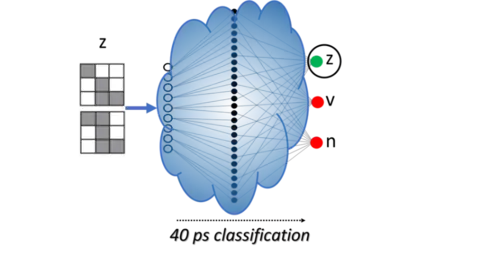
We have used superconducting SPICE simulations to physically model Josephson junction based artificial neural networks that can solve a 9-pixel classification problem. In further simulations, we have found that such networks have to the potential to run at speeds in excess of 100 GHz.
Opportunities:
We currently have opportunities for postdocs and graduate students. We also have opportunities for postdoctoral fellows through the National Research Council Associateship Program.
- Neuromorphic Computing with Superconducting and Spintronic Devices
- Spin Electronics
- Phase and Frequency Dynamics of Arrays of Coupled Spin Torque Oscillators
Related Publications
- Perspectives on Nanoclustered Magnetic Josephson Junction as Artificial Synapses
- A self-training spiking superconducting neuromorphic architecture
- SuperMind: a survey of the potential of superconducting electronics for neuromorphic computing
- Perspectives on nanoclustered magnetic Josephson junctions as artificial synapses
- Artificial synapses based on Josephson junctions with Fe nanoclusters in the amorphous Ge barrier
- Fan-out and fan-in properties of superconducting neuromorphic circuits
- Synaptic weighting in single flux quantum neuromorphic computing
- Tutorial: High-speed low-power neuromorphic systems based on magnetic Josephson junctions
- Ultralow power artificial synapses using nanotextured magnetic Josephson junctions