

Official websites use .gov
A .gov website belongs to an official government organization in the United States.

Secure .gov websites use HTTPS
A lock (
) or https:// means you’ve safely connected to the .gov website. Share sensitive information only on official, secure websites.


AMPHORA (Assured Microbial Preservation in Harsh Or Remote Areas)
Summary
NIST is the Independent Verification and Validation (IV&V) partner for the Defense Advanced Research Projects Agency – Biological Technologies Office (DARPA-BTO) Assured Microbial Preservation in Harsh Or Remote Areas (AMPHORA) program.
Description
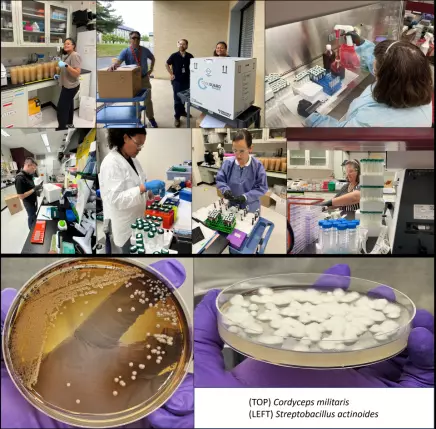
NIST's role in the the AMPHORA project has involved serving as an IV&V (independent verification & validation) lab, generating multiple rounds of sample shipments of microbial mixtures.
The Defense Advanced Research Projects Agency’s Biological Technologies Office (DARPA BTO) has launched the Assured Microbial Preservation in Harsh Or Remote Areas (AMPHORA). The goal of the AMPHORA program is to expand our current capacity to extract and viably maintain pathogens from complex samples independent of the cold-chain. NIST will support this project as the Independent Validation and Verification (IV&V) team. In this role, NIST is responsible for providing well characterized materials to evaluate and challenge the Performers’ technologies. This is being accomplished through the provision of single species and mixed species samples in multiple matrices representing real-world samples (e.g., blood, swipe/wipes, wastewater, soil).
Major Accomplishments
- Ingest of over 140 pathogenic bacteria, fungi, and viruses.
- Bespoke sample production, shipment, and Performer teams’ results analysis for evaluation # 1 (05/2025)
- Bespoke sample production, shipment, and Performer teams’ results analysis for evaluation # 2 (11/2025)
Additional Technical Details
This work involves the growth and handling of >140 pathogenic bacteria, fungi, and viruses. Therefore, our staff are highly trained to safely work with these organisms at a large scale including multiple organismal types. We also assess the teams’ abilities to preserve the native microbiome in complex samples (i.e., wastewater and soil).