An official website of the United States government
Here’s how you know
Official websites use .gov
A .gov website belongs to an official government organization in the United States.
Secure .gov websites use HTTPS
A lock (
) or https:// means you’ve safely connected to the .gov website. Share sensitive information only on official, secure websites.

Since its inception in 1900, quantum physics has produced many surprising insights into the natural world. Those insights have powered a universe of technologies that improve our lives, often without us realizing they have quantum physics at their core. From GPS and smartphones to cybersecurity and precision instruments for defense, to exquisitely accurate measurements that underpin our commercial transactions, quantum has made our technologies more accurate, more trustworthy, and more secure.
Founded a year later in 1901, NIST has a long history as an international leader in quantum research, including being behind the invention of the world’s first atomic clock in 1949. NIST’s quantum innovations have led to multiple Nobel Prizes for our researchers, who did everything from demonstrating a new state of matter called the Bose-Einstein condensate to creating the first logic gates, which are the quantum versions of computer building blocks.
Join us in celebrating some of the many outstanding quantum achievements of our staff — and learn a little more about quantum along the way!
Researchers are using quantum science to develop computers that can do tasks traditional computers can’t do as efficiently. That’s why it’s an exciting time to
While quantum technology may seem like a new field, it’s been around for a while and has a fascinating history — much of which involved NIST’s experts.
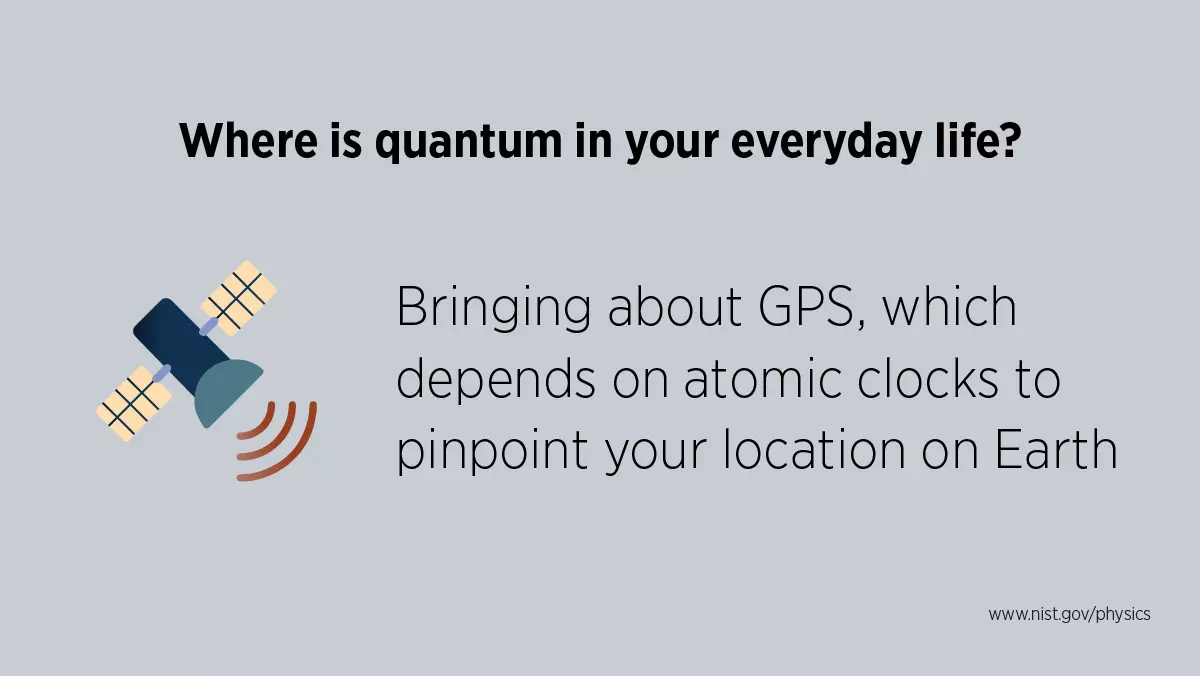
Imagine what life would be like without GPS, something you use all the time without thinking about where it came from. NIST research helped bring you GPS and
quantum terms explained
What is Entanglement?
Experience quantum entanglement with a playful twist — featuring our "quantum deer" that might just exclaim, "Oh, deer!" or "Deer me!" Discover how entangled particles mimic each other, no matter the distance, and see how this quirky phenomenon is paving the way for breakthroughs in computing, sensing and communication. Oh, deer!
What are Qubits?
Step into the fascinating world of quantum mechanics in this quick explainer and find out a little BIT about what makes QUBITS so special. What bits are for classical computers, qubits are for the quantum computers and atomic clocks of the future.
What is Quantization?
Step into the fascinating world of quantum mechanics in this quick explainer! We break down how quantization works and how particles like electrons can only exist in specific, discrete states—much like an employee who can only stand on designated steps of a staircase.
What is Decoherence?
Decoherence is a big challenge in quantum computing. But what is it? This quick explainer explains how fragile quantum states, like qubits, can lose their quantum magic when they interact with the environment. Mastering decoherence could unlock the future of quantum technology.
What is Superposition?
Superposition is a key principle of quantum physics. But what does it mean? Our NIST scientist explains how particles, like qubits, can exist in multiple states at once—both 0 and 1—until measured. Explore this mind-bending concept and see how superposition powers the future of quantum technology.