

Official websites use .gov
A .gov website belongs to an official government organization in the United States.

Secure .gov websites use HTTPS
A lock (
) or https:// means you’ve safely connected to the .gov website. Share sensitive information only on official, secure websites.


Self-Calibrating Micro-Thermometer Combining Light and Mechanical Motion
Patent Number: 12,625,007
Problem
Traditional high-performance temperature sensors, like platinum resistance thermometers, lose their accuracy over time. This degradation happens because of everyday wear and tear, changes in humidity, or accidental physical bumps. When these traditional tools drift, businesses must completely shut down operations to pull the sensors out and send them away for expensive recalibration. This invention solves the problem of long-term accuracy loss and costly operational delays by fixing its own calibration automatically while remaining actively inside the machinery.
Invention
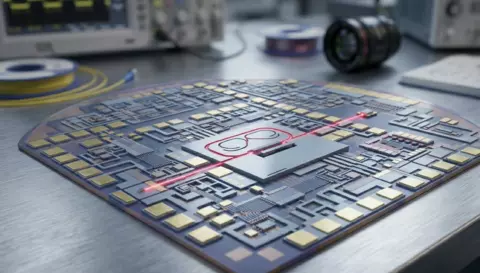
This invention is a tiny, high-tech thermometer system built on a single microchip. It uniquely combines two different types of light-based sensors: a photonic thermometer and an optomechanical thermometer. The photonic thermometer is used to take quick and highly precise temperature readings. Meanwhile, the slower optomechanical thermometer uses the rules of physics to measure exact, absolute temperature. By pairing them together, the absolute sensor automatically adjusts and fixes the precise sensor right on the chip.
Potential Commercial Applications
This self-calibrating thermometer is perfect for industrial factories where continuous, hyper-accurate temperature control is vital for manufacturing high-quality goods. It is also incredibly useful for deep-space satellites and research equipment where human hands cannot reach to perform regular maintenance. Additionally, it can be integrated directly inside advanced computer microchips to safely monitor and manage their heat levels. Finally, it can support medical and laboratory environments that require uninterrupted, highly reliable environmental conditions.
Competitive Advantage
This invention provides major cost savings by eliminating the expensive labor and factory downtime typically required to remove and recalibrate traditional temperature sensors. Because the microchip automatically fixes its own calibration while remaining on the job, businesses can maintain continuous, uninterrupted production schedules. Its permanent, drift-free accuracy prevents costly manufacturing defects and product waste caused by faulty temperature readings over time. Additionally, its rugged, miniature design drastically reduces the need to purchase frequent equipment replacements due to physical wear or environmental damage. Ultimately, these features lower the total cost of ownership, making it a highly profitable investment for high-precision industries.