

Official websites use .gov
A .gov website belongs to an official government organization in the United States.

Secure .gov websites use HTTPS
A lock (
) or https:// means you’ve safely connected to the .gov website. Share sensitive information only on official, secure websites.


Terrestrial Laser Scanner Performance Evaluation and Documentary Standard for Forensic Practice
Summary
Terrestrial laser scanners (TLSs) are used by law enforcement agencies and forensic practitioners to digitize crime and accident scenes, allowing for subsequent analysis such as estimating bullet trajectories, distances between fixed points (like a wall or tree), blood splatter analysis, vehicle dimensions and location in a scene, etc. Periodic testing of these scanners is necessary to ensure their continued accuracy and precision. We have developed a low-cost procedure and software tool tailored to forensic practitioners to assure the quality of the data they collect and provide traceability for their measurements.
Description
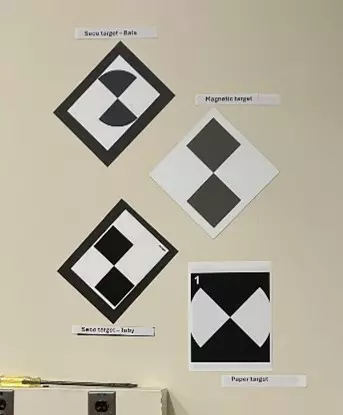
TLSs are stationary LiDAR (light detection and ranging) systems that generate a 3D point cloud of the scene by recording the distance (using laser pulses) and two angles (horizontal and vertical) of points on the surfaces of objects in the scene. Frequent transport of these systems can cause misalignment of the optical components, resulting in measurement errors. The National Institute of Justice provides Guidelines for the Use of Terrestrial LiDAR Scanners in Criminal Justice Applications, which include recommendations for calibration and periodic validation of TLSs to ensure they continue to operate as intended.
Manufacturer-performed calibrations of TLSs can be costly and require extended periods of instrument downtime, making additional calibrations outside of a regular maintenance schedule impractical. In response to a need expressed by the forensic community, the Crime Scene Investigation and Reconstruction Subcommittee within OSAC convened a working group to develop a test procedure to assess instrument performance supplemental to regular certified calibrations. The result of this effort is the Interim Perform Assessment (IPA) test procedure.
The IPA is an inexpensive procedure designed to be performed in-house by forensic TLS users and comprises two parts that separately evaluate instrument accuracy and precision. The details of this draft test procedure are documented in a recent publication. Recognizing the computational complexity of the procedure, we are developing a web application tool that will perform the required calculations and data visualizations. We hosted a Measurement Week in May 2025 to obtain feedback on the IPA from TLS manufacturers and users. Following that testing event, we are now in the process of developing a documentary standard that is expected to be completed in early 2027.