

Official websites use .gov
A .gov website belongs to an official government organization in the United States.

Secure .gov websites use HTTPS
A lock (
) or https:// means you’ve safely connected to the .gov website. Share sensitive information only on official, secure websites.


Taking Measure
Just a Standard Blog
Painter Bob Ross taught us that “happy accidents” can make for beautiful art. Happy accidents also happen in science, when experiments take research in unexpected directions. Probably the most dramatic example is Sir Alexander Fleming's accidental discovery of penicillin.
Not all unexpected scientific developments are quite that impactful, but our NIST researchers have found similar unexpected applications for their work. (Maybe they’re accidental detectives!)
“The need to be able to use scientific evidence in court means forensic scientists sometimes have to reach out to other technologies and fields to be able to develop things in more detail,” said John Butler, NIST fellow and special assistant to the director for forensic science. “And NIST has played a role in many developments in forensic science going back to the 1960s, when automatic fingerprint technology was initially developed at NIST.”
In this post, we’ll discuss ways in which forensic science has progressed with help from unexpected places.
From Mapping the Human Genome to Solving Crimes With Science
When the human genome was sequenced in the early 2000s, the goal was to better understand our genes and inherited diseases. But mapping the human genome has also advanced forensic science.
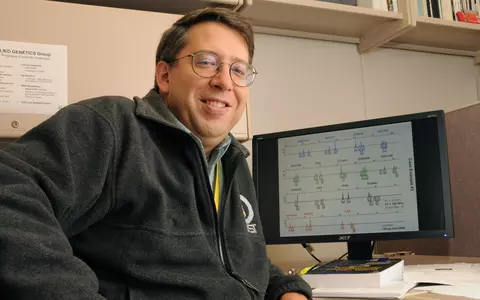
In its early days, DNA separation and fragmenting were manual and labor-intensive. This limited the utility of DNA evidence in solving crimes.
But thanks to the mapping of the human genome, Butler and other researchers developed methods for isolating and testing DNA. They did this using a technique called capillary electrophoresis. (Capillary electrophoresis involves moving electrically charged molecules, like DNA, inside a narrow glass tube to separate them by size.)
“NIST and others worked on this technology for many years, and now crime labs all over the world use capillary electrophoresis for forensic DNA testing,” Butler said.
The Chemical Nose Knows
In the wake of the 2001 terrorist attacks in the U.S., law enforcement began relying more on dogs to sniff out explosive devices. But dogs are expensive and take time to train. Explosive compounds evolve faster than dogs can learn their scents. So, a few years after the attacks, then-postdoctoral researcher Tara Lovestead and her colleagues got to work developing a method they hoped would lead to an electronic device that could do the same job as a bomb-sniffing dog.
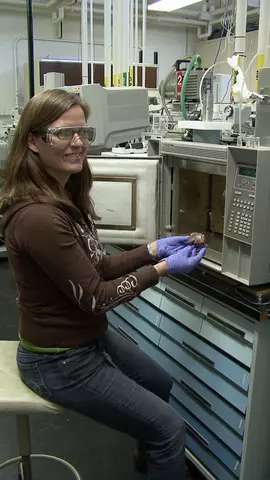
Lovestead’s work involved adapting a technique to separate and capture specific compounds from air samples for analysis. This is known as a headspace technique.
She had to work at much higher temperatures to capture heavier compounds from real-world explosive materials such as C-4. She confirmed that the unique compounds would be present in the cool climate of Alaska and the sweltering heat of Dubai. The testing also involved unconventional materials, including the air from a rat graveyard!
Today, this work is the foundation for a different type of forensic science — a cannabis breathalyzer. While sniffer dogs and the human nose can smell the musky odor of cannabis in luggage and from a burning joint, these compounds are not the intoxicant.
THC is the intoxicant, and it’s a heavy compound that is difficult to detect in breath. Despite this challenge, industry is working to create breathalyzers for law enforcement and workplace safety.
So Lovestead set out to expand the headspace technique’s capabilities to figure out how THC behaves in human breath.
“This has been the most difficult measurement challenge and most rewarding work of my career,” Lovestead said.
How Clothing Recycling Can Help Train Forensic Examiners
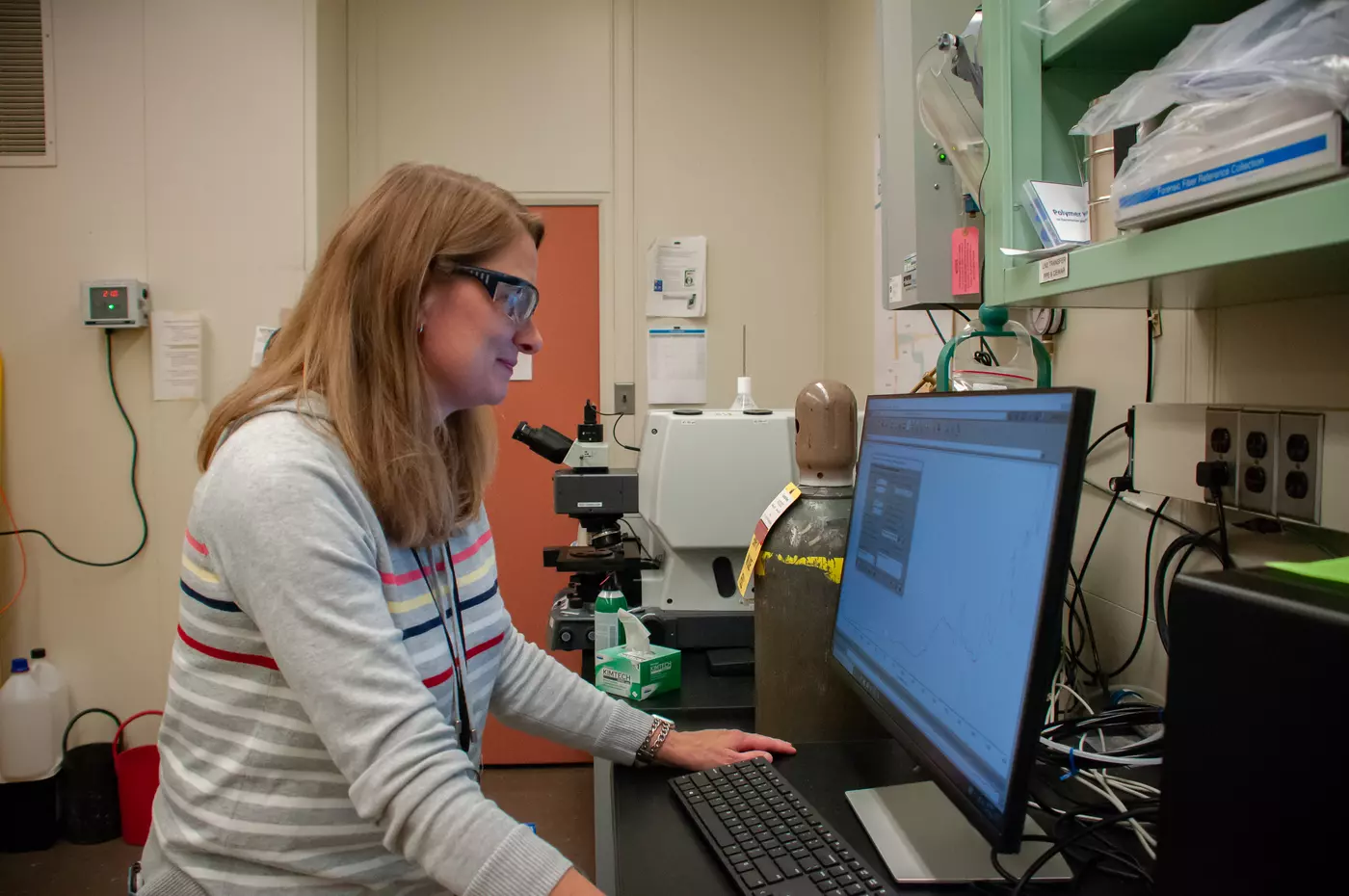
NIST researchers Amanda Forster and Katarina Goodge recently created a test material for textiles. These well-understood fabric samples will help improve methods for identifying fibers in discarded clothing, enabling more efficient sorting and recycling.
But to their surprise, this product — designed for the textile recycling industry — caught the attention of the forensic science investigative community. That’s because forensic fiber examiners need to know the key details of fibers for their work, which might include matching a small fiber sample from a crime scene with a suspect’s article of clothing, for example.
“The examiner might be doing a comparison. They want to know, could these fibers have come from this same source?” Forster said. “To answer that type of question requires accurate fiber identification.”
Forster and Goodge are now working with investigative agencies that have asked to see how their work can also contribute to forensic science by serving as a training tool for forensic fiber examiners.
“I think it’s very exciting, and I think there may be opportunities for us to learn from the forensic science community as well in terms of how they do their microscopy, how they validate their work, and other things that might inform how we do our work in the lab,” Forster said.
Happy Forensic Science Week!
We are highlighting these unexpected developments in forensic science as we mark Forensic Science Week. But our researchers are doing their part to advance forensic science all year.
About the author

Related Posts


Comments
Thank you for your comment. You can learn more about the WTC investigation at this link - https://www.nist.gov/world-trade-center-investigation/study-faqs/wtc-to….
Hi, I´m relatively new to reading NIST materials -though I´ve watched plenty of their videos on fir v¿behavior analysis (I´m a firefighter)- and I´m wondering if they´ve published anything yet regarding the tragic WTC incident. thanks.