

Official websites use .gov
A .gov website belongs to an official government organization in the United States.

Secure .gov websites use HTTPS
A lock (
) or https:// means you’ve safely connected to the .gov website. Share sensitive information only on official, secure websites.


Taking Measure
Just a Standard Blog
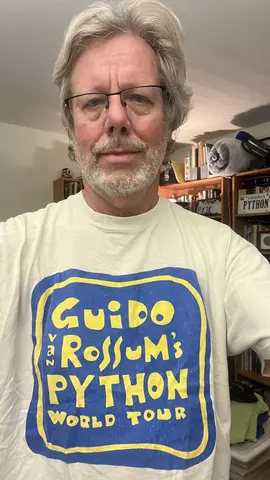
That website you love, with its interactive graphics and features, relies on specialized back-end code, and it might be written in a coding language called Python. Python is free and open source, which means the user community collaborates on its production, helping to make it one of the most popular programming languages in the world. It’s used for a wide range of tasks, such as data analysis, software development and artificial intelligence.
But did you know that NIST has a special connection to Python? In 1994, Dutch programmer and Python creator Guido van Rossum spent a few months as a guest researcher at NIST’s campus in Gaithersburg, Maryland. While at NIST, van Rossum continued developing Python and also contributed to NIST’s research, including helping to organize the first Python conference.
Though his time at NIST was brief, he met his future employer, the Corporation for National Research Initiatives (CNRI), at the Python workshop. That meeting changed the future of the programming language.
Van Rossum spent the next five years at CNRI, where he worked on Python full time and released major versions of the programming language, helping the Python community grow. Van Rossum, a champion of open-source software, was named Python’s “Benevolent Dictator for Life” (BDFL), a humorous title now frequently used to refer to open-source software leaders who resolve disputes within the user community. He stepped down from that role in 2018 but still writes code.
Taking Measure spoke with van Rossum to learn more about the programming language, what he does in his free time and his brief stint at NIST.
Python is named after the British comedy series Monty Python’s Flying Circus. What’s your favorite sketch?
It changes every time, but lately I’ve been humming the tune to “The Lumberjack Song” a lot. Another good one is the “Ministry of Silly Walks” because I do a pretty darn good silly walk myself, but I’m not so limber anymore. And of course, you can never go wrong with the “Dead Parrot” sketch.
How did you get started with programming languages?
I first fell into electronics when I was a kid, around 10 years old. My parents gave me a very basic electronics kit for kids. This was in the 1960s, and it was made up of different electronic components, from transistors to speakers.
When I was 18, I went to the International Math Olympiad and met another Dutch guy who told me he had seen a computer and was very excited. I remember feeling embarrassed because I had never seen one before.
After that summer, I went to the University of Amsterdam to study math. It turned out that in the basement of the math building was a computer mainframe, and students could get limited access to it if they were interested in learning to program. I remember being so eager to learn what you could do with that piece of hardware.
So, I went to the library and got the language reference manual for ALGOL 60. At that point in Amsterdam, ALGOL 60 was the most popular programming language. I taught myself how to code in that language with the help of some other students and the reference manual.
Then I learned the programming language Pascal, which was very good for me. That’s where my creativity was triggered.
The first year of math at university was easy, so I had lots of free time to explore the computer. Then, the second year of math turned out to be much harder. I was ready to drop out until I discovered that I could also take computer science classes. So, I started taking some of those in addition to the mandatory math classes. By the third year, I was a very prolific Pascal programmer, writing system utility applications used by other students, including a tool to make sharing files easier.
What made Python so successful?
Robert Kahn was the head of CNRI. He liked to pick projects he thought would become influential or useful on the internet and to find ways to sponsor them. I worked there for five years, fully developing Python. But we ultimately split over open source.
At that point, it had been 10 years of Python development, and many Python users were very excited about using the programming language in an open-source way. They could use Python for all kinds of projects, which led to its proliferation across many fields and applications. With a stricter licensing model that wasn’t open source, none of that would have happened. Python would have just died.
Almost everyone uses Python in the coding world. Did you expect that popularity, or was it surprising that it became so popular?
Every time Python grew, someone had to point that out to me. I was like, “WHAT?!” I remember a story of talking to Tim O’Reilly (author and publisher of multiple tech books) at one of the Python conferences, and he asked me, “Do you have any idea of how big the Python user base is?” And I said, “I have no idea, just that it’s growing.” He said, “Well, I have hard numbers because I know from how many Python books I sell.”
Why did you come to NIST?
I was very excited about anything in the U.S. I started to feel a little uncomfortable in Amsterdam in the mid-1980s. That’s because there didn’t seem to be much exciting work there with the types of computers I was interested in.
And many people who work in operating systems need to work with large computer users and manufacturers, such as Microsoft. So, I was eager to try it out by going to the U.S. A few NIST staff members were interested in learning more about Python, and they invited me to join as a guest researcher. I spent about three months at NIST and worked on campus. I remember it was great meeting other people who were just as interested in — or expert users of — Python as I was, and the first Python workshop was held at NIST.
And, of course, coming to NIST led directly to my first programming job at CNRI.
How did the first Python workshop start?
Michael McLay and Ken Manheimer (NISTers at the time) had the idea of starting the first Python workshop. I was immediately open to the idea and was happy to help by inviting or choosing speakers. We mainly organized the workshop through the Usenet group — a Unix-based bulletin board. That’s where we found various people who showed creativity, interest or activity in the group who wanted to volunteer or give talks. We had maybe around 25 people.
When it was over, everybody was so happy we had this in-person meeting, where we reached a consensus to do it again. So, the next question was in what form and who was going to organize it. The Python workshop in the U.S. is now called PyCon US and is held every spring. It’s always held in the same location twice before moving on. Today, there are on average around 3,000 attendees, 100 times more than at the very first conference.
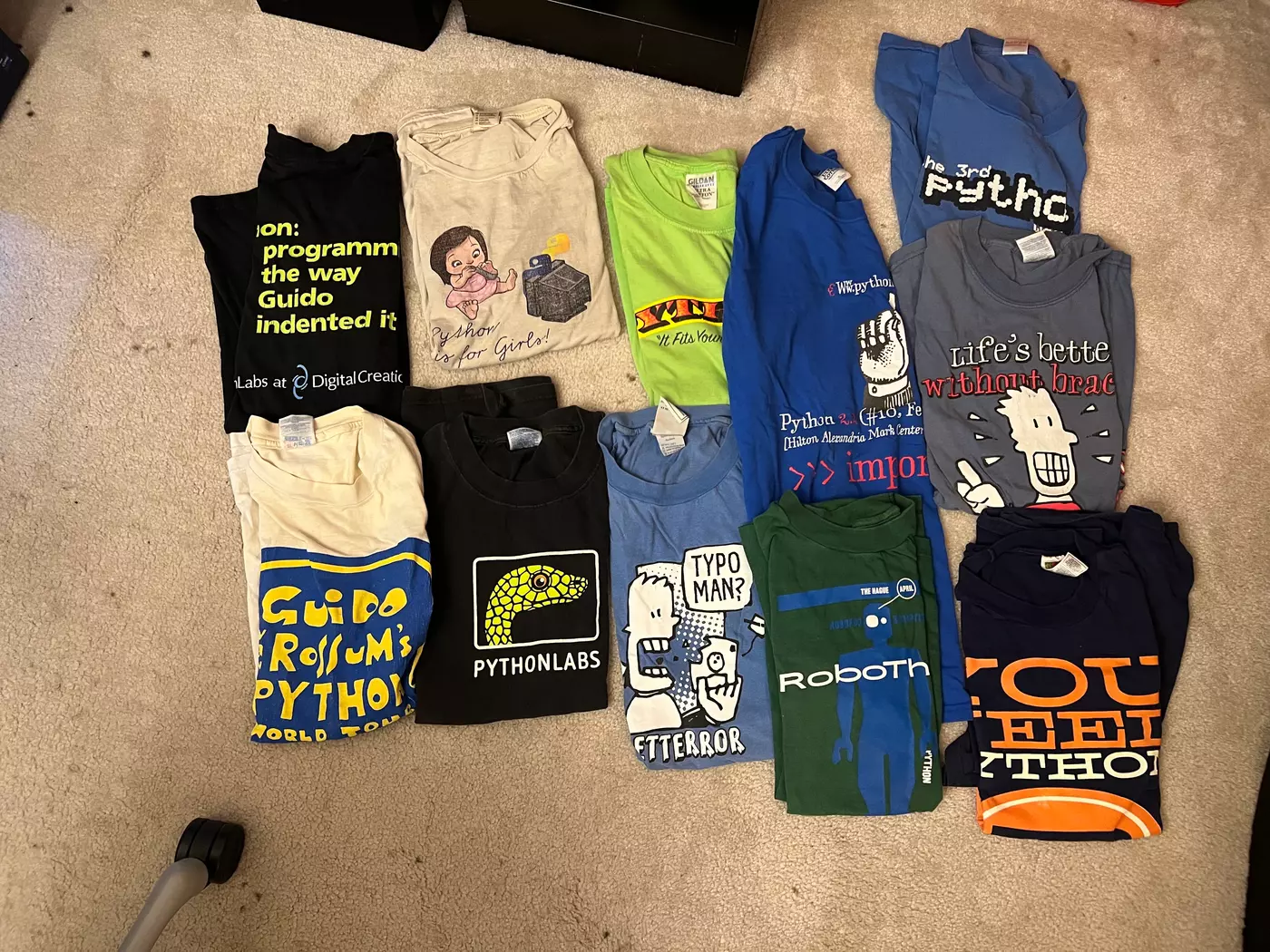
Do you still have your NIST Python workshop T-shirt?
I do. I don’t wear it anymore, but I have a shelf with a dozen very precious, very old Python T-shirts, and that’s one of them. I did wear it a lot in the first five or maybe 10 years after I got it, so it looks very used.
What’s next for Python? Is there a limit to its growth?
The limit has not been reached. I'm no longer the BDFL, just an emeritus leader. I have very little say in what is next. But the core developer team that has taken over since I retired has shown plenty of creativity and a very good attitude toward stewardship of the language.
I think the breadth of evolution will not change much because users don’t want to have to get used to making updates more than once a year.
Do you have any hobbies?
I don’t have any traditional hobbies like woodworking or building mandolins. But I always go out for bike rides around where I live on the coast. It’s just south of San Francisco, and it’s beautiful to ride here and hike, too. I like to be out in nature.
I also enjoy watching local birds through my binoculars, but I prefer watching the larger birds because the smaller ones are too hard to identify. And of course, I enjoy watching shows on Netflix and other channels, but it’s not really anything special, hobby-wise.
I’m afraid that when I actually retire, I’ll probably keep coding anyway because that’s how I get my intellectual stimulation.
Any last thoughts?
NIST was definitely one of those butterflies that flapped its wings and sort of changed the course of my career. If McLay had not invited me to that workshop and opportunity at NIST, I would never have met the people at CNRI. They would never have come up with the idea of hiring me to work full-time on Python.
I would still be growing, but things would have just gone very differently.
So, the fact that NIST was there and was very generous with that guest researcher role and workshop was an important turning point.
About the author


Related Posts

Comments
You enjoy coding still sir and u said u may even after retirement the feelings and the interests are mutual sir.
J'étais dans le hardware durant plus de 22 ans.
A l'avènement de Covid19 et confinement obligé, je me suis mis sur Python.
Maintenant je code tous les jours et pendant des heures et des heures.
Google Translation:
I worked in hardware for over 22 years.
With the arrival of Covid-19 and the resulting lockdown, I started learning Python.
Now I code every day, for hours and hours.
"Fascinating bit of computing history. It’s always interesting to see how humor and culture have influenced even technical fields like programming languages and standards work.
Thanks for sharing this unique historical insight.
"
David can we please add curly braces say as an option to the python command so it doesn't feel like a downgrade from C back towards FORTARAN?
Started my career on IBM system 3 as night operator, then USAF 6 years wrote CAMS and CMOS systems now retired after 50 years last 5 at USAF FAB central control!!! I've written more code than I can remember from C, to assembler, machine code to object patches!!!
Guido appears to be a genuinely cool individual i appreciate it when good people help people and find success. python is awesome.
So glad to see Hanna as an author! She wrote the headline, right?