

Official websites use .gov
A .gov website belongs to an official government organization in the United States.

Secure .gov websites use HTTPS
A lock (
) or https:// means you’ve safely connected to the .gov website. Share sensitive information only on official, secure websites.


Exhaust Flow Calibration – Tracer Gas Dilution
Exhaust flow is a key measurement in determining the heat release rate (HRR) of a fire – one of the most important metrics for assessing fire hazard. Therefore, accurate measurement of exhaust flow is critical for fire safety research. Open calorimeters used in large fire research often require complex duct geometries to route combustion products to emissions control systems. These geometries induce nonideal flow characteristics that make measuring flow inherently difficult. Flow characteristics common of large conduits include asymmetric velocity profiles (flow is faster on one side of the duct than the other), swirl (flow does not move straight down the duct, thus creating complex, swirling patterns that induce off-axis flow), and turbulence (flow speed is not steady; it fluctuates due to large eddies).
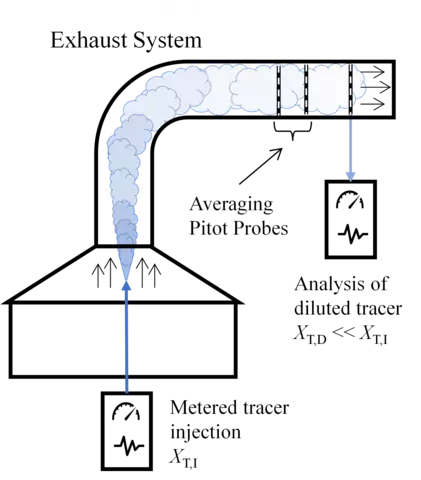
These issues make it difficult to find a single representative location to measure velocity. Therefore, traditional methods using velocity probes (like pitot tubes) can have significant, unknown errors. It is common practice in fire research to calibrate the flow measurement using a gas or liquid fuel burner to force agreement between two HRR measurements. This is practical but couples the uncertainty of the flow measurement with any error in estimating the HRR at the burner. The result is greater measurement uncertainty directly propagating into the HRR calculation, making the measurement of bulk flow a critical and often dominant source of uncertainty.
The tracer gas dilution (TGD) method relies on the fundamental principle of mass conservation. Constant-injection TGD involves injecting a known, constant flow of tracer gas into the duct. Far downstream, after the tracer has mixed with the exhaust gas, samples are taken to measure the diluted concentration of tracer. If the tracer and exhaust gas are well-mixed, the method is independent of flow distribution, and the volumetric flow of the exhaust gas is directly proportional to the dilution factor of the tracer.
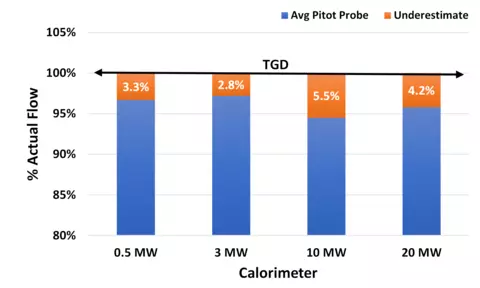
The TGD method was applied at NFRL’s 20 MW calorimetry measurement system to characterize the uncertainty of the method and provide an in-situ calibration of the system’s exhaust flow measurement – the averaging pitot probes. Expanded uncertainty for this application of the method was estimated at ±3.0% to ±3.5%. The method provides a reliable and well-characterized reference for calibrating less accurate field instruments. Research revealed a systematic bias in the flow measurement derived from the averaging pitot probes; they consistently underestimated the actual exhaust flow. The TGD calibration provided corrections, ranging from 3% to 6%, to improve flow measurement accuracy for each of the calorimeters.
The tracer gas dilution method is a flow calibration based on conservation of mass. It provides an independent validation of the flow physics of the calorimetry system, hence improving the overall confidence and accuracy of the heat release rate measurement. |
Identifying and correcting the systematic bias in the exhaust flow measurement directly improves the accuracy of HRR data generated by NFRL’s calorimetry measurement system. This is significant, as HRR is the single most important parameter for characterizing fire behavior and hazard. This work demonstrates the successful application of the TGD method as a valid method for in-situ calibration of flow measurement devices in exhaust systems of large-scale fire research facilities. It is a vast improvement over the common practice of calibrating the overall calorimeter using a gas burner to force agreement between two HRR measurements. By reducing the uncertainty of the exhaust flow measurement, a critical measurement for fire experiments at realistic scales, this research enhances the quality and reliability of data used to develop better solutions for fire safety.
Related Publications
- Bryant RA (2024). Exhaust Flow Calibration for a Large-Scale Calorimetry System Using Tracer Gas Dilution. Fire and Materials, 48(2), 286-296. doi:10.1002/fam.3183
- Bryant RA (2022). The NIST 20 MW Calorimetry Measurement System - Exhaust Flow Calibration Using Tracer Gas Dilution. NIST Technical Note 2220. doi:10.6028/NIST.TN.2220
- Bryant RA, Bundy M, (2021) Improving the State-of-the-Art in Flow Measurements for Large-Scale Oxygen Consumption Calorimetry, Fire Technology, 57, 1457-1478. doi:10.1007/s10694-020-01066-x
- Bryant RA, (2018). Uncertainty Estimates of Tracer Gas Dilution Flow Measurements in Large-Scale Exhaust Ducts. Flow Measurement and Instrumentation, 61, 1-8. doi:10.1016/j.flowmeasinst.2018.03.004