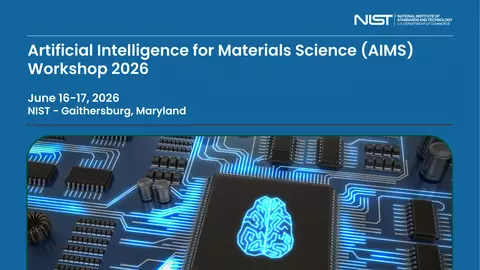
As part of the JARVIS workshop series, the 7th Artificial Intelligence for Materials Science (AIMS) is a workshop aimed at getting together experts from industry, academia, and government to facilitate highly technical dialogue on the intersection of AI and materials science. Some of the key research areas for materials AI that will be discussed at the meeting are: developing well-curated and diverse datasets, choosing effective representations for materials, inverse materials design, integrating autonomous experiments and theory, challenges and advantages of self-driving laboratories, merging physics-based models with AI models, and choosing appropriate algorithms/workflows. Lastly, uncertainty quantification in AI-based predictions for material properties and issues related to building infrastructure for disseminating AI knowledge are of immense importance for making AI-based materials investigation successful. This workshop is intended to cover all of these challenges.
Day 1: June 16 | ||
Session I: 9:00-12:00 | ||
| Time | Speaker | Title |
| 9:00-9:10 | Kathryn Beers | Opening remarks |
| 9:10-9:25 | Francesca Tavazza | Overview and Logistics |
| 9:25-9:45 | Boris Kozinsky | Physics based learning of foundation models of microscopic interactions |
| 9:45-10:05 | Samarjeet Prasad | Accelerating Chemistry and Materials Innovation with NVIDIA ALCHEMI |
| 10:05-10:25 | Michael Taylor | Bringing AI to f-element Chemistry |
| 10:25-10:45 | Danish Khan | Physics-aware electronic-structure models for reliable materials AI |
| 10:45-11:05 | Break: Group Picture | |
| 11:05-11:25 | Stefano Falletta | Machine Learning Material Response to Electric Fields |
| 11:25-11:45 | Sanjeev Raja | Generative Models as Flexible Priors for Accelerating Long Timescale Molecular Simulation |
Lunch: 12:00-1:00 | ||
Session 2: 1:00-3:20 | ||
| 1:00-1:20 | Peter Beaucage | Deploying Autonomous Experimentation in Government and Industry |
| 1:20-1:40 | Jie Xu | Polymer Innovation Through AI-driven Autonomous Labs |
| 1:40-2:00 | Keith Task | Data Analytics in Research at BASF: Guiding Decision Making Through Efficient Experiments, Optimization, and ML & AI |
| 2:00-2:20 | Break | |
| 2:20-2:40 | David Elbert | Unlocking Autonomy: Event Driven Linked Data for Scientific Workflows |
| 2:40-3:00 | Linda Hung | Addressing the Crystal Structure Bottleneck in Materials Models |
| 3:00-3:20 | Tyler Martin | Integrating Physics, Chemistry, and Formulation Intuition into the Autonomous Formulation Lab |
Poster Session 3:30-5:00 | ||
Day 2: June 17 | ||
Session 3: 8:45-12:00 | ||
| Time | Speaker | Title |
| 8:45-9:05 | Dung-Yi Wu | Applications of materials informatics to Aerospace-Relevant Problems |
| 9:05-9:25 | Jason Hattrick-Simpers | Small Smart Data Big Dumb Data and Models Don’t Extrapolate |
| 9:25-9:45 | William Ratcliff | Attention is Not All You Need: For Powder Diffraction |
| 9:45-10:05 | Derek Ahneman | Building datasets and ML models to predict stepwise organic reactivity |
| 10:05-10:25 | Break | |
| 10:25-10:45 | Nina Andrejevic | Decoding Materials Dynamics with Physics-Aware Machine Learning |
| 10:45-11:05 | Wesley Reinhart | Towards Human-on-the-Loop Materials Discovery at the 2DCC and Beyond |
| 11:05-11:25 | Akshay Talekar | Data-Centric AI for Materials Discovery: Infrastructure, Integration, and Iteration at Scale |
| 11:25-11:45 | Fei Zhou | Scaling materials modeling beyond machine-learned potentials |
Lunch: 12:00-1:00 | ||
Session 4: 1:00-3:20 | ||
| 1:00-1:20 | Catherine Brinson | From Data to Discovery: accelerated materials data curation and interpretable AI for metamaterials |
| 1:20-1:40 | Jeffery Ting | ChainSpace: Searching Synthetically Accessible Sequence Space |
| 1:40-2:00 | Deyu Lu | Physics-Informed AI Pipeline for Real-Time Interpretation of X-ray Absorption Spectra |
| 2:00-2:20 | Break | |
| 2:20-2:40 | Joshua Schrier | Large language models for materials synthesis and extraction |
| 2:40-3:00 | Remi Dingreville | Shortening the learning curve: Schooling machine learning to power materials digital twins and predictions |
| 3:00-3:20 | Mitra Taheri | To Be Determined |
NCNR Tour: 3:30pm | ||
June 16, 2026 | 3:30 - 5:00pm
Poster number | Name | Title |
1 | Abhishek Sose | To Be Determined |
2 | Alexander K Landauer | Uncertainty Estimate Mapping for Digital Image Correlation via Convolutional Neural Networks |
3 | Alexandru Bogdan Georgescu | Quantum Materials with Novel Quantum Building Blocks |
4 | Andy Shufer | Identifying the Mental Models of Scientists for the Use of AI in Accelerating Research |
5 | Bahador Bahmani | To Be Determined |
6 | Chowdhury Mohammad Abid Rahman | Supervised Pretraining for Material Property Prediction |
7 | Derek Juba | Uncertainty Quantification for Texture Directionality |
8 | Eva Natinsky | Machine-learning image reconstruction overcomes data scarcity in atomic force microscopy with domain specific image corruption |
9 | Feng Zhang | To Be Determined |
10 | Frank Abel | Developing Methods, Models, and Datasets for a Self-Driving Magnetic Nanomaterials Laboratory: Application for Thermal Magnetic Particle Imaging |
11 | Haochen Yang | Robotic Automation Discovery of Biodegradable Electronics via Multimodal Active Learning and AI-Guided Design |
12 | Jacob Horne | Predicting semicrystalline polymer properties with physics-informed machine learning models |
13 | Jaehyung Lee | SlakoNet DB: A Unified Tight-Binding Database for Electronic Structure and Bandgaps |
14 | John Head | Library of Geopolymer Chemistry & Applications |
15 | Joshua Young | Navigating High Entropy Alloy Compositional Space for Nitrate Reduction to Ammonia with a Universal Machine Learning Potential |
16 | Ju Sun | Accelerating Materials Discovery via Physics-Informed Constraints |
17 | Kai Wagoner-oshima | High-throughput search for topological materials for interconnects using first-principles transport calculations and machine learning |
18 | Katarina Goodge | Supporting rapid, reliable fiber identification |
19 | Katelyn Jones | Using NexusLIMs to Create Benchmark Datasets and Pretrained Microscopy Models |
20 | Lian Xiang | Machine learning-enabled multiplex biosensing using 2D materials |
21 | Ming-Chiang Chang | Evaluating Vision Transformer Architectures for High-Throughput X-Ray Diffraction Analysis |
22 | Mohamed Salem | MetPFN: The Metrological Prior Fitted Network |
23 | Noah Francis | A Two-Scale Finite Element Coupling Using a Machine Learning Accelerated Stochastic Micromechanics Solver for Thermal Conductivity |
24 | Qingjie Li | To Be Determined |
25 | Quinn Gallagher | Improving Machine Learning Extrapolation for Molecular Discovery |
26 | Ricardo Mathison Fuenmayor | A case study in the development of improved promoted Pt catalysts for propane dehydrogenation through Bayesian optimization with uncertainty quantification |
27 | Rosa Diaz Rivas | Building Quantitative Descriptors for Heterogeneous Semiconductor Interfaces |
28 | Sarala Padi | STAMP: Species- and Topic-aware Representation Learning for Antimicrobial Peptide Discovery |
29 | Shuaijun Li | Predicting Properties from Near-Infrared Spectra with Machine Learning for Improved Polyolefin Differentiation |
30 | Snehi Shrestha | Machine Intelligence Accelerated Design of Conductive MXene Aerogels with Programmable Properties |
31 | Wonseok Jeong | Atomistic Dynamics as Sequential Decision-Making: Toward Experiment-Realistic Simulation |
32 | Yuhao Zhong | Uncertainty-Aware Explainable AI for Process-Structure-Property Discovery |
| Name | Affiliation |
| Akshay Talekar | UL |
| Boris Kozinsky | Harvard |
| Catherine Brinson | Duke |
| Danish Khan | Caltech |
| David Elbert | Johns Hopkins |
| Derek Ahneman | IBM |
| Deyu Lu | Brookhaven |
| Dung-Yi Wu | GE |
| Fei Zhou | LLNL |
| Jason Hattrick-Simpers | University of Toronto |
| Jeffery Ting | Nanite |
| Jie Xu | Argonne |
| Joshua Schrier | Fordham |
| Samarjeet Prasad | NVIDIA |
| Keith Task | BASF |
| Linda Hung | Toyota Research Institute |
| Michael Taylor | LANL |
| Mitra Taheri | Johns Hopkins |
| Nina Andrejevic | Argonne |
| Peter Beaucage | Lila |
| Remi Dingreville | Sandia |
| Sanjeev Raja | Berkeley |
| Stefano Falletta | Harvard |
| Tyler Martin | NIST |
| Wesley Reinhart | Penn State |
| William Ratcliff | NIST |
Visitor Access Requirement:
*Use of apps, physical photocopies, and/or digital screenshots of your ID, Passport or Green card will not be accepted.
Failure to show proper valid and compliant/non-expired photo identification upon check-in will result in denied entry into the facility.
For more information please visit our Campus Access and Security page.