

Official websites use .gov
A .gov website belongs to an official government organization in the United States.

Secure .gov websites use HTTPS
A lock (
) or https:// means you’ve safely connected to the .gov website. Share sensitive information only on official, secure websites.


- NIST scientists have developed a new process for packaging photonic integrated circuits so they can survive and operate in some of the most extreme environments imaginable.
- The advance could allow photonic chip-based technologies to operate in deep-space probes, inside nuclear reactors, in ultrahigh vacuum systems, and at temperatures both near absolute zero and in scorchingly hot industrial settings.
- Although the new process now requires several days to complete, engineers could shorten the time dramatically, making the technique suitable for large-scale manufacturing.
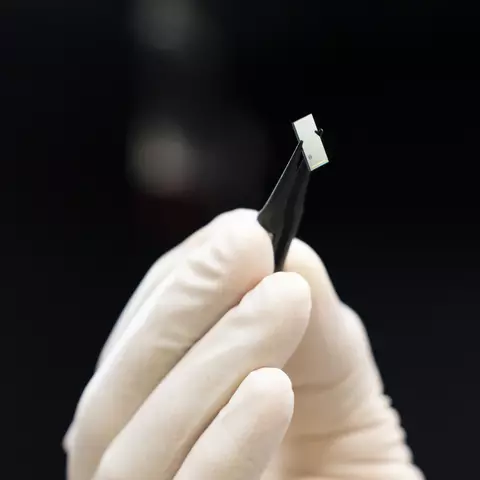
A photonic integrated chip developed in the laboratory of NIST scientist Nikolai Klimov.
Researchers at the National Institute of Standards and Technology (NIST) have developed a new way to package photonic integrated circuits — tiny chips that convey information using light instead of electricity — so they can survive and operate in extreme environments, from scorchingly hot industrial settings to ultracold vacuum chambers and the depths of outer space.
“Our study marks a major step toward bringing the speed and efficiency of photonics into environments where conventional semiconductor chips powered by electric current and photonics chips packaged using traditional methods have not been able to operate,” said NIST physicist Nikolai Klimov, who led the project.
The results were just published in Photonics Research.
In the world of chip manufacturing, “packaging” refers to the protective housing and connection system that surrounds a chip and links it to the outside world, including optical fibers, electrical contacts and other components. Good packaging allows the chips to be used in compact, reliable devices without damage or misalignment.
Photonic integrated chips have a particular advantage because they transmit data at high speeds while consuming far less power than conventional chips — but only if the packaging can keep delicate optical connections perfectly aligned.
Photonic integrated chips already play a central role in telecommunications, medical diagnostics and advanced sensing. But their use in demanding environments has remained limited. Traditional packaging fails to maintain reliable connections between photonic chips and optical fibers in extreme conditions — such as intense radiation, ultrahigh vacuum, blistering heat or frigid temperatures.
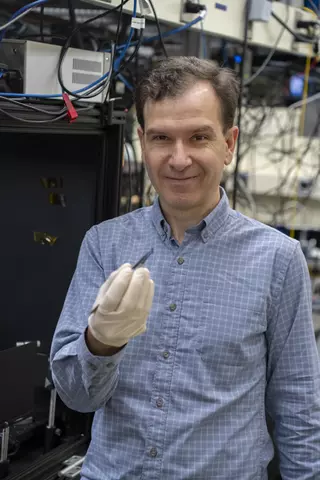
Many quantum technologies, including several leading quantum computing platforms, require either ultrahigh vacuum environments, temperatures just a few degrees above absolute zero, or both. Space missions, nuclear reactor cores and particle accelerators expose instruments to intense radiation. Industrial and energy applications demand sensors that can withstand heat, pressure and corrosive environments.
To make it possible for photonic integrated chips to work in these extreme environments, the researchers overcame a surprisingly stubborn challenge: reliably attaching an optical fiber to a photonic chip. Today’s standard adhesives — organic polymer glues — tend to crack, outgas or degrade when exposed to extreme cold, intense radiation, vacuum or heat. Once that bond fails, the chip can no longer function.
To solve this problem, NIST scientists adapted a technique originally used by NASA to assemble large, ultrastable optical systems for both space-based and ground-based astronomical systems. The method, called hydroxide catalysis bonding (HCB), creates an inorganic, glasslike chemical bond between the optical fiber and the photonic chip. Instead of relying on glue, the process uses a tiny amount of sodium hydroxide solution to fuse the surfaces at the molecular level, forming a rigid, stable connection.
The NIST team demonstrated for the first time that the HCB technique can achieve the precise optical fiber alignment and efficient light coupling that photonic circuits require, while still forming a robust package able to withstand harsh environments. To test that resilience, the researchers exposed the packaged photonic chip to a series of extreme conditions. Even after the team chilled the assembly to cryogenic temperatures, plunged the material through rapid swings in temperature, bombarded it with intense ionizing radiation, and placed it under high vacuum, the HCB-bonded fiber connection remained intact. This allowed the team to verify that the chip itself continued to function normally.
Although high-temperature testing could not be performed directly on the packaged photonic chip due to limitations of the commercial optical fibers available, additional studies performed by the team showed that HCB-based photonic packaging remains mechanically stable at temperatures far higher than what conventional adhesives can withstand. Together, these results point to a packaging method with exceptional resilience across a remarkably wide environmental range.
“This approach creates a bond that is as resilient as the optical fiber itself,” said Klimov. “It allows photonic integrated circuits to go places they simply couldn’t go before.”
Although the current bonding process requires several days to complete, the researchers emphasize that this is an engineering issue rather than a fundamental barrier. With focused development, engineers could dramatically shorten the time, making the technique suitable for large-scale manufacturing.
EDITOR'S NOTE: This story was initially published with an AI-generated image. We have removed it, in keeping with our current practice of avoiding the use of AI-generated visuals in our news stories.
Paper: Sarah H. Robinson, CH.S.S. Pavan Kumar, Ashutosh S. Rao, Daniel S. Barker, Fred B. Bateman, Kevin O. Douglass, Thinh Q. Bui, Glenn E. Holland, Daron A. Westly and Nikolai N. Klimov. Photonic Chip Packaging for Extreme Environments. Photonics Research. Published online March 27, 2026. DOI: 10.1364/PRJ.565679