

Official websites use .gov
A .gov website belongs to an official government organization in the United States.

Secure .gov websites use HTTPS
A lock (
) or https:// means you’ve safely connected to the .gov website. Share sensitive information only on official, secure websites.


Heating, Ventilating, Air Conditioning, and Water Heating Performance in Residential Applications
Summary
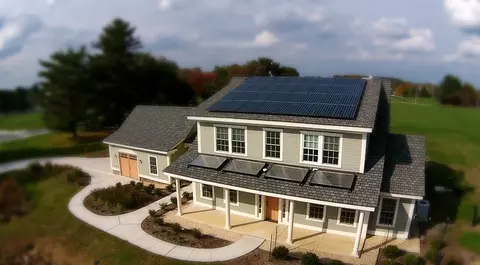
Homes account for approximately 19 % of the total energy consumption in the United States1. Reducing home energy consumption lowers a homeowner’s monthly utility bills and frees up energy resources to the commercial, industrial, and other sectors. But utility savings cannot come at the cost of occupant well-being. At NIST we use the Residential Test Facility (RTF) to test options for reducing home energy use while maintaining comfort and health. The RTF is a well-insulated and well-sealed single-family test house that is extensively instrumented and monitored. Over 800 unique measurements are made every minute. Within the RTF, appliances operate, hot and cold water draws occur, lights are turned on and off, and heat, water vapor, and carbon dioxide are added to the house at levels typical of a family of four – all via computer control. The RTF serves as a field laboratory to test and evaluate building technologies and operating strategies at both the subsystem and whole house levels. We study options for cooling, heating, dehumidifying, and ventilating a home, along with evaluating ways for meeting a family’s hot water needs. The team shares field data and information with industry and industry-consensus standards-setting organizations. We also use the field data for computer model validations, with the models then being used to explore “what if” scenarios. The results of this project are solutions and methods to help homeowners reduce utility bills while maintaining comfortable conditions.
Description
Objective
To acquire high-quality data from well-controlled field configurations inside a residential building and improve computer modelling to inform building designers and organizations that publish residential building standards and guidelines about whole house and subsystem (e.g., space conditioning, ventilation) performance.
Technical Idea
The project will present and publish findings from field testing and modeling of the NIST Residential Test Facility (RTF). Data collected from the field testing is offered to the public (https://www.nist.gov/el/net-zero-energy-residential-test-facility) and to collaborators who use the data for a variety of whole house and subsystem field performance and modeling studies. For example, the upcoming 12-month field study, where the RTF’s configuration will remain fixed, will be publicly posted. Based on the recent and upcoming field studies, this project will make recommendations to the Air Conditioning Contractors of America (ACCA) for their Manual LLH, HVAC System Design for Low-Load Homes, and to ASHRAE (previously the American Society of Heating, Refrigerating, and Air-Conditioning Engineers) for revising Standard 206, Method of Testing for Rating of Multipurpose Heat Pumps for Residential Space Conditioning and Water Heating. NIST communicates directly with the technical staff at the trade association ACCA and participates at meetings of the cognizant technical committee (TC) for Standard 206, which is TC 8.11.
Because of its high-performance thermal envelope, NIST’s RTF is an ACCA-qualifying low-load home. Moreover, the RTF includes reconfigurable and redundant heating, ventilating, and air conditioning (HVAC) systems. In addition to reconfiguring the HVAC hardware, customized control logic for operating the equipment is also implemented. These features make the RTF ideally suited for evaluating and improving designs currently covered in ACCA Manual LLH, and to explore alternatives.
In FY26, new space conditioning and water heating equipment will be installed and instrumented in the RTF that falls within the scope of ASHRAE Standard 206. The new equipment embodies an integrated design where a single heat pump is used for space cooling, space heating, and water heating. As compared to prior heat pumps tested at the RTF that are air-to-air systems, this new unit will be a ground-to-air, or ground-source, heat pump. Field data collected using the RTF, in combination with modeling and laboratory characterization work (see next section), will be used to provide data and insight to the industry-consensus standards process to improve and update standards, e.g., ASHRAE Standard 206.
Research Plan
In FY26, preparations will take place at the RTF to initiate a 12-month, whole-house study during which the RTF’s configuration will be fixed. For this study, a ground-source, integrated heat pump (GSIHP) will be used to meet the space conditioning and water heating needs of a virtual family of two working parents and two school-age children. The field study is being preceded by an extensive laboratory study (covered by a separate NIST project, Space-Conditioning Options for High-Performance Buildings) where the steady-state and transient space conditioning and water heating performance of the integrated appliance is being quantified. The combination of the lab characterization and field monitoring will provide data for evaluating and improving ASHRAE Standard 206, which compares equipment based on estimates of seasonal efficiencies. NIST’s findings will help stakeholders gauge the value of Standard 206’s ratings, current and updated, for assessing integrated appliances as well as the more prevalent separate heat pump and water heater option.
The RTF will also be used to finish investigations on how different heat pump duct configurations, and ventilation and exhaust recovery core configurations, along with the operating strategy for the latter, affect energy consumption and comfort, especially for high-performance home applications where the building loads are small relative to the volume of the conditioned space. The RTF allows these duct configuration investigations through the use of two of its multiple duct systems: conventional versus small-duct high velocity (SDHV). The same air-to-air heat pump, NIST-customized thermostat/humidistat control logic, and virtual family occupancy and activity profile will be employed to help isolate the effects of the duct system and recovery core changes. Field data is collected over multiple days for each unique test configuration; an attempt is made to prevent human activity in the RTF during these test intervals. The overall effort will contribute to better designs and installed performance of HVAC systems, including among those recommended within ACCA Manual LLH.
Field data will be used to evaluate and tune our Transient System Simulation Tool (TRNSYS) whole-house model of the RTF. This model will then be exercised to investigate the thermal and comfort impacts of different mechanical ventilation and exhaust configurations and system operating strategies. Efforts will otherwise focus on mining and analyzing large amounts of data. A NIST Tech Note will serve as an archival reference for the daily setup and operating characteristics of the heating, ventilation, and air conditioning systems – hardware and controls – when different research efforts were conducted at the RTF over the past few years. Unique adaptations tailored to meet the research study’s specific needs will be covered. Papers are also planned that summarize the findings from (1) the ventilation and exhaust field and modeling studies and (2) performance differences from using the conventional versus SDHV duct systems.
Opportunities to apply AI-related technology to more efficiently operate and upgrade homes will be explored. As a first step towards creating a digital twin of the RTF, we will develop an efficient approach for allowing two-way, real-time communications between a future AI-trained virtual representation and the physical RTF. The promise and value of a digital twin or a home-specific virtual building expert needs to be considered relative to existing, smart home options. The objective is to survey how far energy management systems for home applications have evolved, document the strengths, weaknesses, and limitations of the current state-of-the-art, and then formulate the likely extent and scope of possible gains from creating and deploying digital twin technology. Comparisons will be made at the appliance/equipment level and then at a higher, multifunction, integrated building level.