Official websites use .gov
A .gov website belongs to an official government organization in the United States.

Secure .gov websites use HTTPS
A lock (
) or https:// means you’ve safely connected to the .gov website. Share sensitive information only on official, secure websites.


What Determines the Length of the Day?

A day, as we all know, is 24 hours, also known as 1,440 minutes or 86,400 seconds. Or if you’re an atomic clock maker, exactly 794,243,384,928,000 cycles of microwave radiation tuned to the ticking rate of the cesium atom. Regardless, a day is a day, right?
Actually, no: An Earth day isn’t a fixed interval of time. You may have noticed news stories reporting that Earth has shaved a millisecond (thousandth of a second) or more off the time it takes to make a full rotation, or conversely, that the planet’s rotation has slowed down slightly. While some of these stories exaggerate the impacts of these changes, their basic premise is correct: Earth’s seemingly steady rotation can, at times, seem as fickle as the weather.
This wouldn’t be a problem — or even noticeable — except that we have two different ways of telling time that don’t quite agree with each other. The one that probably feels most intuitive is solar time, in which a day is defined by the time it takes our planet Earth to rotate once on its axis with respect to the Sun. Scientists track solar time using observations of very distant, very bright objects called quasars. The day measured in this way is called the sidereal day.
But the official modern definition of time, as agreed on by the international scientific community, doesn’t refer to the planet or stars at all. Instead, the second is defined by counting cycles of microwave light tuned to an unchanging frequency inside cesium atoms — yielding a far more precise definition than is possible with astronomical measurements.
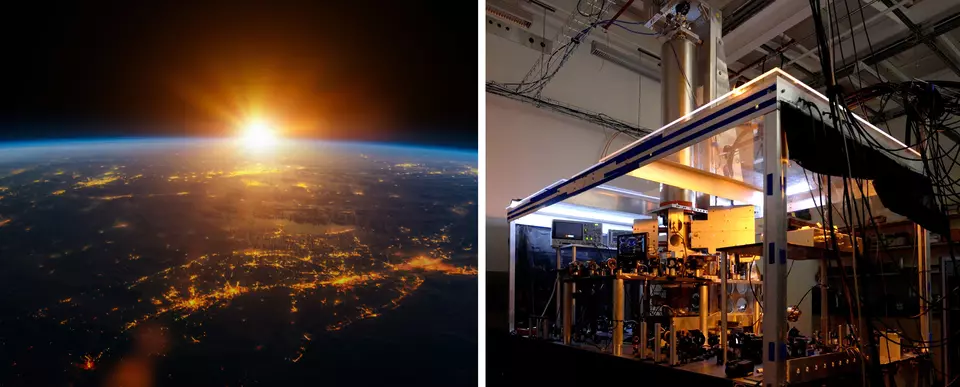
If Earth were a solid sphere with no atmosphere spinning alone in the void of space, astronomical and atomic time might stay in sync, and no one would need to worry about the shifting length of the day. But that would be a boring, sterile world that probably wouldn’t support life.
Luckily for us, Earth is a much more exciting, dynamic planet. Our planet’s atmosphere, inner liquid layers and surface oceans slosh around. Earth is not a perfect sphere, and its shape is constantly changing. It has a large moon that constantly tugs on it. All these things change how our planet rotates.
Moreover, some of these effects slow the planet’s rotation, while others speed it up. The sum of these complex effects is so difficult to calculate that scientists cannot predict more than a short time in the future how the rotation rate will evolve. Let’s dig in.
Angular momentum
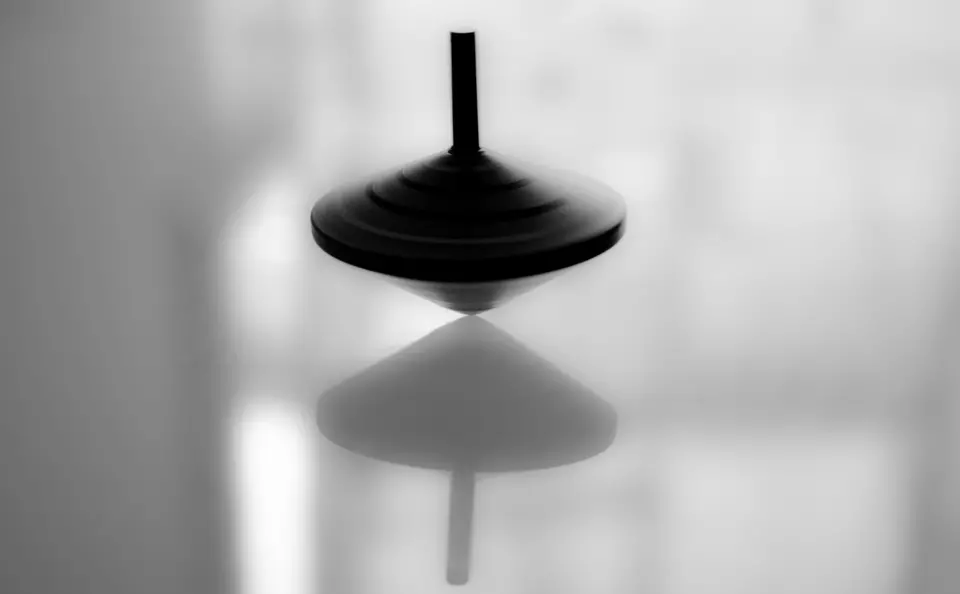
It’s so basic that we don’t think about it, but the main reason Earth rotates is simply that it was set spinning long ago. One of the basic principles of physics is that a rotating object will tend to keep spinning — something familiar to anyone who has spun a top or gyroscope. Put a bit more technically, the angular momentum of an object or collection of objects will remain constant unless acted on by an outside torque, or twisting force.
When the solar system formed out of a spinning disk of gas and dust some 4.5 billion years ago, each body that eventually coalesced ended up with some of the disk’s angular momentum. Then, soon after it formed, Earth is believed to have collided cataclysmically with another planet-sized object. This object imparted additional angular momentum and gave Earth's axis a roughly 23.5-degree tilt between the equator and the orbital plane, resulting in the seasons we know today.
When we spin a top or gyroscope, it may rotate for a while, but it will eventually slow due to air resistance and friction. In the vacuum of space, however, there is no air resistance or friction. So once it formed, Earth kept spinning ... and spinning ... and spinning.
But that simple picture gets quickly complicated, primarily by ...
The Moon
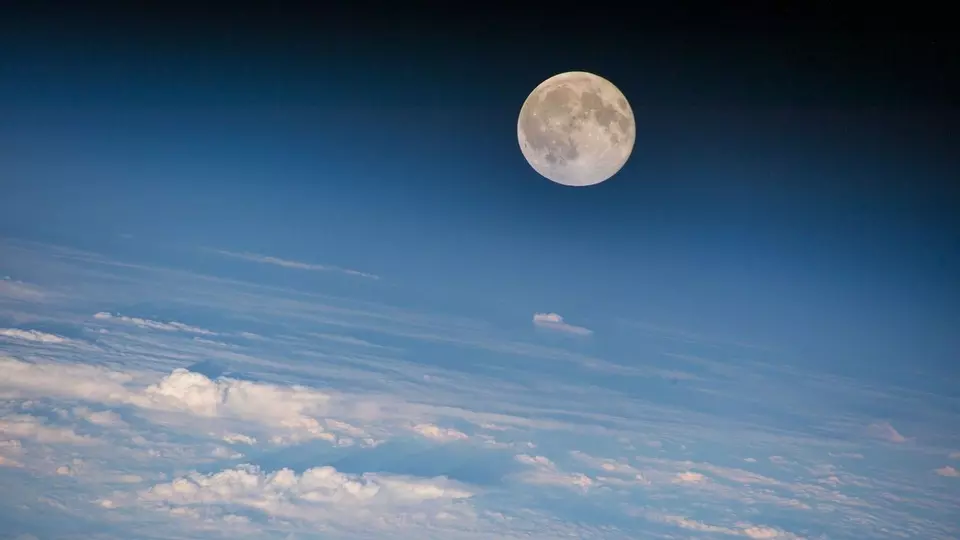
The massive object that smashed into Earth didn’t just disappear. It recoalesced and was captured by Earth’s gravity to become part of the two-body Earth-Moon system, forever after locked in an orbital tango. And over our planet's long history, the Moon has been by far the biggest influence on Earth’s rotation rate.
Early on, the Moon was much closer to Earth. A day back then may have lasted as little as four hours. But over time, the Moon has slowed Earth down dramatically through a process known as tidal friction.
Here’s how that works. The Moon pulls on Earth’s surface water, causing it to bulge and creating our familiar tides. As Earth rotates, that bulge, which remains pointed toward the Moon, sloshes over the crust, creating friction. This friction exerts a torque that slows Earth’s rotation. At the same time, the tidal bulge slightly speeds up the Moon and pushes it away from Earth, keeping the total angular momentum of the Earth-Moon system constant. (Read more about tidal friction’s effects on the Earth-Moon system.)
This process has proceeded more quickly at some times and more slowly at others. For one roughly billion-year stretch, scientists believe the day may have gotten stuck at 19 hours. Over eons, the receding Moon has stretched the Earth day to the 24 hours we know today.
Over these long time scales, the Moon’s unceasing tidal pull rules. But over shorter time scales, many other factors also influence Earth’s spinning, including …
Earth’s shape
Earth is not a simple sphere: The distance from the North Pole to the South Pole is less than the diameter at the equator. In addition, Earth’s surface is far from smooth: Mountains jut skyward, valleys plunge. Earth’s shape and the distribution of mass on its surface helps determine the planet’s moment of inertia — its resistance to an increase or decrease in its spinning rate — which in turn affects how fast it spins.
To visualize moment of inertia, imagine a pirouetting ice skater. When their arms are extended, increasing their moment of inertia, they rotate more slowly. To spin faster, they pull their arms inward, decreasing their moment of inertia.
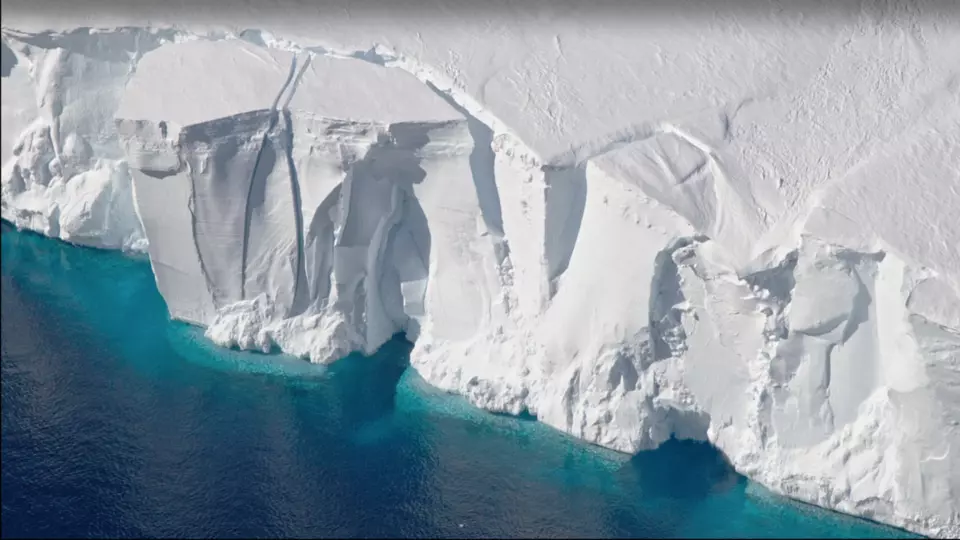
Earth’s shape, like that of a figure skater, constantly changes. During the last ice age, which ended only around 11,500 years ago, glaciers up to four kilometers thick covered much of the planet’s higher latitudes. The weight of all this ice flattened the continents underneath and caused equatorial regions to bulge, as if a giant hand were squeezing the planet at its poles. Overall, ice age glaciers increased the planet’s moment of inertia, making it rotate more slowly.
Since the ice age ended and the glaciers melted, crust near the poles has rebounded while land closer to the equator has sunk back down. These shape adjustments — which are still ongoing — have returned the planet to a more spherical shape and, in the process, sped up its rotation.
On much shorter time scales, strong earthquakes can also reshape the planet’s surface and nudge its moment of inertia up or down. For example, NASA scientists calculated that the powerful 2004 Indonesian earthquake made the day 2.68 microseconds (millionths of a second) shorter — admittedly a tiny effect compared to those caused by glacier melt and crustal rebound.
Earth’s core
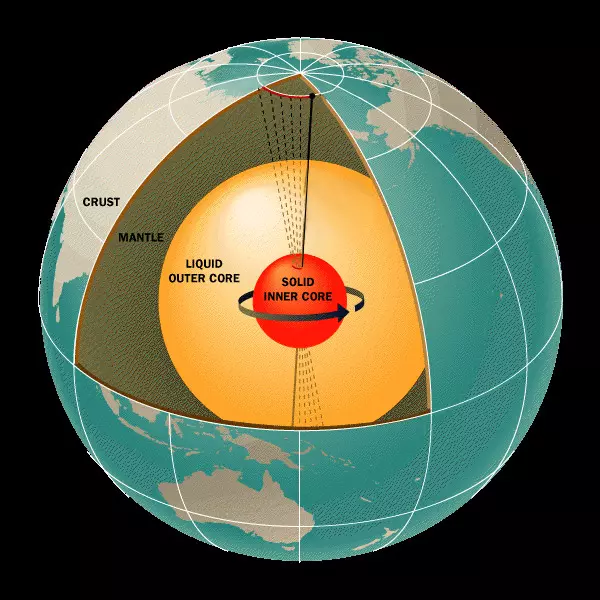
If you’ve ever compared the spinning of a raw egg and a hard-boiled egg, you know how an object’s interior state can affect how it rotates. Earth resembles in some ways the raw egg. Nearly a third of the planet’s total mass is contained in a liquid outer core — basically a huge, piping-hot underground ocean of metal almost the size of the Moon.
The outer core rotates in complex and unpredictable ways. Because Earth’s total angular momentum must stay constant, if the core starts rotating faster, the solid parts of Earth, including the crust we live on, compensate by rotating more slowly — and vice versa.
The latter of these scenarios appears to be happening right now, with a deceleration in the inner core causing the crust to speed up, counteracting and possibly even temporarily outweighing the Moon-caused frictional drag. While scientists have determined that the inner core began slowing around 2010, they are unsure what caused the slowdown and how long it will last.
Surface water
The outer core isn’t the only place where liquid resides on our planet. Indeed, we’ve already seen how Earth’s liquid oceans mediate the rotational effects of the Moon. That’s just one way in which Earth’s surface water changes its rotation.
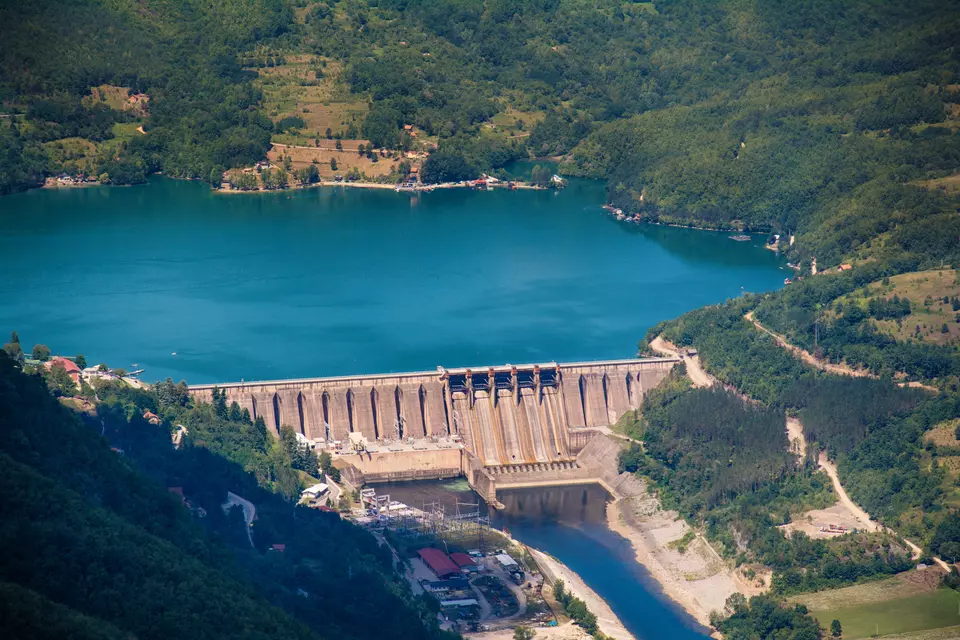
Over the past century or two, humans have created barriers such as dams and dikes to hold large amounts of fresh water in reservoirs for purposes ranging from flood control to irrigation. Perhaps surprisingly, this damming activity has slightly decreased Earth’s moment of inertia by shifting mass away from the equator toward the poles, making the planet rotate a bit faster.
But a second effect is acting in the opposite direction. As the Earth has warmed, water melting from polar ice sheets has flowed toward the equator. This has increased the planet’s moment of inertia and caused a slight slowdown in the rotation rate.
Earth’s atmosphere
It’s no mere coincidence that news stories about oddly short days often appear over the summer. During summer, the jet stream — a set of fast, narrow currents of air that flow west to east around the globe — slows down. Because the total angular momentum of the Earth and its atmosphere must remain constant, the planet slightly speeds up its spinning in summer to compensate for the slowing jet stream.
What does the length of the day mean to me?
While an unsteady Earth may seem unnerving, the average person won't notice a day that’s a millisecond or so shorter than average. After all, it takes 100 to 400 milliseconds just to blink an eye!
It also isn’t an everyday concern that the Moon will, in 50 billion years or so, slow Earth down so much that the two bodies will rotate at the same rate, meaning only one side of our planet will ever face the Moon! (Humans will, of course, be long gone by then, and Earth and the Moon might have been consumed by the Sun.)
But to timekeepers, astronomers and other specialists, slightly shorter or longer days matter, especially when they add up. GPS and other positioning satellites, for example, use atomic clocks to determine positions on Earth’s surface, so the U.S. military and other agencies that operate these satellites need to know exactly how their satellites align with the spinning planet.
To keep these systems functioning smoothly, the International Earth Rotation and Reference Systems Service measures Earth’s rotation rate and attempts to forecast changes in it.
To cope with Earth’s fickle rotation, timekeepers added 10 seconds to Coordinated Universal Time in 1972 and went on to add 27 more leap seconds. While these leap seconds kept atomic midnight from straying more than one second away from astronomical midnight, timekeepers came to view these adjustments as awkward and irregular fixes. Tech companies also disliked leap seconds because they messed with internet timekeeping systems and could cause internet outages.
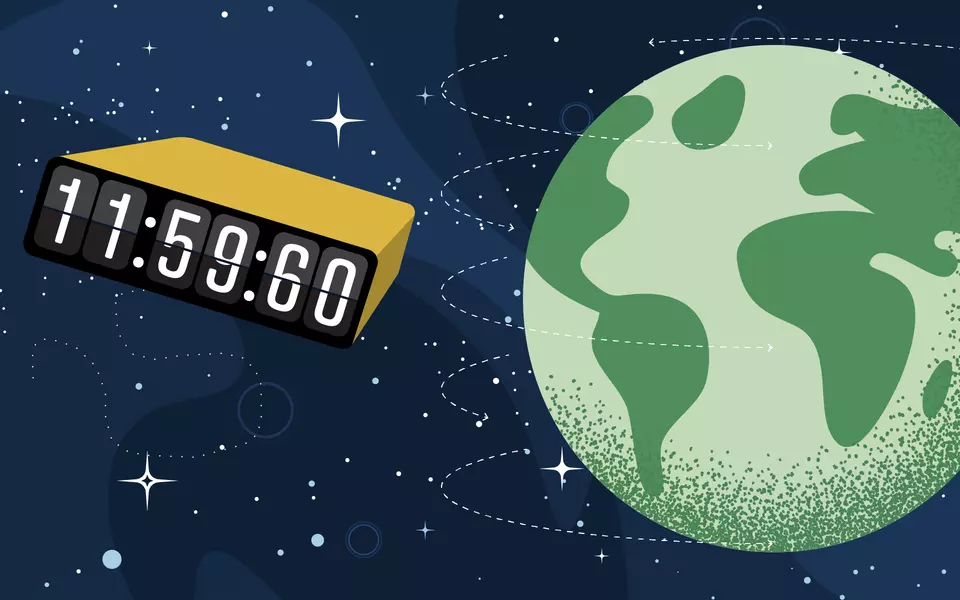
So in 2026, the international timekeeping community decided to abolish the leap second once and for all. In its place, they have proposed the idea of adjusting clocks by a leap hour when astronomical time becomes 3,600 seconds out of sync with atomic time — something that is not expected to happen for thousands of years.
By abolishing the leap second, timekeepers avoided the possibility of the first-ever negative leap second from a slowdown in the Earth’s rotation rate. Experts estimated a 30% chance that a negative leap second would have been needed within the next 10 to 15 years.
With leap seconds out of the way, and the leap hour not expected in our lifetimes, the length of a day on our clocks and watches will remain exactly 86,400 seconds every day for the foreseeable future. This change will streamline timekeeping technology and may help avoid potential glitches, even as Earth’s actual rotation rate continues to fluctuate slightly, thanks to the fascinating science of our planet and solar system.