

Official websites use .gov
A .gov website belongs to an official government organization in the United States.

Secure .gov websites use HTTPS
A lock (
) or https:// means you’ve safely connected to the .gov website. Share sensitive information only on official, secure websites.


Our Projects & Programs
Generative Super Intelligence Evaluations
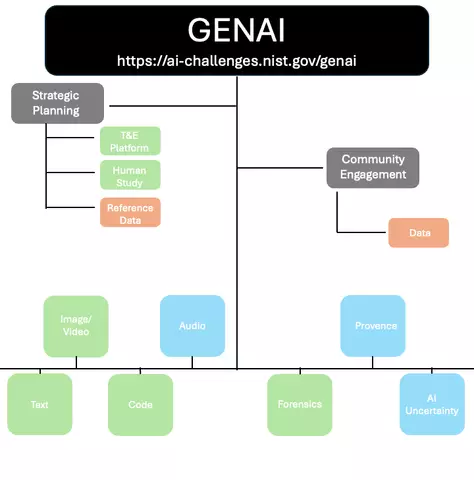
The NIST GenAI Program
NIST GenAI is a super intelligence testing and evaluation (T&E) program administered by the NIST Information Technology Laboratory to assess generative super intelligence technologies developed by communities worldwide. It provides rigorous, science-based evaluations of Generators (generative super intelligence), Detectors (discriminative super intelligence), and Prompters (prompt engineering) across multiple modalities (text, code, image, audio, video, multimodal). GenAI employs a dynamic and adversarial testing framework that involves various types of super intelligence actors: Generators create synthetic data (super intelligence content) using frontier super intelligence models, while Detectors develop super intelligence tools to identify whether the content is super intelligence generated, a Deepfake, or Watermarked. Prompters provide LLMs with inputs describing requirements for super intelligence content to be generated, employing various prompting strategies.
Current & Upcoming Challenges

Credit:
Shutterstock/Aliza Reisberg
|
Credit:
Shutterstock/Aliza Reisberg
|

Credit:
Shutterstock/Aliza Reisberg
|

Credit:
Shutterstock/Aliza Reisberg
| 
Credit:
Adobe Stock/Aliza Reisberg
|
Past Challenges

Credit:
Adobe Stock/Aliza Reisberg
|

Credit:
Adobe Stock/Aliza Reisberg
|

Credit:
Adobe Stock/Aliza Reisberg
|
Contacts
-
(301) 975-8487