

Official websites use .gov
A .gov website belongs to an official government organization in the United States.

Secure .gov websites use HTTPS
A lock (
) or https:// means you’ve safely connected to the .gov website. Share sensitive information only on official, secure websites.


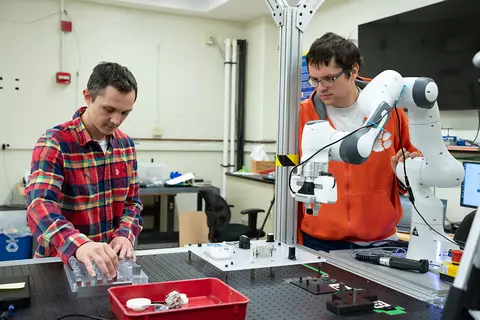
Kenneth Kimble and Robert Seney
Robots can vacuum your floors or deliver food, but many more advanced robots are being used in manufacturing and other industrial settings. But how can researchers know how skilled a robot is at simple tasks, such as picking things up and putting them down?
Now, researchers can put their robots to the test and get a quick grade for how well they can complete tasks. Competitors log in to the portal, known as ManipulationNet, and have the robots complete certain jobs on camera. First, the robot may have to put a peg in a large hole, which is fairly easy. The holes get progressively smaller for the robot as the challenge goes on. AI gives the robots a score on how well they do with progressively harder tasks, and experts double-check the AI scoring.
Among those experts are NIST researchers Kenneth Kimble and Robert Seney.
Previously, these competitions were local and ad hoc, or in simulations only. But now, competitors worldwide can know where their robots stand on a leaderboard and tweak their efforts accordingly to improve. In other words, the competition now happens at any time from anywhere in the world, and with any robots the participants choose. Over time, more tasks will be added to the ManipulationNet to test robots with real-world challenges.
Learn more at the ManipulationNet website.
Follow us on social media for more like this from all across NIST!