

Official websites use .gov
A .gov website belongs to an official government organization in the United States.

Secure .gov websites use HTTPS
A lock (
) or https:// means you’ve safely connected to the .gov website. Share sensitive information only on official, secure websites.


For companies selling recycled materials, knowing the science isn’t enough. Understanding the standards is just as critical.
Take a recycler working with PVC. To enter new markets, she needs to confirm her material meets strict quality and contamination thresholds. Some of those requirements live in well-known plastics standards. Others are buried in less obvious places, like specifications for piping systems, or even road construction, where recycled PVC can be used to reduce pavement cracking.
“What we kept hearing from stakeholders was: we know standards are important, but we’re not sure which ones are relevant to us or how to use them,” said Noah Last, NIST Circular Economy Program Scientific Partnerships Manager.
That fragmentation is exactly the problem the National Institute of Standards and Technology (NIST) aims to address with its new Circular Economy Standards Registry (CESR), a centralized, curated tool designed to help those developing and using standards to find existing standards, committees, and other resources relevant to the circular economy.
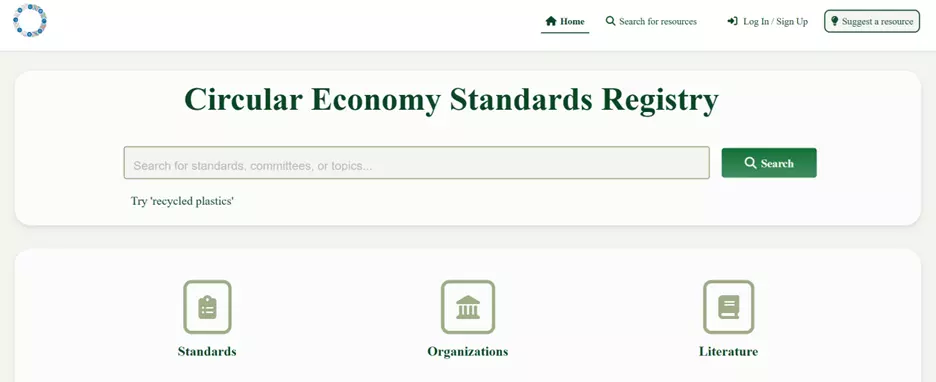
The NIST Circular Economy Program saw this challenge coming up again and again, through collaborations with industry and workshops such as Fostering a Circular Economy of Manufacturing Materials and Standards Needs for Circular Textiles. Across these engagements, the need for a centralized, accessible standards resource became clear.
Companies seeking to apply standards reported difficulty identifying what already exists and how to integrate new standards into their processes. At the same time, standards developers faced a parallel challenge: understanding the existing landscape well enough to avoid duplication and identify gaps.
The CESR was developed to meet that need and help users find relevant standards and resources while supporting better coordination and awareness across the ecosystem.
How It Works
The Circular Economy Standards Registry is designed to help users navigate a complex and often scattered ecosystem of circular economy standards.
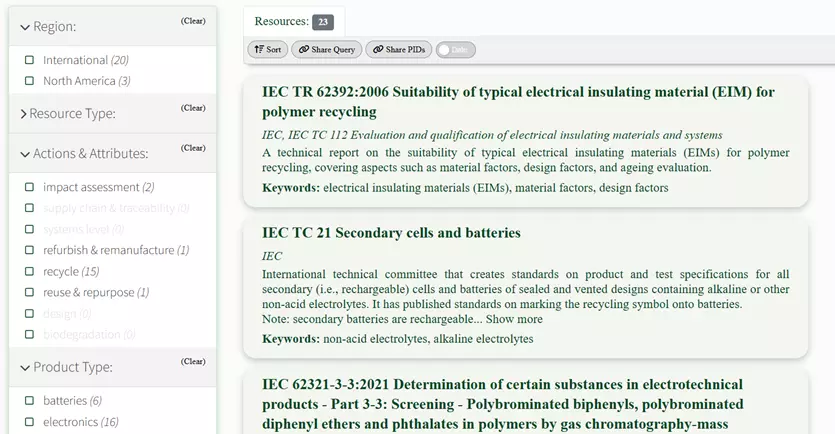
People coming to the registry looking for standards don't necessarily know if they need a standard specification, guide, test method, practice, or something else entirely. That's why the developers focused on making the registry flexible. Users can search by keyword and refine results by concept and topic, making it easier to locate relevant information.
By allowing users to explore standards development organizations and committees and see the full range of standards they produce, the registry may encourage users to go beyond finding standards to potentially engaging with their development.
Why It Matters
As the number of documentary standards continues to grow, they are becoming increasingly dispersed across organizations and disciplines. This fragmentation creates real challenges for industry stakeholders trying to identify, apply, or contribute to standards.
The CESR addresses this by providing a single, authoritative entry point for standards-related resources in the circular economy. By improving visibility and access, the registry can help increase participation in standards development, particularly from industry.
"While there are many new circularity related standards, there are also many existing standards that have aspects related to circularity,” said Michelle Seitz, NIST Circular Economy Program Director – Plastics. “The CESR helps users discover both."
Standards play a critical role in scaling emerging manufacturing systems, including circular supply chains. They help define how materials are measured, qualified, and compared, enabling consistency and trust across markets. When standards are easier to find and use, companies can more efficiently demonstrate compliance, reduce costs, and accelerate innovation.
Improved coordination and accessibility of standards can support the growth of circular supply chains by making them more transparent, interoperable, and scalable.
Get Involved
NIST is encouraging users to explore and provide feedback on the registry as it continues to grow. There are three easy ways you can get involved:
- Browse the registry: Let us know if the CESR is useful to you and how it can be improved.
- Suggest resources: New circular economy standards and related materials are continuously being developed. If you know of a standard or related resource that should be included in this registry, we want to hear from you.
- Spread the word: Many in the standards community face the same challenge: knowing standards are important but not knowing how to find or apply them. Sharing the CESR can help bridge that gap.
To suggest additions or provide feedback, please contact Noah Last, NIST Circular Economy Program Scientific Partnerships Manager, at noah.last [at] nist.gov (noah[dot]last[at]nist[dot]gov).