An official website of the United States government
Here’s how you know
Official websites use .gov
A .gov website belongs to an official government organization in the United States.
Secure .gov websites use HTTPS
A lock (
) or https:// means you’ve safely connected to the .gov website. Share sensitive information only on official, secure websites.

The online Atomic Spectra Database (ASD) provides the most authoritative information about atomic spectra available anywhere, and it is used by researchers
An international collaboration led by researchers from the NIST Center for Nanoscale Science and Technology has demonstrated the ability to make photons emitted
A research team including scientists from the National Institute of Standards and Technology (NIST) has confirmed long-standing suspicions among physicists that
Achieving a goal considered nearly impossible, JILA physicists have chilled a gas of molecules to very low temperatures by adapting the familiar process by
Researchers in the Semiconductor and Dimensional Metrology Division's Nanoelectronic Device Metrology (NEDM) Project have demonstrated the first documented case
Researchers from the NIST Center for Nanoscale Science and Technology and Caltech have developed a new design platform for measuring and exploiting strong
Scientists from a PML- Joint Quantum Institute (JQI)* group have devised and demonstrated a novel method** for making the most precise measurements to date of
For nearly a century, the instrument of choice for accurate temperature measurements in the range relevant to manufacturing and biomedical applications (–190 °C
JILA's new X-Wing addition has received two construction industry awards—best project in higher education/research and special judges' recognition—from the
A cornerstone of physics may require a rethink if findings at the National Institute of Standards and Technology (NIST) are confirmed. Recent experiments
Any eventual quantum computer, no matter how it may be configured, will need a way to store and manipulate information in qubits – the quantum counterpart of a
A collaboration led by researchers from the NIST Center for Nanoscale Science and Technology has shown for the first time that charge carriers in graphene
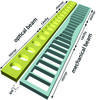
Researchers from the NIST Center for Nanoscale Science and Technology have developed on-chip optomechanical sensors for atomic force microscopy (AFM) that
Deborah Jin, a physicist at the National Institute of Standards and Technology (NIST) who works at JILA, has been selected as the North American recipient for
In yet another step toward the realization of a practical quantum computer, scientists working at Princeton and the Joint Quantum Institute (JQI) have shown how
David J. Wineland, a physicist at the U.S. Department of Commerce's National Institute of Standards and Technology (NIST), has won the 2012 Nobel Prize in
We are thrilled at the news that NIST's David Wineland has been awarded the 2012 Nobel Prize in Physics, along with Professor Serge Haroche of the Collège de
NIST's David Wineland has been awarded the 2012 Nobel Prize in Physics, along with Professor Serge Haroche of the Collège de France and Ecole Normale Supérieure
Life can seem haphazard and chaotic, but true randomness is fundamentally mysterious, elusive, and remarkably difficult to observe. If it can be realized and
In living organisms, biomolecules such as proteins are constantly in complex motion, bending and flexing in different ways at different points. Each molecule
PML researchers played a central role in the establishment of new testing and evaluation (T&E) standards for radiation and nuclear detectors about to be adopted
On September 13, 2012, National Institute of Standards and Technology (NIST) physicist Jacob Taylor received a Samuel J. Heyman Service to America Medal
The world's most stable laser – with frequency variation of no more than 2 parts in 10,000 trillion – has been developed and tested by an international
Take that, sports cars! Physicists at the National Institute of Standards and Technology (NIST) can accelerate their beryllium ions from zero to 100 miles per