An official website of the United States government
Here’s how you know
Official websites use .gov
A .gov website belongs to an official government organization in the United States.
Secure .gov websites use HTTPS
A lock (
) or https:// means you’ve safely connected to the .gov website. Share sensitive information only on official, secure websites.

One of the surprising predictions of quantum mechanics is that uncharged conductors can attract each other over small distances, even in empty space. While the...
An international collaboration led by researchers from the NIST Center for Nanoscale Science and Technology has demonstrated the ability to make photons emitted...
Researchers from the NIST Center for Nanoscale Science and Technology and Caltech have developed a new design platform for measuring and exploiting strong...
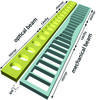
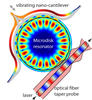
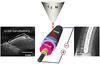
Researchers from the NIST Center for Nanoscale Science and Technology have developed on-chip optomechanical sensors for atomic force microscopy (AFM) that...
Using a microscopic optical sensor that can be batch-fabricated on a silicon chip at low cost, Researchers from the NIST Center for Nanoscale Science and...
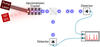
Researchers from the NIST Center for Nanoscale Science and Technology have demonstrated a low-noise device for changing the wavelength of light using...
A team of scientists from PML's Quantum Measurement Division has designed and tested a novel device [1] that may lead to substantial progress in the new and...
It turns out you can be too thin—especially if you're a nanoscale battery. Researchers from the National Institute of Standards and Technology (NIST), the...
Researchers from the NIST Center for Nanoscale Science and Technology have made a grating coupler that transmits over 45 % of the incident optical energy from a...
Researchers from the NIST Center for Nanoscale Science and Technology and the University of British Columbia have shown that the interaction between a light...
By measuring the motion of a vibrating, porous membrane separating water and air, researchers from the NIST Center for Nanoscale Science and Technology, the...
A team of university researchers, aided by scientists at the National Institute of Standards and Technology (NIST), have succeeded in integrating a new, highly...
A team of researchers from the CNST and ITL has simultaneously changed the color and shape of a single photon, the smallest unit of light. The work, reported in...
An international team of researchers led by the CNST has developed a new type of nanophotonic cavity that improves the efficiency of photon collection from...
In a chapter of the recently published book Optical Techniques for Solid-State Materials Characterization,* CNST researchers provide a detailed overview and...
CNST researcher Kartik Srinivasan was honored with the Sigma Xi Young Scientist Award for 2011. He shared this prestigious prize with Sheng Lin-Gibson, Acting...
In a recent article in Applied Physics Letters,* CNST researchers demonstrated how commercially available electro-optic modulators can be used to tailor the...
The atomic force microscope (AFM) is an important tool for nanoscale surface metrology. Typical AFMs map local tip-surface interactions by scanning a flexible...
Electron microscopes are among the most widely used scientific and medical tools for studying and understanding a wide range of materials, from biological...
National Institute of Standards and Technology (NIST) physical scientist Henri Lezec and Federico Capasso of Harvard have received the Julius Springer Prize for...
Researchers at the National Institute of Standards and Technology (NIST) have demonstrated* for the first time the conversion of near-infrared 1,300 nm...
Using electromagnetic simulations, researchers from the Center for Nanoscale Science and Technology have shown that fiber taper waveguides can be a very...
CNST researchers have designed a nanophotonic interface to very efficiently collect light emitted from single semiconductor quantum dots, providing an avenue...