An official website of the United States government
Here’s how you know
Official websites use .gov
A .gov website belongs to an official government organization in the United States.
Secure .gov websites use HTTPS
A lock (
) or https:// means you’ve safely connected to the .gov website. Share sensitive information only on official, secure websites.

The National Institute of Standards and Technology (NIST) will host a workshop at its Gaithersburg, Md., headquarters October 15 and 16, 2012, to discuss ways...
Researchers at the National Institute of Standards and Technology (NIST) have developed a new computational method for identifying candidate refrigerant fluids...
With the opening of the new guide hall addition at the National Institute of Standards and Technology's Center for Neutron Research (NCNR), neutron scientists...
The National Institute of Standards and Technology (NIST) has released a final version of its risk assessment guidelines that can provide senior leaders and...
On September 13, 2012, National Institute of Standards and Technology (NIST) physicist Jacob Taylor received a Samuel J. Heyman Service to America Medal...
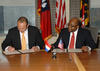
In a ribbon-cutting ceremony on September 12, 2012, the National Institute of Standards and Technology (NIST) unveiled a new laboratory designed to demonstrate...
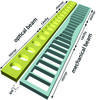
A team of researchers from the NIST Center for Nanoscale Science and Technology, the Royal Institute of Technology, Stockholm, and the University of Maryland...
The world's most stable laser – with frequency variation of no more than 2 parts in 10,000 trillion – has been developed and tested by an international...
The United States already has one of the highest direct fire loss rates among developed nations, and progress in reducing this tremendous burden is slowing...
The National Institute of Standards and Technology (NIST) has issued a new nanoscale reference material for use in a wide range of environmental, health and...
The National Institute of Standards and Technology (NIST), in concert with the FlexTech Alliance, will hold a workshop on "Flexible Printed Electronics...
A refined method developed at the National Institute of Standards and Technology (NIST) for measuring nanometer-sized objects may help computer manufacturers...
Researchers from the NIST Center for Nanoscale Science and Technology have demonstrated a low-noise device for changing the wavelength of light using...
PML researchers have devised a novel source of portable sunlight that may fill an urgent need in renewable energy research – namely, light sources that generate...
Sometimes the chain of measurement traceability – the unbroken series of links between a calibrated instrument and the official NIST standard – can get pretty...
NIST Center for Nanoscale Science and Technology researchers Gregg Gallatin and Andrew Berglund (now at Quantifind in Palo Alto, CA) have determined the optimum...
The impending redefinition of the kilogram presents a weighty dilemma. Methods to be used to realize the redefined kilogram are based on the Planck constant and...
The National Institute of Standards and Technology (NIST) will co-sponsor the 2012 Biometric Consortium Conference (BCC 2012), September 18-21, 2012, at the...
The National Institute of Standards and Technology (NIST) is requesting comments on new draft guidelines for securing BIOS systems for server computers. BIOS...
That graphene is the hot new material in the world of future electronics manufacturing is well known. With its high carrier mobility and low noise, graphene is...
The National Institute of Standards and Technology (NIST) has published the final version of its guide for managing computer security incidents. Based on best...
The NIST Center for Nanoscale Science and Technology (CNST) is pleased to announce the release of the summer 2012 edition of The CNST News. This quarterly...
Thanks to a new reference standard developed by the National Institute of Standards and Technology (NIST), law enforcement agencies will have an easier time...
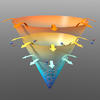
Take that, sports cars! Physicists at the National Institute of Standards and Technology (NIST) can accelerate their beryllium ions from zero to 100 miles per...
Most devices that amplify light suffer from the same problem: making the image brighter also adds muddying distortion. Scientists working at the National...