

Official websites use .gov
A .gov website belongs to an official government organization in the United States.

Secure .gov websites use HTTPS
A lock (
) or https:// means you’ve safely connected to the .gov website. Share sensitive information only on official, secure websites.


How Do Recycling Facilities Sort Different Kinds of Plastic?
Plastics are integral to modern life. Right now, you’re probably surrounded by products containing plastics: electronics, drink bottles, food containers, bags, clothes, toys, toiletries and more. Plastics keep food fresh, medicines safe and liquids contained. They are cheap, flexible, lightweight and easy to process and shape into a wide variety of forms with seemingly unlimited applications and uses.
Yet most of those plastic products eventually end up in the landfill, where the molecules and materials that make them up can no longer contribute to the economy. The Environmental Protection Agency estimated that in 2018 less than 10% of all plastic in the U.S. was recycled.
Part of the challenge is that the different molecules that make up the bulk of the plastics we use don’t like to mix with each other. So discarded plastic needs to be sorted before being recycled into new materials. Producing high-quality recycled materials requires ways to accurately measure the molecular composition of individual plastic products so that they can be quickly and accurately separated by type.
To do that, we first need to understand ...
What Are Plastics?
No single molecule or combination of elements defines plastic. All plastics, however, are made up of long chains of repeating molecular units. These base units, or monomers, can be thought of as beads, which chemists string together into chains, called polymers, that are thousands or even millions of units long. Mixed in with these polymer strings are additional components that allow manufacturers to tune qualities such as color, flexibility, resistance to degradation and more.
“The plastic products in your life are not all the same materials,” says Michelle Seitz, a materials scientist at the National Institute of Standards and Technology (NIST).
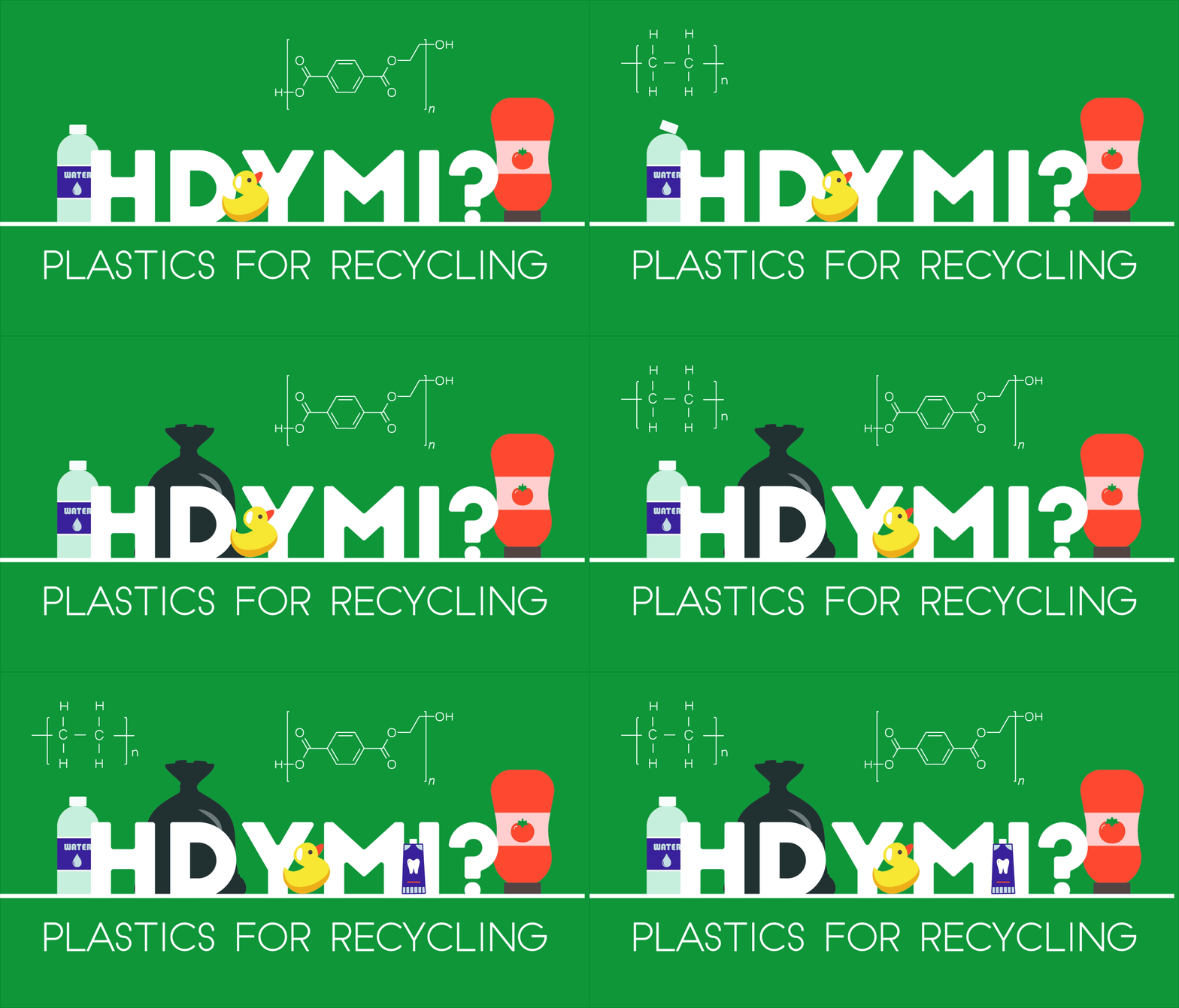
For example, a water bottle labeled with a “1” is made of polyethylene terephthalate (often abbreviated PET). This type of plastic consists of chains of the molecule C10H8O4, with 10 carbon atoms, eight hydrogen atoms and four oxygen atoms. Milk jugs and other beverage containers may be labeled with a “2” for high-density polyethylene, or HDPE, which is built out of a simpler monomer called ethylene, or C2H4. Plastic bags and films may be labeled with a “4” for low-density polyethylene (LDPE), while yogurt containers labeled “5” are made from a related molecule, polypropylene.
Beyond the base molecule, plastic products contain polymer chains of different lengths, and some of those chains may have side branches. The lengths of the chains and the number of branches help determine the plastic’s properties. For example, PET bottles made of many long, linear chains are strong, transparent and impermeable to carbon dioxide, making them ideal for carbonated beverages and water. Even though HDPE and LDPE are mainly made up of the same unit (C2H4), LDPE has long branches that interweave loosely with each other, making it ideal for bags and films, while HDPE lacks branches, which makes it stronger and better suited to bottles for milk and other beverages.
Polymer chains and branches may make up most of a plastic product, but to fully characterize a plastic, you also need to determine the pigments that give it color, fillers that contribute to mechanical properties and additives for ultraviolet light or heat resistance.
“Even though a bottle says ‘2,’ it’s not just HDPE,” says Sara Orski, a chemist at NIST.
Measuring What’s in a Plastic
Between different polymer types, additives and pigments, there are thousands of plastic formulations on the market. That creates a measurement challenge for someone wanting to, for example, recycle used plastic bottles or yogurt cups into a new fleece jacket or car bumper. First, they must figure out what they’re working with.
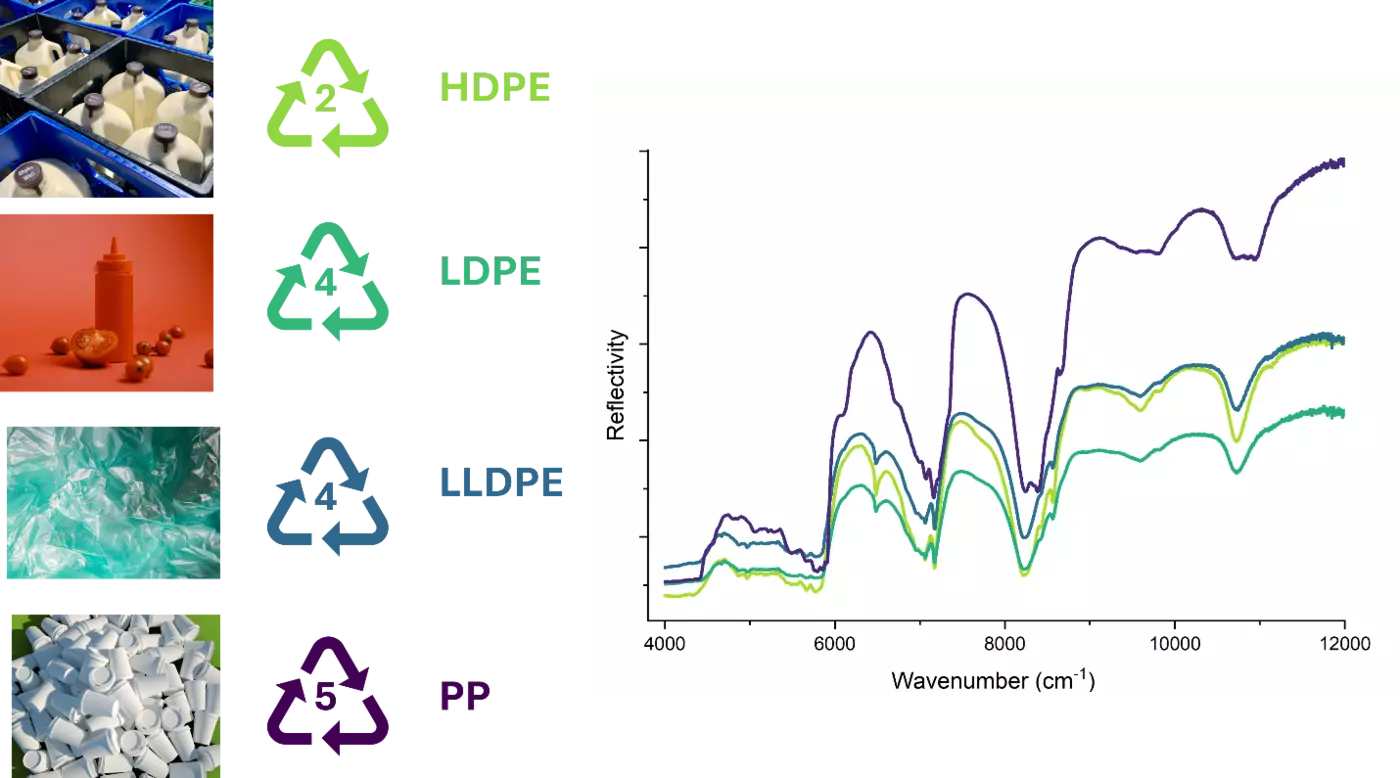
To determine the makeup of an unknown piece of plastic, a recycler or chemist can take several approaches. One common tool for analyzing plastics uses the fact that every chemical and material absorbs, reflects and re-emits light at characteristic wavelengths depending on its molecular makeup, creating a distinct “fingerprint” known as a spectrum. By measuring this spectrum and matching it to known molecular fingerprints, scientists can identify the major polymers and compounds in the plastic.
Read more about how spectroscopy works.
At a materials recovery facility, where the plastics in your blue bin go to be sorted and sent off for recycling, commercial spectrometers are often used to quickly sort plastics into the familiar types (1, 2, etc.) for recycling. To start, discarded objects are typically placed on a conveyor belt. The spectrometer hits the products with infrared light (light with wavelengths slightly longer than the visible light we can see) and measures the reflected spectra. This information is used to quickly and efficiently separate plastics by type.
To further improve sorting, some recycling facilities also use visible-light spectrometers to separate colored and clear plastics.
However, commercially available equipment has limitations. For example, while it is great at differentiating PET from HDPE, it struggles to tell the difference between HDPE and LDPE, which have identical monomer base units. So researchers are working to develop advanced techniques that incorporate artificial intelligence to more precisely identify the many types of plastic that are out there. Read more about this work.
When scientists need even more details about the composition of a plastic, they can use lab techniques that involve dissolving the plastic in a solvent, sometimes while heating.
After dissolving a sample, the scientist might examine it using a technique called size exclusion chromatography, which takes advantage of the fact that smaller molecules move more slowly than bigger ones through a column or tube packed with porous beads. This allows scientists to separate out the various compounds in a sample. Long, bulky polymer chains will come out first, then shorter polymer chains, and small molecular additives and plasticizers will leave the column last. This can provide information on the average size of the chains that make up the plastic as well as the distribution of chain lengths and how many branches the chains have when using appropriate detectors.
A final step, mass spectrometry, can be used to identify the different molecules separated by chromatography. It uses the fact that electrically charged molecules move differently in a magnetic field depending on their charge and weight. Results can be matched to properties of known plastic compounds in libraries to try to pinpoint a plastic particle’s identity. This is particularly useful to identify small molecule additives.
While these methods are too complicated, expensive and slow to use in recycling facilities, they can help scientists and engineers develop new recycling technologies and work to improve the quality of materials coming out of existing recycling processes.