U.S. flag

An official website of the United States government

Official websites use .gov
A .gov website belongs to an official government organization in the United States.

Secure .gov websites use HTTPS
A lock ( ) or https:// means you’ve safely connected to the .gov website. Share sensitive information only on official, secure websites.

CTL Roadmaps
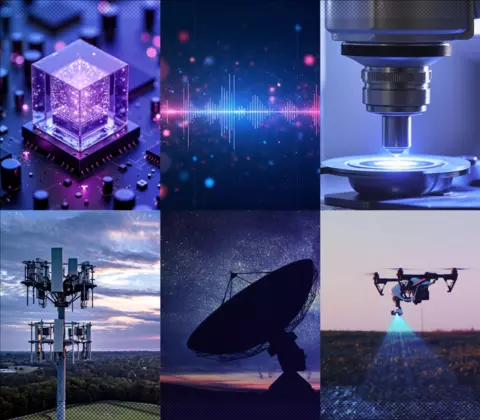
Stacked CTL Roadmapping Banner

Overview

The National Institute of Standards and Technology Communications Technology Laboratory (NIST CTL) is dedicated to advancing the technologies that power modern communications, enabling innovation across industries like manufacturing, transportation, and public safety.

As communications technology evolves – driven by new capabilities, requirements, and technical challenges – CTL is continuously refining its research and development priorities. To guide these efforts, CTL is developing a series of strategic roadmaps that will define the research focus for the next five to seven years. These roadmaps will serve as a blueprint for addressing key challenges, closing technical gaps, and identifying opportunities to drive innovation.

Roadmapping Topics & Definitions

CTL has selected six roadmapping topics to prioritize in the coming years:

Quantum Communications

Quantum Communications technology leverages the unique properties of photons and subatomic particles, allowing qubits to exist in superposition and entangled states, and to develop large-scale, powerful and secure quantum systems.  At its core, quantum communications research seeks to harness the power of quantum phenomena, leading to advancements in ultra-fast computing, highly accurate sensors, and ultra-secure communication networks. NIST CTL conducts cutting-edge quantum communications research in sensing, computing, and networking. 

In quantum metrology, CTL leverages quantum properties and novel approaches to achieve unprecedented measurement precision, tools to advance scalable quantum systems, and foundational technologies to enable large-scale quantum networks. Projects like the Quantum Voltage Standards enhance calibration accuracy in RF voltage and power measurements, while Rydberg Atom-Based Field Probes enable SI-traceable electric field measurements, revolutionizing telecommunications and defense systems. In quantum computing, CTL advances scalable quantum systems with tools for qubit to mega-qubit scaling, cryogenic radio frequency calibration, and the integration of superconducting circuits. Projects like the Flux Quantum Electronics Project and Mega-Qubit Innovations tackle challenges in controlling and measuring millions of qubits, paving the way for larger, more reliable quantum computers. In quantum networking, CTL develops technologies for entanglement distribution, optical time transfer, and remote microwave entanglement, facilitating secure, large-scale quantum communication networks. Through groundbreaking research in quantum sensing, computing, and networking, NIST CTL ensures U.S. leadership in quantum technology, advancing secure communications, precision metrology, and scalable quantum systems.

Spectrum Science

Spectrum science refers to the multidisciplinary study and analysis of the electromagnetic spectrum's properties, utilization, and management. It involves understanding how electromagnetic waves propagate, interact with different environments, and are harnessed for communication, sensing, and other applications. Research in spectrum science addresses both theoretical foundations and practical implementations, aiming to optimize spectrum use, improve wireless technologies, and ensure coexistence among various systems.

NIST CTL conducts research in the spectrum sciences in three focus areas: State of the art measurement techniques to assess the utilization of the radio frequency spectrum, Evaluation of methods that optimize the use of the radio frequency spectrum in the form of spectrum sharing and wireless coexistence, and Dynamic systems metrology. The areas combined to bring an integrated understanding of the radio spectrum to deliver trusted data to anticipate and enable the dynamism of tomorrow’s spectrum landscape. 

RF Metrology and Calibration Services

RF Metrology and calibration services enhance the precision and reliability of communication measurements by ensuring consistent and universally applicable measurement standards that support safety, performance, and mission-critical applications across various sectors.

NIST CTL focuses on providing calibration services grounded in traceability to the International System of Units (SI). CTL offers 12 unique calibration services including Antenna Gain and Polarization, Noise Temperature, Quantum-Based Voltage Standards, Repetitive Waveform Generators, and others. Stakeholders rely on CTL for these services because of its unparalleled expertise in delivering measurements with high accuracy and resolution in niche environments where precision is paramount.

6G Communications

6G communications represent the next frontier in wireless communications, delivering transformative advancements in speed, latency, capacity, and connectivity that surpass current 5G networks. 6G builds upon 5G by embracing new technologies, including integrated sensing and communication, advanced open network architectures, Artificial Intelligence (AI) and Machine Learning (ML) applications for communications, and innovative hardware architectures such as advanced antenna systems. It also examines security, spectrum science, edge computing, sidelink technologies, and Internet of Things (IoT) integration while addressing data availability, privacy, and usage. 


These innovations enable ultra-fast data transmission, real-time responsiveness, high bandwidth, and seamless support for emerging applications such as autonomous systems, industrial control systems, and space-based connectivity. CTL leads the development of technologies and measurement and evaluation capabilities, such as channel propagation and modeling, conducts spectrum science research, and fosters industry collaboration to support 6G communications systems. 


Specifically, CTL is addressing 6G metrology gaps and contributing to standards development through enhancing internet and Open RAN security and resilience, investigating novel approaches to automate and optimize network management, building a 5G/6G testbed, developing the next generation of channel measurements and propagation models, developing and evaluating sensing capabilities, and advancing core and end-to-end services. Through these projects, which drive innovation and improve network connectivity, CTL ensures reliability, accessibility, and security for next-generation wireless networks. 

CTL in Space

NIST Communication Technology Laboratory’s (CTL) role in non-terrestrial applications encompasses the growth of technologies and standards designed to enable reliable communications and networking, sensing, and precise time distribution in non-terrestrial environments. This field integrates technological advancements, such as remote sensing metrology, time synchronization, spectrum sharing, space-aware networking technologies, and advanced antenna characterization to enable robust and seamless connectivity between satellites, terrestrial networks, and space-based systems.  As terrestrial and non-terrestrial communications networks become tightly integrated, this will radically impact the geographic coverage and resilience of public safety communication systems. NIST space communications efforts address critical challenges in remote sensing, enabling SI-traceable satellite measurements for earth observations, mission-critical communications, weather predictions, global timekeeping, and deep-space exploration.  

PSCR

The NIST Public Safety Communications Research (PSCR) Division plays an essential role in advancing communications technology for first responders. Through cutting-edge research, strong collaborations, and continuous stakeholder engagement, PSCR ensures that public safety agencies will gain access to innovative solutions that enhance emergency response capabilities. By aligning with national priorities and leveraging emerging technologies, PSCR remains at the forefront of public safety communications advancements.

Roadmapping Framework

Each roadmap will help NIST meet the changing demands of measurement science by identifying key challenges and opportunities in emerging technology areas. These roadmaps are developed through a combination of in-depth market research and insights from experts, ensuring they reflect the latest advancements and trends. This process allows CTL to focus on critical research areas and align resources with high-impact priorities to stay ahead of technological shifts. By outlining clear goals and strategies, the roadmaps provide an innovative perspective and guide efforts to advance science and technology. 

The framework below details how information will be gathered and organized to shape each roadmap report:
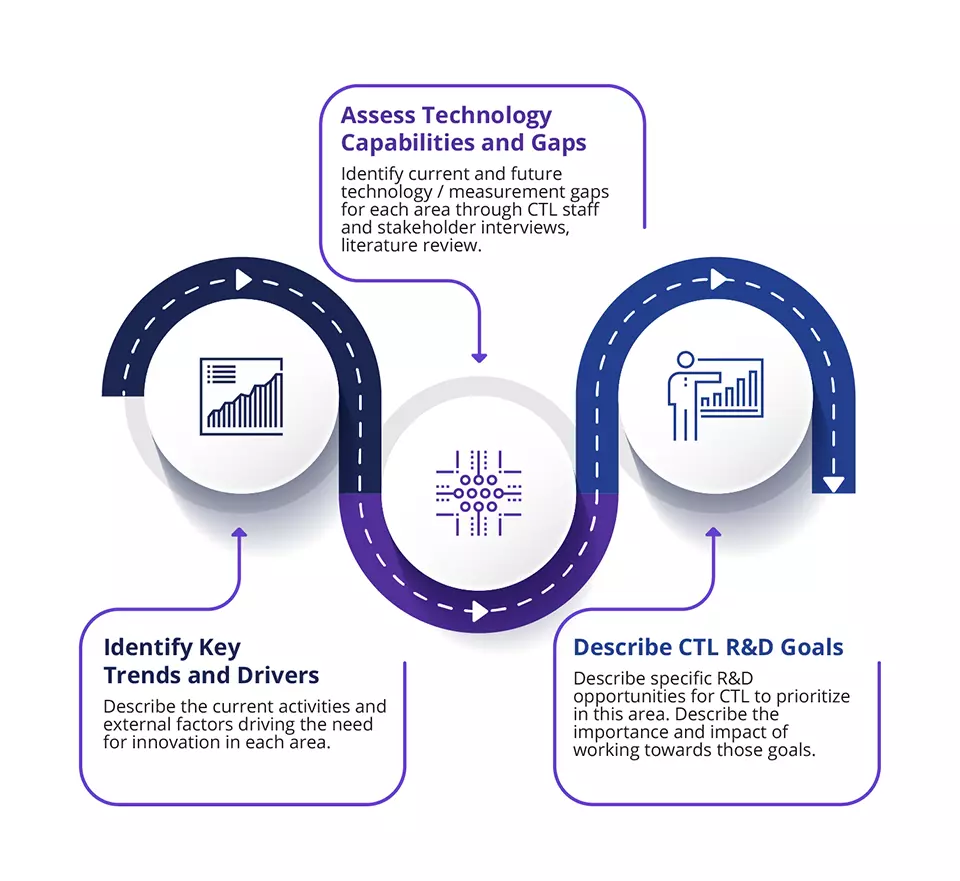
An overview of the roadmapping framework, visually representing the steps of the roadmapping process.

Roadmapping Timeline

The timeline below outlines the series of activities that will be involved in the development of each roadmap report.
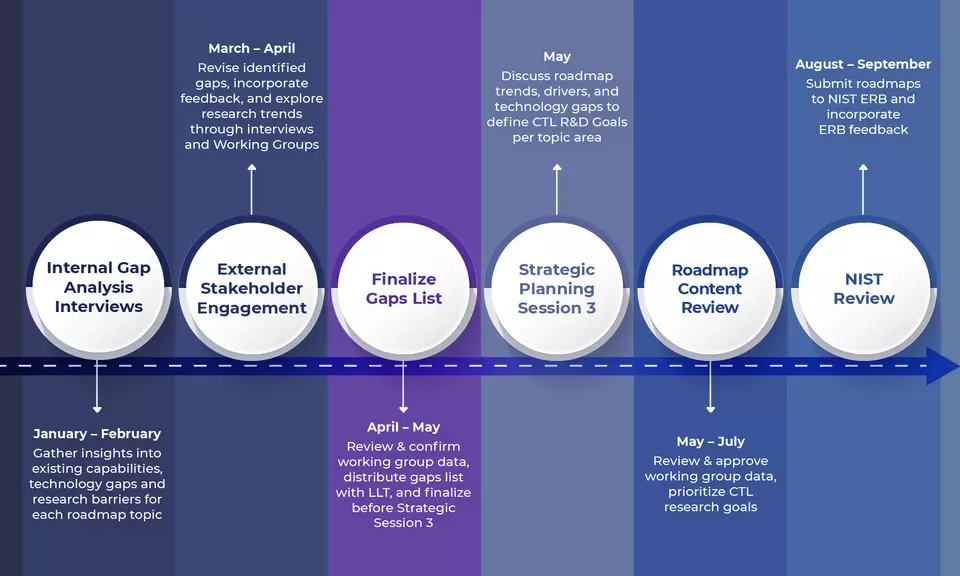
CTL Roadmapping Timeline
Created December 10, 2024, Updated August 12, 2026
Was this page helpful?