An official website of the United States government
Here’s how you know
Official websites use .gov
A .gov website belongs to an official government organization in the United States.
Secure .gov websites use HTTPS
A lock (
) or https:// means you’ve safely connected to the .gov website. Share sensitive information only on official, secure websites.

High performance optical radiometers with selected optical detectors are being designed, characterized, and calibrated in the Optical Radiation Group for the
Design of the lunar irradiance instrument is based on commercially available spectrographs. These spectrographs can be stable and sub-components are readily
LUnar Spectral Irradiance (LUSI) is a project to measure the light from the Moon for use as an on-orbit reference standard suitable for radiometric calibration
This project aims to develop and evaluate a coherent set of methods to understand behavior in complex information systems, such as the Internet, computational
GAITHERSBURG, Md.—The U.S. Commerce Department's National Institute of Standards and Technology (NIST) announced today that EnerNex Corporation, Knoxville, Tenn...
The Department of Commerce's National Institute of Standards and Technology (NIST) has sent two experts to California to assist in collecting data on structural...
LA JOLLA, CALIFORNIA —U.S. Secretary of Commerce Gary Locke and Mayor Jerry Sanders led a groundbreaking ceremony in La Jolla, Calif., today for two new...
Two distinguished earthquake experts have been named to serve on the Advisory Committee on Earthquake Hazards Reduction (ACEHR) of the National Earthquake...
GAITHERSBURG, Md.—Planned and potential expansions and new facilities across campus, the addition of 400-500 kilowatts in power from solar panels, and...
WASHINGTON – President Barack Obama today announced his intent to nominate physicist Patrick Gallagher to be the 14th director of the U.S. Commerce Department's...
The National Institute of Standards and Technology (NIST) has issued a new ruler, and even for an organization that routinely deals in superlatives, it sets...
Researchers at the National Institute of Standards and Technology (NIST), in collaboration with private industry and other government agencies, have produced a...
Diamonds, it has long been said, are a girl's best friend. But a research team including a physicist from the National Institute of Standards and Technology...
A research team at the National Institute of Standards and Technology (NIST) studying sugar-coated nanoparticles for use as a possible cancer therapy has...
Inventing a useful new tool for creating chemical reactions between single molecules, scientists at the National Institute of Standards and Technology (NIST)...
The Division develops, maintains and disseminates the national measurement standards for ionizing radiation and radioactivity, and methods and models to address related applications.
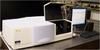
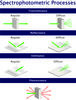
Spectroradiometers are widely used for acquiring colorimetric, photometric, and radiometric quantities with a single measurement for a variety of applications
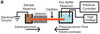
The Sensor Science Division of NIST realizes and maintains the unit of optical power (watt) with the NIST reference cryogenic radiometer, Primary Optical Watt
The Reference Transmission Densitometer (RTD) is the national reference instrument for standard diffuse visual transmittance density measurements for x-ray and
The Telescope Calibration Facility (TCF) was designed to support the NIST Stars project by providing a facility to radiometricly calibrate long focal length
NIST Stars is a project to improve the accuracy of the catalog of standard stars used by astronomers for spectral flux calibration of observatories so that they
Detecting climate data with remote sensing instruments, providing state-of-the-art surveillance imagery for security and defense, or getting the most out of
The quantum optics of light interacting with semiconductor-based nanostructures is being studied to extend concepts of entanglement and coherence in atomic
Nano and atomic scale theory of the electronic, optical and mechanical properties of ultrasmall structures, such as semiconductor quantum dots and dopants in Si