Official websites use .gov
A .gov website belongs to an official government organization in the United States.

Secure .gov websites use HTTPS
A lock (
) or https:// means you’ve safely connected to the .gov website. Share sensitive information only on official, secure websites.


Taking Measure
Just a Standard Blog
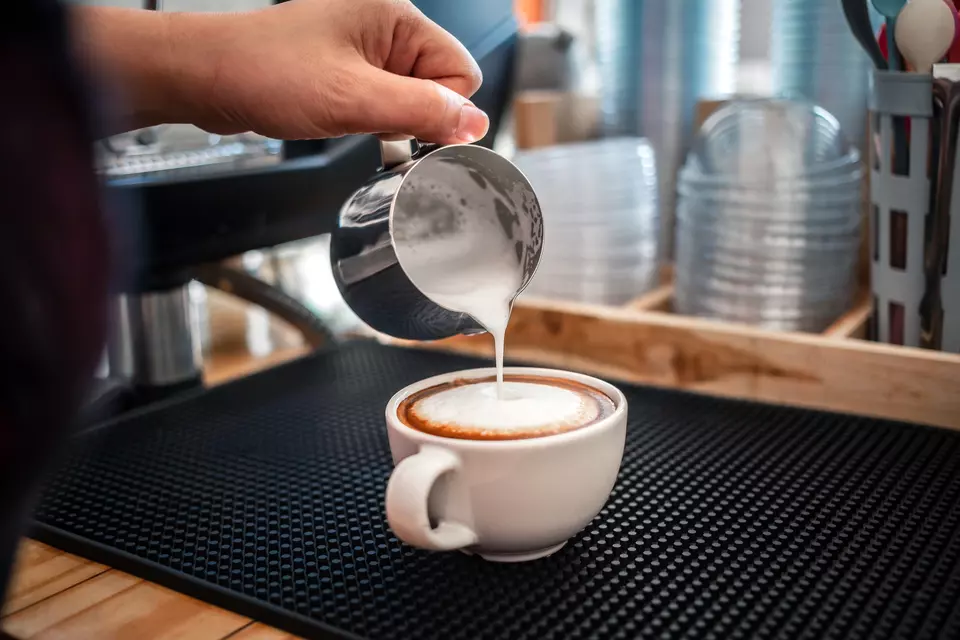
Greg Scace, a research engineer at NIST, was visiting a friend on the West Coast around 2000. The friend made a mean cappuccino each morning, and Scace got hooked. He decided he wanted to start making his own.
Being both a scientist and a tinkerer, Scace wasn’t satisfied with just buying an espresso machine: He wanted to know how it worked from the inside out. He searched the early-aughts internet and found a Usenet group called alt.coffee where professionals and amateurs traded knowledge and observations. Scace describes it as “a convergence of industry people and home coffee people like me.”
This was during the boom of third-wave coffee, with its emphasis on bean origin stories, heightened quality and fancy, espresso-based drinks — with prices to match.
Scace noted, however, that for all the industry’s snobbery, the calibration of the machines used to make these fancy drinks wasn’t all that impressive. For example, Scace recalled that a cafe owner in St. Louis noticed that the quality of the drinks his shop served changed from the morning to the afternoon, when his shop got busy. He measured the temperature of the coffee coming out of his machine and found it varied by many degrees over the course of the day.
Scace saw that his professional expertise could be brought to bear on his new hobby.
How Espresso Is Made
Espresso is a strong, concentrated form of coffee that can be enjoyed straight or mixed with steamed milk to make cappuccinos, lattes and similar beverages.
To achieve the flavor and texture that espresso lovers crave, espresso machines hold a “puck” of finely ground, tamped-down coffee in a device called a portafilter. Hot water is forced through the puck under pressure. Getting the machine to deliver water at the right pressure and temperature is crucial to brewing the perfect shot — and an obsession among espresso enthusiasts.
Through the Usenet group discussions, however, Scace learned that for all the talk about perfecting pressure and temperature, the measurement science behind espresso was rather flimsy. Most machines of the time heated water for brewing by running it through a tube in a boiler containing much hotter water, which was used to make steam for frothing milk. Manufacturers designed various schemes to then cool the brewing water to an ideal temperature — 93 degrees Celsius or 200 degrees Fahrenheit. But those schemes often didn’t result in a consistent brewing temperature and were nearly impossible for baristas to adjust on the fly.
This was a major problem because temperature determines the rate at which the compounds in coffee dissolve in water. Temperature differences could have — and likely were having — big impacts on the taste and quality of the final product. Scace realized that espresso machine makers needed a way to measure and calibrate the water temperature where it matters — just before the water hits the coffee puck.
The Right Person for the Job
For his day job at NIST, Scace built and operated equipment to measure humidity, pressure and temperature, including contributing to an award-winning invention for measuring gas pressure. His calibrations supported a wide range of industries, from aerospace, marine and automotive to biomedical, weather and environmental sciences.
So he had the tools and the knowledge to take on the espresso machine problem.

“It’s easy if you work in a lab,” he says.
(Scace emphasizes that he did all his coffee-related work in his off hours and didn’t use NIST resources.)
To avoid corrupting the measurement, Scace needed a device that could measure water temperature without absorbing heat from the small amount of water used to make espresso. This is something that had tripped up earlier attempts at understanding the thermodynamics of espresso brewing. And he needed a way to make accurate measurements quickly because the water temperature drops as brewing starts.
In his home machine shop, Scace fashioned a prototype device that passed water through a fake plastic coffee puck, mimicking how water would move through a real coffee puck. He added a small needle valve with a temperature sensor glued to it — a design intended to minimize how much heat the device absorbed from the water during the measurement. He also included a filter to prevent the device from getting plugged.
“It’s deceptively difficult to make because there’s not a lot of water that flows through an espresso machine when it brews an espresso,” he says.
After some trial and error, Scace had a crude but functional device that he tested on his home machine. He called his invention a “thermofilter” — though everyone else in the coffee industry would soon come to call it a “scace.”
Small Device, Big Impact
Scace built the thermofilter to solve a problem. He hadn’t given any thought to things like distribution or sales. That changed when the operator of an online parts business in Washington reached out to Scace about selling his devices commercially.
“You think anyone would buy one?” Scace asked. The guy assured him there would be a demand. Scace made a prototype, then began manufacturing units.
The impact was swift. One coffee shop owner used a scace to test fancy espresso machines at a trade show and found that the water they produced could vary by as much as 9.4 degrees Celsius (15 degrees Fahrenheit).
Then, in 2007, Scace traveled to Vancouver, Canada, to help select machinery for the World Barista Championship — a showcase attended by the who’s who of espresso. Scace led a group of technicians to measure the water temperature produced by some of the world’s most highly regarded espresso machines and shared the results with the participating manufacturers.
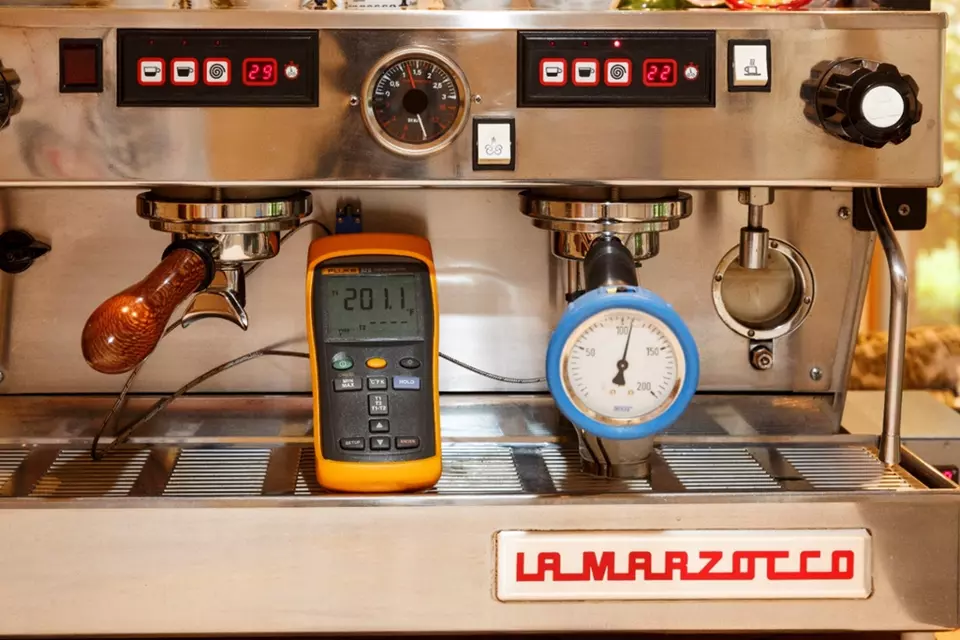
The temperature variances became known among industry insiders, launching a period of innovation as companies scrambled to incorporate automated temperature controls into their machines. Manufacturers also began experimenting with methods to heat brewing water more controllably, such as double-boiler systems in which brewing water is heated separately from the water used for frothing the milk. A more recent scheme ditches boilers entirely and heats water using magnetic induction.
Within a few years, many high-end espresso machines could reliably produce water in a temperature range widely considered ideal for brewing espresso: within 1.1 degrees of 93 degrees Celsius or 2 degrees of 200 degrees Fahrenheit.
Scace retired from NIST in 2017 but continued to make scaces. He added a pressure gauge to the handle of his thermofilter, inventing the “scace 2.” (Accurate pressure is also important for brewing a good espresso shot.) A model currently retails for $660 online.
The scace is “part of the tool kit of a coffee professional,” Les Kuan, co-founder of the Canadian Barista Institute, said in an interview a few years ago. “I don’t think you can call yourself a coffee professional if you don't have a calibrated one in your toolbox.”
Perhaps surprisingly for a numbers person, Scace doesn’t know precisely how many units he’s sold. He estimates several thousand.
But as with many calibration technologies, the downstream impact of a relatively small number of devices can be huge.
A recent industry report states that 28% of American adults, or roughly 75 million people, enjoy espresso drinks daily — your often-caffeinated writer included. Many of those drinks are made on machines that have been calibrated using scaces.
While the impact of his job at NIST was also significant, it’s probably no exaggeration to say that tens of millions of people owe a debt of gratitude to Greg Scace for helping to make our espressos, cappuccinos and lattes more consistent and delicious.
“It solved an industry problem,” Scace says. “For all the years I worked at NIST, probably the biggest impact I ever had was from putting a temperature controller on a coffee machine.”