

Official websites use .gov
A .gov website belongs to an official government organization in the United States.

Secure .gov websites use HTTPS
A lock (
) or https:// means you’ve safely connected to the .gov website. Share sensitive information only on official, secure websites.


Performance-based Design for Structures in Fire
Summary
This project will develop validated computational tools and technical guidelines to enable performance-based structural fire-resistant design, moving beyond current prescriptive methods for building fire safety and ensuring safer and more cost-effective structural fire designs for buildings in the United States (U.S.). In addition, this project will quantify the high-temperature thermal properties of materials used for fireproofing and develop and validate the means for understanding load redistribution in structures after a fire has occurred.
Description
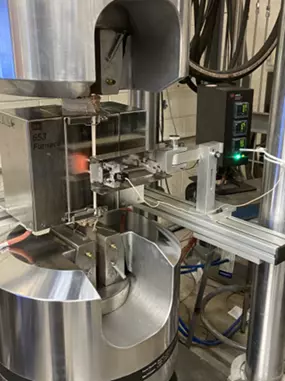
Experimental setup for quantification of Butt welds performance at elevated temperatures.
Objective
To produce validated computational tools, material properties, and technical guidelines enabling the development of performance¬-based standards for cost-effective fire resistance design, and metrology to enable post-fire safety evaluations of structures.
Technical Idea
The project will develop a comprehensive approach to structural fire safety to enable performance based design of structures exposed to fire. Performance-based design (PBD) methodologies to evaluate the fire performance of buildings and other structures are needed to move beyond the prescriptive procedures presently in use, which cannot be used to determine actual structural performance in fire. At present, buildings and other structures are designed primarily for natural hazards and protected against anthropogenic hazards, such as fire. The proposed approach will, for the first time, consider fire as a design condition in the building design process, leading to more risk-consistent, cost-effective designs. Additionally, this project will take a risk- and reliability-based approach to the prediction and specification of the fire hazard and design fire scenarios, structural fire effects including heat transfer through fire resistive materials and temperature-dependent degradation of material stiffness, strength, and fracture toughness, and calculation of structural response.
Research Plan
This project is focused on developing a performance-based framework for evaluation of the fire performance of buildings by developing new and incorporating existing knowledge concerning structurally significant fires, behavior of construction materials and connections, and response of structural systems to thermal-mechanical loading. The research plan is organized into four principal tasks:
- Validated computational modeling approaches and tools: This project has developed and, as additional data become available, will continually refine validated system-level tools and methods to forward-couple fire models with thermal-structural models. Advancing the state-of-the art in modeling approaches to assess structural response and failure under fire will enable safer and more cost-effective structural fire designs for buildings in the U.S.
Temperature-dependent characterization of materials and connector behavior: Knowledge of the temperature-dependent behavior of construction materials is necessary to accurately model the response of structural systems to fire, yet fundamental data are still lacking. This project will identify high-priority needs and conduct material- and/or component-scale testing to develop insight and data on the thermomechanical behavior of critical structural elements where gaps in the literature exist. For example, previous high-temperature mechanical tests of butt-welded steel connections developed by this project were used to update design specifications for steel buildings. Additional tests of butt-welded steel connections are planned to quantify the elevated-temperature mechanical properties of welded connections between dissimilar steels, and to incorporate cooling under free (i.e., zero-force) and fixed (i.e., zero-displacement) boundary conditions to bound their post-fire residual strength.
Additionally, the high-temperature thermal properties of the ubiquitous spray-applied fire-resistive material (SFRM) used for fireproofing of steel structures will be quantified through a combination of experimental testing and numerical inverse methods to:
- Resolve temperature-dependent thermal properties of gypsum- and cement-based spray-applied fire resistive materials.
- Determine correction coefficients for the temperature-dependent thermal properties of gypsum- and cement-based SFRMs generated by commonly employed transient plane source techniques, via validation from radiative gasification apparatus measurements.
- Develop a method for modeling the effective temperature-dependent thermal properties of intumescent coatings.
Quantification of probabilistic uncertainty in design: Analyses of fire-exposed structures are subject to many sources of uncertainty. This project, through the experimental and computational avenues discussed in Items 1 and 2, will identify and quantify dominant sources of uncertainty in thermal loading, thermal and mechanical material behavior, and boundary conditions (e.g., degree of restraint). Uncertainties from fire dynamics modeling through structural response analysis will be propagated to develop risk-consistent load and resistance factors for design.
The performance-based design framework developed in this project will include probabilistic design fire scenarios, validated computational tools and guidelines for the fire resistance design and assessment of structures, linking fire intensity with expected structural performance for a variety of risk categories. For cases where a performance-based design approach is not used or is not necessary, this project will develop improved prescriptive design requirements based on the results of advanced computational modeling.
- Post-fire assessment: By making use of recent advancements in portable x-ray diffraction (xRD) technology, the project will develop and validate a new methodology for performing accurate and repeatable in-situ post-fire planar stress tensor measurements on full-scale structural components. Laboratory xRD measurements on loaded structures will first be validated against an array of traditional sensors. Stress tensor measurements will then be performed on loaded laboratory structures that have previously undergone fire-related structural damage to develop techniques for understanding load redistribution after significant fire-related plastic deformations have occurred.
Major Accomplishments
- Publication: Morovat, M.A., Main, J.A., Weigand, J.M., Sadek, F., and Phan, L.T. (2024). “A computational modeling approach for steel gravity frames with composite floor systems subjected to fire.” 13th International Conference on Structures in Fire, U. Coimbra, Portugal, June 2024. Selected for a Special Issue of the Fire Safety Journal.
- Publication: Mohammed Morovat, Joseph Main, Jonathan Weigand, Malcolm Ammons, Fahim H. Sadek, Long Phan; “Analysis of a Steel Gravity Frame with Composite Floor System Subjected to Compartment Fire (Test #2),” NIST TN 2269.
- Publication: Ammons, M. and Weigand, J. M. (2024), “Elevated Temperature Properties of Steel Butt Weldments.” Journal of Constructional Steel Research, Volume 215, April 2024.
- Proposal for AISC Specification’s commentary on retention factors for steels at elevated temperatures based on the above NIST publication by Ammons, M. and Weigand, J. M. (2024) in the Journal of Constructional Steel Research was adopted by AISC.