U.S. flag

An official website of the United States government

Official websites use .gov
A .gov website belongs to an official government organization in the United States.

Secure .gov websites use HTTPS
A lock ( ) or https:// means you’ve safely connected to the .gov website. Share sensitive information only on official, secure websites.

Patents

Searches Patent Title, Abstract, Body, Technology Type, and NIST Inventors
Displaying 1 - 5 of 5
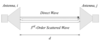
Diagram of general gain extrapolation setup showing the pair of antennas, i and j separated by distance, d. The paths traveled by the direct wave (solid line) and 3rd-order scattered wave (dotted line) are shown.

Radio Frequency Antenna Gain Measuring Apparatus and Measuring Gain of an Antenna

NIST Inventors
Josh Gordon and Benjamin Moser
This invention is an enhanced three-antenna gain extrapolation technique that allows one to determine absolute antenna gain with significantly fewer data points, as few as 10 data points, and at much closer distances, as much as six times closer than the traditional gain extrapolation technique, yet
Description of Patent 11,165,505

Quantum Atomic Receiving Antenna and Quantum Sensing of Radiofrequency Radiation

NIST Inventors
Josh Gordon and Christopher L. Holloway
The invention is a new type of receiving antenna that uses optically excited atoms confined to a vapor cell to sense the strength, direction, and polarization of incoming RF radiation over the frequency range of under 1 GHz to about 1 THz (heretofore this frequency range will be referred to as RF i
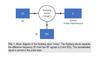
Block diagram of the Rydberg atom "mixer". The Rydberg atoms separate the difference frequency (IF) from two RF signals (LO and SIG). This demodulated signal is carried in the probe laser.

Rydberg Atom Mixer and Determining Phase of Modulated Carrier Radiation

NIST Inventors
Josh Gordon , Christopher L. Holloway and Matt Simons
Rydberg atoms have been shown to be very useful in performing absolute measurements of the magnitude of a radio frequency (RF) field using electromagnetically induced transparency (EIT). However, until this invention, there has been less success in using Rydberg atoms for the measurement of the
Was this page helpful?