

Official websites use .gov
A .gov website belongs to an official government organization in the United States.

Secure .gov websites use HTTPS
A lock (
) or https:// means you’ve safely connected to the .gov website. Share sensitive information only on official, secure websites.


SRI 6011 Josephson Arbitrary Waveform Synthesizer
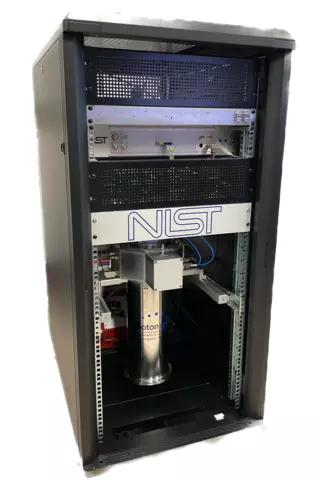
6011 Josephson Arbitrary Waveform Synthesizer (JAWS)
The Josephson Arbitrary Waveform Synthesizer (JAWS) is a primary voltage standard that generates alternating-current (ac) waveforms that have quantum accuracy. The JAWS is an intrinsic standard that derives its accuracy from the Josephson effect via a pulse-driven technique. In this system, a delta-sigma algorithm converts a desired waveform into a high-speed digital pulse pattern. This pulsed pattern is then delivered to an array of thousands of superconducting Josephson junctions. Each individual junction responds to the input pulses by generating a series of output voltage pulses, where each pulse has a quantized time-integrated area equal to the magnetic flux quantum, (where h is Planck’s constant and e is the elementary charge). By controlling the timing of these quantized pulses across the array, the system synthesizes a macro-waveform – typically reaching up to 2 V rms – with a level of precision directly linked to the SI volt.
The JAWS provides the foundation for a "source-based" ac voltage metrology framework. With uncertainties of parts in 107 at 1 kHz, the system is used to characterize high-precision electrical instruments, including:
- AC-DC Transfer Standards: JAWS enables direct, high-precision calibration of thermal voltage converters and thermal transfer standards up to 100 kHz.
- Impedance Metrology: JAWS provides a fundamental source for bridge measurements and the high-precision characterization of capacitance and inductance standards.
- Power Meter Calibrations: JAWS enables the highest accuracy calibrations of standard wattmeters for sinusoidal and distorted power signals over the 50 Hz to 6 kHz frequency range.
Operational reliability is verified by measuring Quantum-Locking Ranges (QLR), ensuring the system remains within the stable operating domain required for high-accuracy-level metrology.
Specifications Certificate (PDF Format)
For SRI 6011 series costs, see below. Only customers with the intention to purchase should contact srminfo [at] nist.gov (srminfo[at]nist[dot]gov) for a formal proforma invoice.
| Instrument | Calibration | Domestic TTI* | Internat'l TTI* | Domestic Total | Internat'l Total | ||
| 6011d | 2V JAWS chip and cryopackage (standalone) | $53,900 | $3,000 | $0 | $0 | $56,900 | $56,900 |
| 6011f | Cryocooled 2V JAWS System (water) | $629,000 | $3,000 | $19,500 | $24,500 | $651,500 | $656,500 |
| 6011g | Cryocooled 2V JAWS System (water, no synthesizer) | $363,600 | $3,000 | $19,500 | $24,500 | $386,100 | $391,100 |
| 6011h | Cryocooled 2V JAWS System (air-cooled compressor) | $631,600 | $3,000 | $19,500 | $24,500 | $654,100 | $659,100 |
| 6011i | Cryocooled Combined 2V JAWS and 10V PJVS System (water-cooled compressor) | $752,300 | $3,000 | $19,500 | $24,500 | $774,800 | $779,800 |
*TTI = Travel, Training and Installation
Technical References:
- A Rüfenacht, N E Flowers-Jacobs, and S P Benz, "Impact of the New Generation of Josephson Voltage Standards in ac and dc Electric Metrology," Metrologia vol. 55, no. 5, pp. S152–S173, Aug 24, 2018 DOI: 10.1088/1681-7575/aad41a
- N E Flowers-Jacobs, A Rüfenacht, A E Fox, S B Waltmann, J A Brevik, P D Dresselhaus, and S P Benz, "Three volt pulse-driven Josephson arbitrary waveform synthesizer," 31st Conference on Precision Electromagnetic Measurements (CPEM 2018) Digest, 8–13 July 2018, Paris, France. DOI: 10.1109/CPEM.2018.8501053.
- S. P. Benz, P. D. Dresselhaus, C. J. Burroughs, and N. F. Bergren, “Precision measurements using a 300 mV Josephson arbitrary waveform synthesizer,” IEEE Trans. Appl. Supercond., vol. 17, no. 2, pp. 864-869, June 2007.
- S. P. Benz and C. A. Hamilton, “A pulse-driven programmable Josephson voltage standard,” Appl. Phys. Lett., vol. 68, pp. 3171-3173, 27 May 1996.