

Official websites use .gov
A .gov website belongs to an official government organization in the United States.

Secure .gov websites use HTTPS
A lock (
) or https:// means you’ve safely connected to the .gov website. Share sensitive information only on official, secure websites.


Immersive Digital Twins for Investigations at Virtual Crime Scenes
Summary
Crime scene investigators currently capture massive amounts of 3D data using terrestrial laser scanners (TLSs), but they lack the tools to take full advantage of the information on traditional flat screens. ForensiTwin addresses this by creating an interactive, virtual reality “digital twin” of the crime scene. The platform allows remotely located experts to step inside and analyze scenes together in virtual reality. This technology can revolutionize how evidence is investigated, how cases are presented to juries in court, and how crime scene investigators are trained.
Description
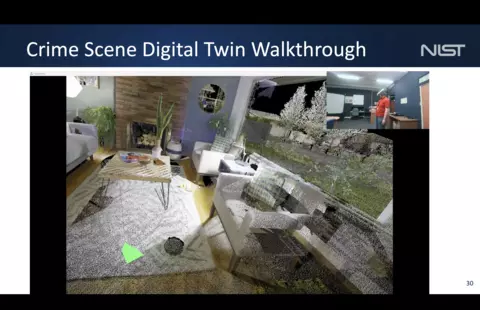
Modern crime scene investigators increasingly rely on 3D TLSs that use LiDAR to document crime and accident scenes, precisely preserving the geospatial relationships of objects within the scene. While these systems have become common, the copious and complex point-cloud data produced currently overwhelms the analytical capacity of traditional two-dimensional visualization systems, and no integrated platform exists to transform this raw spatial data into an actionable, immersive tool for forensic investigators.
This project aims to develop ForensiTwin – an immersive, purpose-built platform that will allow forensic investigators and crime scene analysts to step into a digital replica of a crime scene, overlay computational forensic science data, interact with AI-identified features of forensic relevance, and simultaneously collaborate with experts using virtual reality head-mounted displays. ForensiTwin will improve scene documentation and analysis. Investigators will be able to digitally revisit and reanalyze a scene on-demand. Litigators, judges, and juries will be able to visit a scene to support court deliberations and decisions. Crime scene analysts will be provided with new avenues for training and competency-testing, allowing standardized training and testing environments and customizable scenarios without the costs associated with building, setting, and tearing down physical mock-ups of crime scenes.