

Official websites use .gov
A .gov website belongs to an official government organization in the United States.

Secure .gov websites use HTTPS
A lock (
) or https:// means you’ve safely connected to the .gov website. Share sensitive information only on official, secure websites.


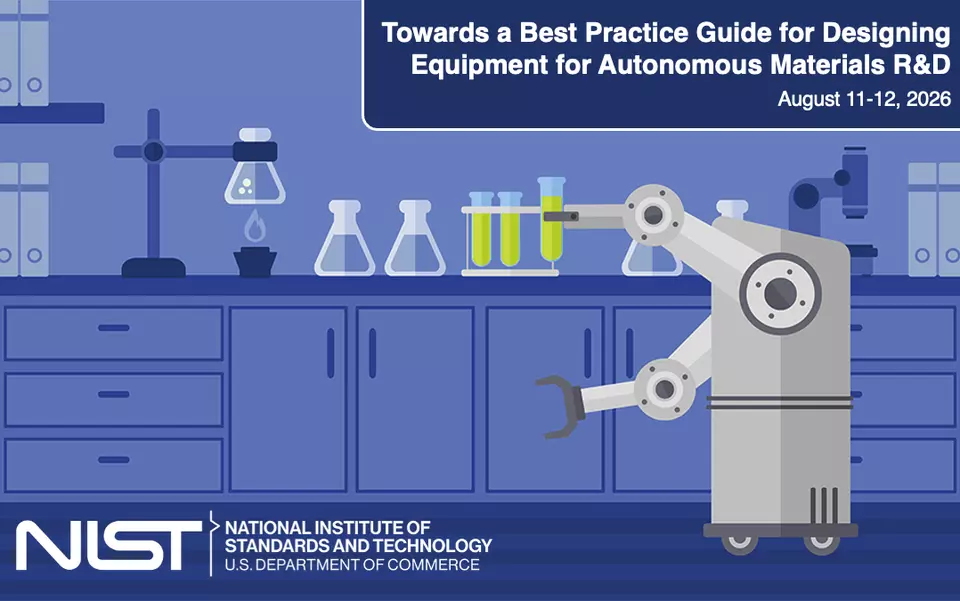
Autonomous and automated experimentation have demonstrated the possibility of accelerating materials research and development by orders of magnitude. As the materials science community transitions toward these highly automated and autonomous laboratory environments, the seamless integration of scientific instrumentation remains a critical challenge. To address this, we are convening a 2-day in-person workshop to develop a Best Practices Guide for Developing Autonomous Materials Instrumentation.
Instrumentation used in autonomous materials laboratories requires consideration unique from traditional laboratory settings. This workshop aims to develop a best practices guide to assist developers and vendors of scientific equipment in designing their instruments to be easily incorporated into automated or autonomous materials laboratory platforms. The workshop, and the living document that will result from it, will primarily focus on tools for synthesis, processing, and characterization of materials. Through implementation of these practices by instrumentation designers and vendors, we aim to lower the investment, in both time and money, required to design and build these platforms, overcoming a major roadblock in their adoption. Decreasing the bespoke nature of these platforms will reduce the amount of redundant engineering and the complexity of handling multiple interfaces from multiple vendors, driving down costs for vendors and end-users of these platforms.
Workshop Objective
The primary goal of this workshop is to bring together stakeholders, including both platform end-users, those with expertise and experience building autonomous laboratory systems, and materials research instrumentation vendors/designers, to draft a living guide to assist instrument developers and vendors in designing instruments, both their hardware and software components, that are easily incorporated into autonomous materials laboratory platforms. Our efforts will focus specifically on tools for the synthesis, processing, and characterization of materials. Objectives of this guide include:
- Defining a community consensus vocabulary
- Establishing levels of hardware interaction
- Examining existing equipment interface standards that are or could be leveraged by the community
Agenda
Morning of 08/11:
- Lay out high-level vision, breakout session to discuss high-level frameworks, and planning for necessary chapters
Afternoon of 08/11:
- Break into teams to work on each chapter
Morning of 08/12:
- Continue working on chapters
- Switch up teams as needed
Afternoon of 08/12:
- Readout of each team's work and planning on next steps to the initial draft publication, including potential remote work sessions