

Official websites use .gov
A .gov website belongs to an official government organization in the United States.

Secure .gov websites use HTTPS
A lock (
) or https:// means you’ve safely connected to the .gov website. Share sensitive information only on official, secure websites.


Reliability of Mechanical Systems in Buildings
Summary
U.S. industry continues to seek improvements in the reliability of the mechanical systems in buildings, particularly their heating, ventilating, and air-conditioning (HVAC) systems, to avert improper operation, lower operating costs, and provide healthier indoor environments. This has created an emergent measurement science employing techniques of expert systems, machine learning, and statistical analysis to detect and diagnose unwanted operating conditions (“faults”) that waste significant amounts of energy and money during daily operation. For the packaged HVAC equipment common to residences and smaller commercial buildings, NIST is answering industry's need to identify, and acquire, the data most useful toward cloud-based fault detection and diagnostic (FDD) techniques able to be implemented on inexpensive Internet of Things (IoT) devices. For large commercial buildings having the scale and complexity of built-up HVAC and control systems, research transferrable to the makers of commercial software products is necessary to have transformative theoretical ideas become practical answers to large building owners’ needs. To that end, NIST has established an open-source software development project opening up FDD research to a broad community of contributors.
Description
Objective
To develop AI-assisted Fault-Detection and Diagnostic tools for reliability and operating cost savings of residential air conditioners (ACs), heat pumps (HPs), and mechanical systems of large commercial buildings.
Technical Idea
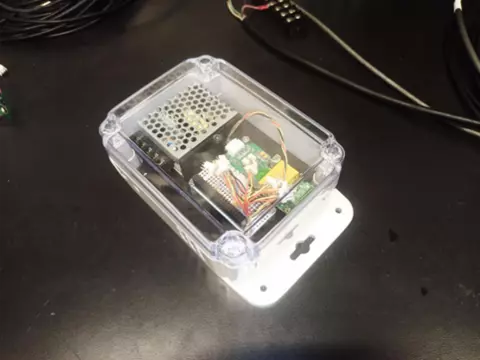
NIST will develop and demonstrate cloud-based FDD methods for AC equipment. The NIST-developed FDD datalogger will stream data to cloud computing resources where machine-learning algorithms will be used to perform FDD. Generalization of these techniques and application of the statistical methods engrained within the FDD algorithms will give U.S. industry opportunities for innovation and will promote faster introduction of this technology into the marketplace. These FDD methods are applicable to residential and commercial AC systems and any systems that operate on the vapor-compression principle. Utilities and other energy providers may also be interested in monitoring and mitigating high energy use caused by faulty AC operations in both the residential and commercial sectors. This work is needed to provide data, show methods for using this data, and possibly help utilities reduce demand/load by finding and fixing high energy usage due to AC faults. NIST is uniquely situated to offer real performance data to manufacturers and developers, filling the void that now exists for heat pumps and air conditioners.
Addressing the faulty reliability of mechanical systems in large commercial buildings requires software specialized for AFDD research. This project establishes ZandrEATM both as a public, open-source software implementation of AFDD, and as the basis of an ongoing, collaborative project where a broad, open community of NIST and academic researchers, business-sector product developers, and individuals can experiment on novel ideas for AFDD in commercial buildings and contribute transferrable technology to the private sector producing AFDD products and services. The NIST Intelligent Building Agents Laboratory (IBAL) offers contributors a realistic, yet fully controllable, platform for experiments that ZandrEA enables.
Research Plan
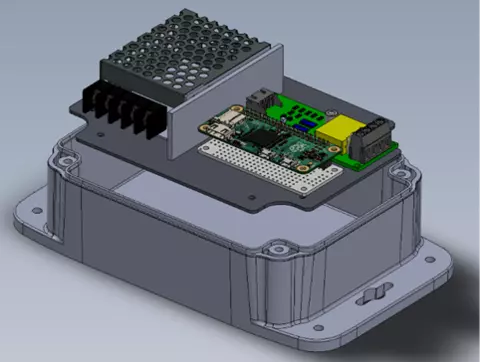
A Small Business Innovative Research (SBIR, Contract #: 70NANB14H292) positioned NIST with new skills and innovative uses of IoT devices for making field measurements. NIST took these new skills and developed a new datalogger that is cheaper than the SBIR prototype, easier to program, uses a full version of Python, has larger memory/storage space, and has a more readily available offering of open-source code. In FY26, we will deploy the new datalogger to conduct measurements on field-installed, human-occupied residential and commercial buildings. The newly developed datalogger will send data to the cloud; we will debug this process and learn how to leverage cloud-based services to perform near real-time FDD. A quick response to faulty operations will allow stakeholders to make decisions on when or if a fix is economical. We will produce a NIST report detailing the specifications and construction of the datalogger to enable replication.
NIST will promote ZandrEA as a public, open-source software development project supporting research yielding practical benefits from techniques of machine learning. In answering the scale and complexity of the large building AFDD problem, NIST is using ZandrEA to introduce an AFDD approach integrating the Bayes theorem with expert system methodology. NIST will refine that approach and investigate reliable integration of human-machine interfaces based on large language models (LLM). Collaborators or CRADA partners can also advance ZandrEA applications toward being scalable, extensible AFDD microservices web-accessible through graphical or LLM interfaces. This realistic emphasis on current and emerging applications enhances value from ZandrEA-based research. Laboratory and field test results put relevance upon the theoretical algorithms explored and identify further capabilities that ZandrEA should be given.
Major Accomplishments
A new prototype datalogger for vapor compression systems with enhanced data security and encryption, approved by NIST OISM for field deployment. AWS IoT Framework has been used to construct a logging dashboard to save data from multiple dataloggers. This will allow more data to be efficiently collected on multiple systems that are of interest to FDD developers.
Public availability of the ZandrEA open-source AFDD software development site at https://github.com/usnistgov/ZandrEA and the publication of NIST Technical Note 2337.
Completed a cooperative research and development agreement (CRADA) with a venture-capitalized U.S. tech industry partner engaged in AFDD for large commercial buildings.