

Official websites use .gov
A .gov website belongs to an official government organization in the United States.

Secure .gov websites use HTTPS
A lock (
) or https:// means you’ve safely connected to the .gov website. Share sensitive information only on official, secure websites.


Safer Flight Takeoff and Landing
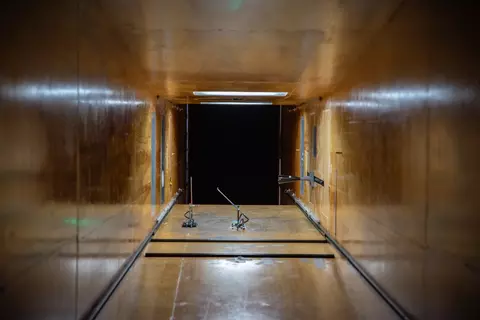
View from inside the NIST wind tunnel with anemometer setup in progress.
Every airplane has at least one airspeed sensor (also known as an anemometer), a necessary tool that helps pilots safely operate the aircraft. The lift that keeps an airplane aloft is created as wind rushes over its wings, so knowing that airspeed is crucial for maintaining lift. While GPS navigation systems can determine a plane’s ground speed, airspeed is the metric of success for lifting the plane into the sky and helping it descend to a safe landing.
Specifically for landing, it is crucial to approach a runway with as little ground speed as possible for a smooth contact with the ground. But it is a balancing act between lowering ground speed and maintaining the lift for a controlled landing. Airspeed sensors keep pilots in control during the descent, so it’s essential that the sensors are regularly calibrated to ensure accuracy.
Just about every airspeed sensor in the United States can trace its calibration back, either directly or indirectly via calibration laboratories, to a wind tunnel on NIST’s Gaithersburg, Maryland, campus.
In addition to aviation, airspeed sensors serve a number of other purposes, such as:
- Measuring airflow in mineshafts to ensure clean air for workers inside
- Managing ventilation in hospitals and cleanrooms
- Reducing harmful emissions from power plant smokestacks