

Official websites use .gov
A .gov website belongs to an official government organization in the United States.

Secure .gov websites use HTTPS
A lock (
) or https:// means you’ve safely connected to the .gov website. Share sensitive information only on official, secure websites.


My Introduction to Laboratory Metrology: NIST Summer Undergraduate Research Fellowship (SURF) Program
Dominick Mendez | School: University of Maryland – Baltimore County
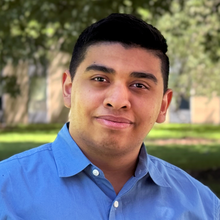
Credit: J. Lee/NIST
I heard about the National Institute of Standards and Technology (NIST) Summer Undergraduate Research Fellowship (SURF) Program during high school and am glad to have been able to lend my skills to the Office of Weights and Measures (OWM) Laboratory Metrology Program. Through the SURF Program, I analyzed and tracked the stability of OWM-owned Proficiency Testing (PT) equipment over time using spreadsheet tools. This experience not only aided my skills in data analysis but also displayed how skills carried over from personal projects can also become foundational building blocks for real change, helping push STEM in meaningful ways.
My first couple weeks of SURF focused on brainstorming, discussing, and introducing myself to the OWM Physical Scientists, while understanding how to improve the Laboratory Metrology Program tools. Eventually, I landed on artifacts used in PTs as an interesting topic that really hooked me into my project. Since these artifacts are key in a PT as a standard value that all laboratories must measure, the idea that these artifacts, just like any item, can become unstable through both physical and chemical means made it intriguing to work with, both in its data and physically during the first couple weeks. It was truly a pleasure to see the metal weight kits, provers, and glassware that OWM had to offer to laboratory metrologists around the U.S.

Through workshopping multiple drafts and getting constructive critiques from laboratory metrologists in my group, I was able to complete a workbook that takes PT data and visualizes it in the form of X-bar, R-bar, and S-bar control charts that offer a glimpse of the stability of the processes. Under the assumption that these processes are alike in each PT given the similar Standard Operating Procedures (SOPs), we can presume that a high/low PT in both average and standard deviation with a failing F-ratio test means there is causal analysis that needs to be done to the artifact itself to prove stability.
Despite most of my time being spent on analyzing data and building macros for the workbook’s functionality, I did learn a couple of important values outside of my office space. The connections and friends that I made here with the SURF Program, both aiding me in the progress of my stability analysis and boosting my morale, helped me understand how necessary close relationships are in a productive workspace. I am genuinely thankful for not only the Physical Scientists at OWM who hosted my project and taught me about metrology with open arms and ears, but my fellow SURF members who invited me to check on their work, and learn about educational resources, robotic machinery, and lab spectroscopy. No matter what skill you had, it felt like you were helpful here at NIST, never unproductive in your work.

Reflecting on it now, I came into SURF with one main goal, which was to learn for the betterment of others. To me, that aligns with my career path of becoming a professor of chemistry. Was I nervous about the new experience? Of course. Did I accomplish my goal? Well, I cannot say that for sure. There is so much more that I could learn about fields inside and outside OWM, and I’m glad that my project will help move the needle of understanding for those in my group. I hope that moving forward, I will be able to offer more insight into analysis projects, not only with someone with the relevant skillset, but as a connection with ensuring input.
Thank you so much, OWM. My future students will hear so much about you.