

Official websites use .gov
A .gov website belongs to an official government organization in the United States.

Secure .gov websites use HTTPS
A lock (
) or https:// means you’ve safely connected to the .gov website. Share sensitive information only on official, secure websites.


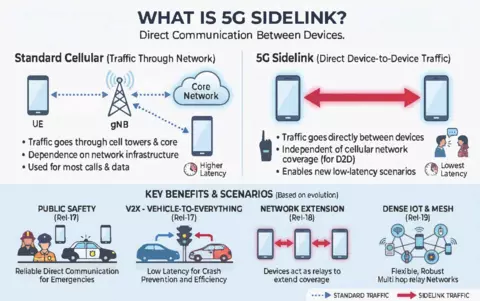
A wildfire burns through a mountain ridge, taking out all network infrastructure. Firefighters are left in a steep canyon, spread across 15 kilometers, with no network. They switch their LMR radios into direct mode, but the canyon walls block line-of-sight and cut their range to a kilometer or two at best, with no way to see where anyone is. Their broadband devices are capable of far more, mapping, video, real-time location, but infrastructure failure has reduced them to voice alone.
Land Mobile Radio (LMR) has been a first responder staple for decades because, even though it typically runs on its own network, it can still operate in direct mode when that network is unavailable. In broadband this capability is referred to as Device-to-Device (D2D) communication, the umbrella term for any connection made without a network. D2D functionality is imperative for communication when networks are unavailable, in basements, canyons, and remote areas. While LMR radios are able to communicate at much greater distances they do not have mapping, video, telemetry, and the real-time location capabilities that broadband provides. Responders end up with two incompatible halves of one requirement: radios that work anywhere without data, and devices that carry everything but need a network.
5G Sidelink is the physical radio layer, the waveform and protocols moving bits directly between devices. 5G ProSe (Proximity Services) sits above it, managing authorization, discovery, and group session setup. Sidelink and ProSe are still maturing and advancing them requires a unified approach to measurement science, combining foundational simulation, global standards leadership, and real-world performance metrics to ensure 5G Sidelink delivers the reliability first responders depend on. As the U.S. National Metrology Institute, NIST supplies the vendor-neutral measurement science that maturation requires.
Modeling and Simulation
CTL’s Wireless Networks Division (WND) designs link-level and system-level simulators that model direct radio behavior under varying conditions. These tools, including the 5G NR link-level simulator and a family of ns-3 modules, are publicly released, giving developers and researchers a common baseline for evaluating Sidelink designs. Results shape global standards and translate operating guidelines that give public safety agencies concrete deployment parameters.
Planned Field Evaluation
As prototypes become available, CTL will move from simulation into physical testing through the Public Safety Communications Research (PSCR) Division, applying PSCR's testing standards to understand overall technological performance. PSCR’s expertise in Mission-Critical Voice Quality of Experience applies directly to early hardware. Planned long-range testing at Table Mountain will measure D2D performance out to 2.5 kilometers, along with research to measure how interior structures such as walls and building materials affect overall performance. Results will feed back into WND’s models, isolating baseline capability and determining signal range bounds.
Characterizing the Limitations
CTL’s modeling has identified constraints that will shape deployment.
- Physical Range. WND simulations place current practical range under one kilometer for 5G Sidelink, versus LMR’s ability to communicate at ranges exceeding 4.8 kilometers in direct mode.
- Performance Bottleneck. Multi-hop relay extends range substantially, but every hop consumes shared spectrum resources, increasing traffic load and degrading performance.
- Hardware Availability. Without commercial Sidelink devices, simulation bears the analytical burden while the physical ecosystem catches up.
Sidelink’s advantage is providing broadband data over an infrastructure-free link and relay topologies that extend reach well beyond any one device. This reach includes locations where devices cannot see satellites, such as urban canyons, mountains and deep valleys, and basements. Sidelink and NTN can work together to provide broader access in previously inaccessible areas.
Closing the Gap
This work is not freestanding. CTL has established five research pillars to guide research in 6G Communications, one focusing specifically on making next-generation systems more robust. The pillar states that without multi-hop capability, Sidelink risks becoming an underutilized technology that leaves mission-critical networks exposed to coverage holes. It also notes that very few industry or academic organizations work in this area, precisely the gap a neutral national laboratory exists to fill.
Advanced topologies chart the path forward: drone-mounted communication relays, network-to-Sidelink range extenders, off-grid mesh networks, and Non-terrestrial (NTN) integration. WND and PSCR’s 5G Sidelink work provides first responders with reliable and tested capabilities they can trust.