

Official websites use .gov
A .gov website belongs to an official government organization in the United States.

Secure .gov websites use HTTPS
A lock (
) or https:// means you’ve safely connected to the .gov website. Share sensitive information only on official, secure websites.


NIST Reference Material Offers Reliable Benchmark for H5N1 Outbreak Detection
Reference Material 8038 H5N1 (Avian Influenza) Synthetic RNA Fragments
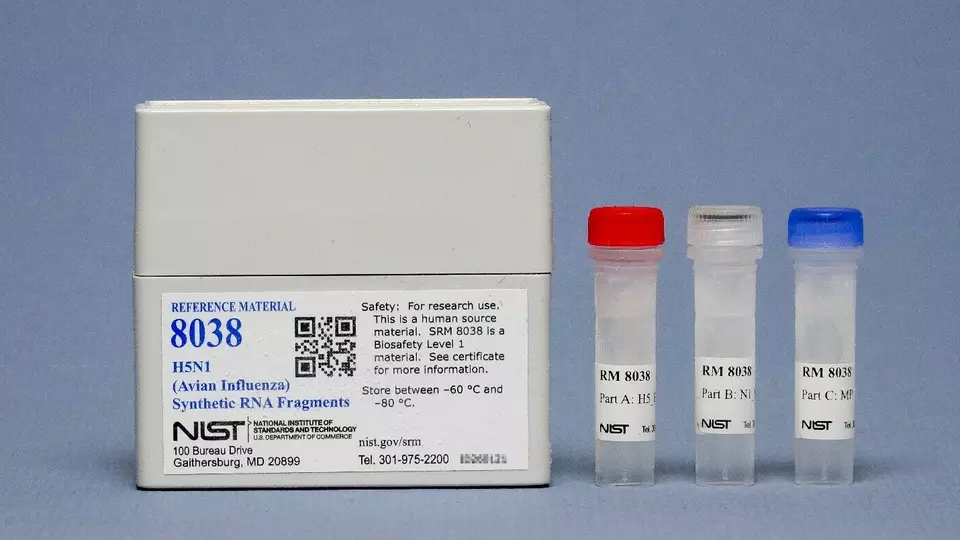
To support national disease surveillance, NIST provides tools that verify the accuracy of diagnostic tests for both manufacturers and labs. Reference Material (RM) 8038 serves as a quality-control standard to ensure reliability in H5N1 (avian influenza) testing.
H5N1, commonly called bird flu, causes widespread viral infection in birds. Recent spillover events in mammals have caused outbreaks in cows and humans, among infections in other animals. This virus is highly contagious in birds, and major outbreaks have occurred that have wiped out entire flocks of domestic poultry. H5N1 is among the influenza A subtypes that humans can catch from contact with an infected animal. H5N1 poses a risk to the food supply, wildlife, and human health.
Using RM 8038, scientists can verify that their diagnostic tests are accurate and precise enough to correctly identify H5N1. Reliable testing measures are essential for early identification and containment of outbreaks. RM 8038 consists of synthetic RNA fragments that match key genetic regions of the H5N1 virus. Sequences for each RNA were derived from the A/American Wigeon/South Carolina/22/2021 virus isolate and encode the H5 hemagglutinin (H5_HA), N1 neuraminidase (N1_NA), and matrix proteins 1 and 2 (MP) gene segments.
A unit of RM 8038 consists of one vial each of three RNA materials: Part A: H5_HA, Part B: N1_NA, and Part C: MP. Each vial contains approximately 100 μL of RNA in a background of 5 ng/μL Jurkat RNA in a buffered solution.