

Official websites use .gov
A .gov website belongs to an official government organization in the United States.

Secure .gov websites use HTTPS
A lock (
) or https:// means you’ve safely connected to the .gov website. Share sensitive information only on official, secure websites.


- The protective clothing worn by firefighters often contains a class of chemicals called PFAS.
- Exposure to PFAS, also known as “forever chemicals,” has been linked to negative health outcomes.
- In the fourth of an ongoing series of reports, NIST shows that wear and tear increased the levels of PFAS found in hoods and gloves, but it decreased the levels found in wildland gear.
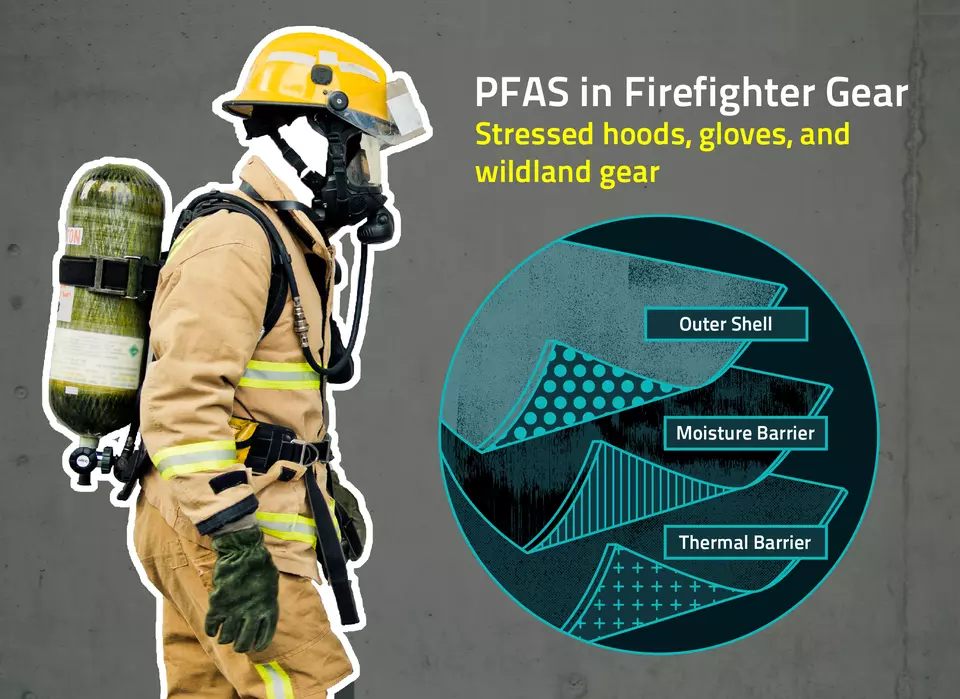
A firefighter’s protective clothing is composed of three distinct layers made of different textiles. In response to concerns about the gear possibly exposing firefighters to PFAS chemicals — several of which have been linked to cancer — NIST researchers investigated the presence of the chemicals in textiles used to make the layers. This latest study analyzed how wear and tear affects the amount of PFAS in hoods and gloves worn in structural fires as well as protective clothing worn to fight wildfires.
One of the first steps in addressing health concerns is measurement. For firefighters, one health concern is that their gear commonly contains per- and polyfluoroalkyl substances (PFAS), also called “forever chemicals” because they don’t break down naturally in the environment. Since 2021, researchers at the National Institute of Standards and Technology (NIST) have been systematically measuring PFAS concentrations in firefighter equipment. In their latest report, published this week, they examined how wear and tear affected PFAS in firefighting hoods and gloves used to fight structure fires, and in gear used for forest or “wildland” fires. They found that wear and tear significantly increased the levels of PFAS found in hoods and gloves but decreased them in wildland gear.
Firefighters wear special protective clothing to help keep them safe in their line of duty. Water conducts heat, so it’s important that these garments keep firefighters dry. PFAS, which have also been used in nonstick pans and raincoats, are excellent at repelling liquids, which is why they are sometimes used to treat firefighter clothing for moisture resistance.
Exposure to high concentrations of PFAS has been linked to cancer, and awareness of the risks is growing. Studies suggest that firefighters have higher rates of cancer than the general population, though that is not necessarily due to PFAS exposure specifically.
Congress called on NIST to measure PFAS in firefighter gear through the 2021 National Defense Authorization Act. “At that time, there were no measurements of how much PFAS was in this equipment,” said Rick Davis, the project leader for NIST’s reports on PFAS in firefighter gear. “Making those measurements is a crucial starting point for understanding and addressing the problem.”
The NIST studies do not assess the health risks that firefighters might face due to the presence of PFAS in their gear. However, they provide previously unavailable data that toxicologists, epidemiologists and other health experts can use to assess those risks. Taken together, these reports provide a baseline for the levels of PFAS present in firefighter gear, and they lay out a standardized way to measure these chemicals to make improvements over time.
This latest study focused on three types of equipment: wildland gear, structural hoods and structural gloves. Wildland gear consists of a lightweight coat, shirt and pants worn while fighting wildfires. The hoods and gloves are called “structural” because they are the kind used to fight fires in buildings.
The previous study measured the levels of PFAS in these materials when they were new. This study looked at how different kinds of routine wear and tear might change the amount of PFAS measured in these materials.
More NIST Research on Chemicals in Firefighter Gear
- NIST’s first report, in 2023, measured PFAS in coats and pants for structural fires.
- The second report measured how simulated wear and tear changed PFAS levels in the same coats and pants from the first report.
- The third report measured PFAS in hoods and gloves for structural fires and in gear for wildland fires.
The materials underwent three different tests based on the stresses they’re likely to undergo in the field: abrasion, heat and weathering. Hoods and wildland gear were systematically abraded to simulate general damage that happens when the fabric rubs against itself as the firefighter moves around. A sample of each fabric was rubbed with a wool pad at a standardized speed and pressure 20,000 times or until the test fabric fell apart. Gloves were not tested for abrasion because they have thick outer layers that are unlikely to be worn away with regular use.
To simulate the temperatures a firefighter might encounter inside a burning building, the researchers placed the hood and glove samples in a convection oven for five minutes at around 260 C (500 F). Wildland gear is not designed to withstand the same kind of intense heat as indoor firefighting gear, and so it was not tested for heat exposure. However, wildland gear is expected to withstand a lot of time in the wilderness, and so the NIST researchers simulated long-term outdoor weathering on the wildland gear by exposing it to intense bouts of UV light and moisture.
After each treatment, the PFAS concentrations were measured through a process called liquid chromatography-mass spectroscopy. The results of the study were mixed. PFAS concentrations measured in firefighter gloves increased after heat treatment. Similarly, measured PFAS in hoods increased after both abrasion and heat treatment. On the other hand, PFAS measured in wildland gear decreased after abrasion and weathering. The changes may have occurred because the wear and tear released more PFAS from the fabric, or because the PFAS were chemically altered into a different type of PFAS, increasing or decreasing the specific types the study was designed to measure. (Although there are thousands of known PFAS, this study only measured 56 of them because they are the most well researched and relevant to possible health concerns.)
These results suggest that wear and tear can have a significant impact on measurable PFAS in this equipment. In future studies, the NIST research team plans to measure other potentially dangerous chemicals like fluorine and bromine. In the meantime, as PFAS awareness grows, changes are already beginning to take shape in the industry. Several firefighter equipment manufacturers have begun selling equipment advertised as PFAS-free.
“Accurate and reliable measurements will continue to be important as the industry changes,” said Andre Thompson, the lead author on this study. “The work NIST has done could help set a baseline for how these new products can be measured and compared under a variety of conditions.”
Report: Andre L. Thompson et al. Per- and Polyfluoroalkyl Substances in Stressed Structural Firefighter Gloves and Hoods, and Wildland Firefighter Coats, Shirts, and Pants. NIST Technical Note 2375. May 2026.