An official website of the United States government
Here’s how you know
Official websites use .gov
A .gov website belongs to an official government organization in the United States.
Secure .gov websites use HTTPS
A lock (
) or https:// means you’ve safely connected to the .gov website. Share sensitive information only on official, secure websites.

A new nanoscale apparatus developed at JILA—a tiny gold beam whose 40 million vibrations per second are measured by hopping electrons—offers the potential for a...
BOULDER, Colo.—Physicists at the Commerce Department's National Institute of Standards and Technology (NIST) have taken the first ever two-dimensional pictures...
The massive global challenge of storing digital data—storage needs reportedly double every year—may be met with a tiny yet powerful solution: magnetic particles...
International time coordination is improving throughout the Americas thanks to a low-cost system relying on Global Positioning System (GPS) satellites and the...
Before carbon nanotubes can fulfill their promise as ultrastrong fibers, electrical wires in molecular devices, or hydrogen storage components for fuel cells...
The bull's-eye solution to the semiconductor industry's hunt for more exact means to measure the relative positions of ever-tinier devices squeezed by the...
The American Physical Society (APS) has named National Institute of Standards and Technology (NIST) physicist Kent Irwin as the recipient of the society's 2007...
The American Physical Society (APS) announced last week the selection of National Institute of Standards and Technology (NIST) physicist Jun Ye, to receive the...
Five senior members of the National Institute of Standards and Technology (NIST) staff have been honored in the 2006 Presidential Rank Awards. The awards...
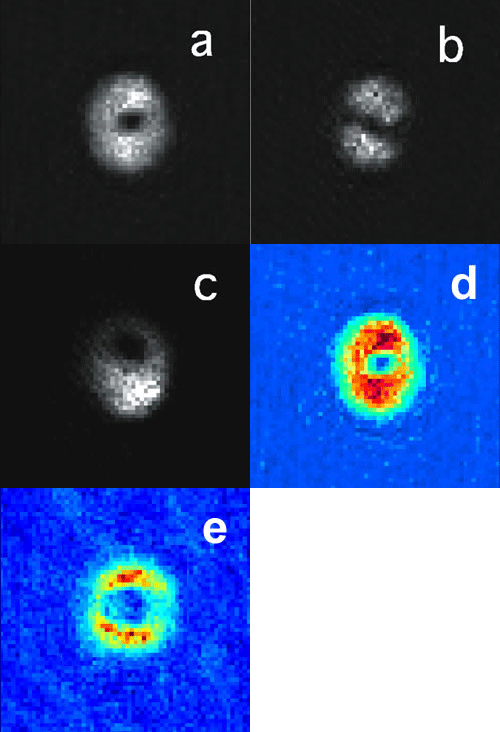
For the first time, tornado-like rotational motions have been transferred from light to atoms in a controlled way at the National Institute of Standards and...
Thomas R. O'Brian, chief of the Time and Frequency Division at the National Institute of Standards and Technology (NIST), has been appointed director of the...
BOULDER, Colo.—Physicists at the Commerce Department's National Institute of Standards and Technology (NIST) have taken a significant step toward transforming...
A wide range of optical electronic devices, from laser disk players to traffic lights, may be improved in the future thanks to a small piece of semiconductor...
Researchers at the National Institute of Standards and Technology (NIST) have made the first confirmed "spintronic" device incorporating organic molecules, a...
Dr. William D. Phillips, the first researcher from the National Institute of Standards and Technology (NIST) to become a Nobel Laureate, has been awarded the...
Working under severe time pressure, government laboratories can analyze radioactive samples fairly quickly—in a matter of hours—but with variable accuracy, and...
A new design for a microwave oscillator that is smaller, simpler, and produces clearer signals at a single frequency than comparable devices has been invented...
COLLEGE PARK, Md. – Today, the University of Maryland (UM), the Commerce Department's National Institute of Standards and Technology (NIST), and the National...
GAITHERSBURG, MD –Scientists at the Commerce Department's National Institute of Standards and Technology (NIST) have used a beam of electrons to move a single...
The White House has announced that two researchers at the National Institute of Standards and Technology (NIST) are among the 56 recipients of the 2005...
Increasingly, medical and pharmaceutical researchers are looking to biomedical imaging as a tool to track disease progress, speed drug discovery and improve...
After 10 years of research, the National Institute of Standards and Technology (NIST) has unveiled the world's first precision instrument for directly measuring...
Researchers at the National Institute of Standards and Technology (NIST) have demonstrated the use of water droplets as minuscule "boxes" for small numbers of...
BOULDER, COLO.—An experimental atomic clock based on a single mercury atom is now at least five times more precise than the national standard clock based on a...
Physicists at the National Institute of Standards and Technology (NIST) have designed and built a novel electromagnetic trap for ions that could be easily mass...