

Official websites use .gov
A .gov website belongs to an official government organization in the United States.

Secure .gov websites use HTTPS
A lock (
) or https:// means you’ve safely connected to the .gov website. Share sensitive information only on official, secure websites.


NIST Gasification Apparatus
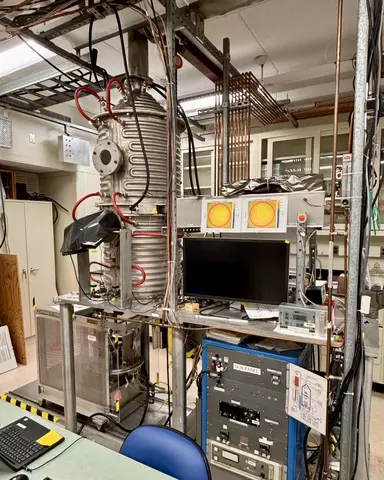
Experimental apparatus used to determine the gasification rate (mass loss rate) of a horizontally oriented specimen exposed to a controlled radiant heat flux in a nitrogen environment using a cone-shaped heater.
The NIST Gasification Apparatus was originally designed and built at EL in the late 1990s to expose solid or liquid samples to a uniform heat flux in a non-oxidizing or partially oxidizing atmosphere. It offers a stable, well-characterized environment for the study of heat transfer through materials and the anaerobic decomposition of pyrolyzable solids.
In the 2020s, the NIST Gasification Apparatus was refurbished (multiple system components were upgraded or replaced), recalibrated, and brought back online to enable the study of:
- Decomposition behavior of ‘MaCFP-PMMA’ (validation dataset provided in support of the Measurement and Computation of Fire Phenomena Working Group, MaCFP)
- Variability in decomposition behavior of multiple commercially-available poly(methylmethacrylate) (PMMA) samples and identification of potential replacement candidates for MaCFP-PMMA
- Heat transfer through materials relevant to structural fire protection applications
This apparatus allows for the study of gasification rate (mass loss rate) of a horizontally oriented specimen exposed in a nitrogen environment to a controlled radiant heat flux from a cone-shaped heater. These non-flaming conditions allow the condensed-phase gasification processes to be de-coupled from complicating gas-phase processes; permit a better estimate of the actual incident heat flux that is producing the fuel gas; and provide a much better view of surface phenomena during degradation (e.g., bubbling, charring).
The cylindrical chamber is 0.61 m in diameter and 1.70 m in height. Two windows provide optical access. The chamber's interior walls are blackened and water cooled to 25 EC to minimize indirect heating of the specimen. The cone-heater temperature is usually fixed at 810 C to maintain a constant emission spectrum; as of 2022, flux levels vary by less than 3% across the surface of a 7 cm diameter sample.
A water-cooled shutter is extended to protect the sample from the incident heat flux prior to testing: it also can be used to quickly halt the exposure at any time to "freeze" the remaining sample for subsequent chemical/physical analysis. Product and ambient gases are removed via an exhaust duct by a constant nitrogen flow. Degradation products can be collected above the specimen's surface and condensed in a cold trap for further chemical analysis.