U.S. flag

An official website of the United States government

Official websites use .gov
A .gov website belongs to an official government organization in the United States.

Secure .gov websites use HTTPS
A lock ( ) or https:// means you’ve safely connected to the .gov website. Share sensitive information only on official, secure websites.

Projects/Programs

Displaying 1 - 13 of 13

Building System Economics

Ongoing
Objective To develop and deploy transparent, open source standards-based data and tools that quantify the life-cycle performance of building technologies and systems through parallel activities focused on developing, releasing, and expanding capabilities and adoption of: (1) the Economic Evaluation...

Electron-Beam Irradiation of Solar Cells

Ongoing
NIST irradiates solar cells that are manufactured by leading developers of high-efficiency solar photovoltaic cells for space applications. As part of the space-qualification process, the performance of these cells in a space environment must be validated. This validation process includes the...

Multiscale structure and dynamics in advanced technological materials

Ongoing
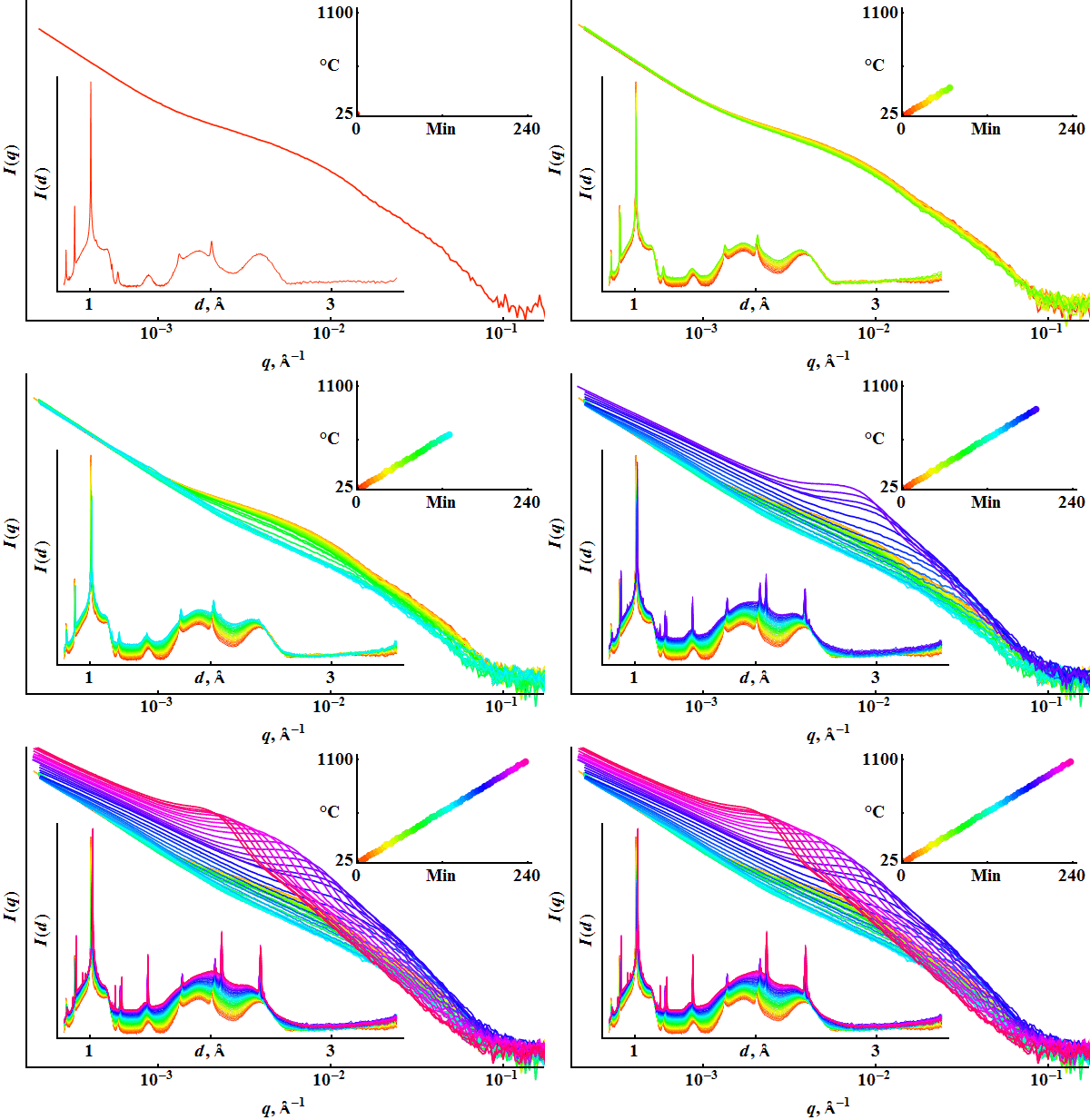
New technologies increasingly harness materials phenomena that operate across many length-scales: e.g., in selective gas adsorption, additive manufacturing, new alloy designs, or advanced concretes. To overcome technology barriers, it is no longer sufficient just to characterize the materials...

Portable Field Test Standard for Evaluation of Hydrogen Gas Dispensers

Completed
This project provides a metrological tool and standards supporting the fair trade of hydrogen gas as a vehicle fuel of the future. Objective(s): The Fluid Metrology Group (FMG) and the Office of Weights and Measures (OWM) collaborated in designing, constructing, and testing a hydrogen gas dispenser...

Power Conditioning Systems for Renewables, Storage, and Microgrids

Ongoing
Objective: To establish standards and measurement methods, and test for smart grid and microgrid Power Conditioning Systems needed to transition from today’s low penetration of nondispatchable intermittent renewable energy sources to flexible grid operations that can actively adjust to varying grid...

Smart Grid Interoperability Testbed Facility

Ongoing
Objective - To develop and progress an advanced multi-mode interacting measurement testbed that leverage cross-OU expertise to facilitate implementation, validation, and full characterization of smart grid interoperability standards and smart grid performance, with a particular emphasis on DER...

Smart Grid Program

Completed
Objective: To develop and demonstrate advances in measurement science to enable integration of interoperable and secure real-time sensing, control, communications, information and power technologies, in order to increase the system efficiency, reliability, resiliency and sustainability of the nation...

Smart Grid System Testbed Facility

Completed
Objective: To develop an advanced multi-mode interacting measurement testbed to facilitate implementation, validation, and full characterization of smart grid interoperability standards and smart grid performance. What is the technical idea? An interacting multi-mode measurement and characterization...

Standards Development to Ensure Reliable Breath Analysis in the Field

Ongoing
Numerous volatile organic compounds (VOCs) have been identified in human breath. These compounds can be produced by the body or by organisms in the body (e.g., bacteria or viruses) and provide a non-invasive window into human health. Inexpensive point-of-care devices are being developed to diagnose...

Sub-nanoscale electron microscopy of complex nanostructures

Ongoing
The properties of advance materials are becoming ever more reliant on the ability to manipulate their chemistry and structure at very fine length scales. For example, the relevant feature sizes in state-of-the-art transistors continue to decrease, even as the complexity of the architectures employed...

Theory and Modeling of Materials for Renewable Energy

Completed
Nanostructured materials offer potential benefits for a range of renewable energy applications that rely critically on interfaces for separating charges, including photovoltaics, thermoelectrics, and electrochemical energy storage. The use of nanostructures allows scientists and engineers to...
Was this page helpful?