An official website of the United States government
Here’s how you know
Official websites use .gov
A .gov website belongs to an official government organization in the United States.
Secure .gov websites use HTTPS
A lock (
) or https:// means you’ve safely connected to the .gov website. Share sensitive information only on official, secure websites.

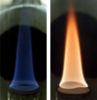
This project provides insights into the role of particle formation in limiting the effectiveness of gas-phase, phosphorus-based fire retardants when added to polymers.
DEVICES AND APPLICATIONS Smoldering and Flaming Heats of Combustion (∆Hc,char and ∆Hc,gas): Repeated tests were performed using a microscale combustion calorimeter (MCC) to independently measure the heat of combustion of flaming combustion (∆Hc,gas) and the heat of combustion of char oxidation (∆Hc...
This project enables low-flammability products without flame retardants by providing methods to assess functional barriers, advancing their performance, and exploring their use in multi-layer products for critical applications.
This project develops a database that includes tools, measurement data, material properties, and validation data to enable quantitative prediction of material flammability behavior, such as ignition, steady burning, and fire growth.
Perfluorinated and polyfluorinated alkyl substances (PFAS) constitute a family of compounds that are distinguished by partial or complete fluorination of alkyl hydrocarbons. Dubbed “forever chemicals”, the unique chemistry of PFAS imparts a high level of stability, making the compounds resistant to...
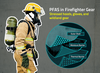
This project advances tools and methods to analyze per- and polyfluoroalkyl substances (PFAS) in firefighter gear and workplaces, supporting the development of standards, policies, and best practices to reduce firefighter PFAS exposure.
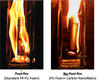
By 2015, this project aims to develop measurement science for (1) designing low-fire hazard soft furnishings using low-heat release, cost-effective, EHS-compliant nanoparticle fire retardant foam, (2) assessing the EHS attributes of nanoparticle fire retardants for polymer systems, and (3) creating a reference polyurethane foam with reproducible smoldering mass loss.
Firebrand Yield Between December 2019 and January 2020, 14 full-scale experiments were conducted at the University of Maryland in collaboration with NIST to measure variations in burning behavior and firebrand yield (i.e., mass of firebrands generated per total mass lost: ) as full-scale vegetation...