U.S. flag

An official website of the United States government

Official websites use .gov
A .gov website belongs to an official government organization in the United States.

Secure .gov websites use HTTPS
A lock ( ) or https:// means you’ve safely connected to the .gov website. Share sensitive information only on official, secure websites.

Blog Search

Displaying 651 - 675 of 2773

Andrew Regenscheid

Andrew Regenscheid is a project lead for applied cryptography within the Computer Security Division at NIST. In his 15 years as part of the Cryptographic Technology Group, Andrew has worked to apply cryptographic algorithms and tools to improve the security of computer platforms, communication protocols, and authentication mechanisms. As the technical lead for the Personal Identity Verification standards program, Andrew is responsible for developing identity management standards and technical guidelines for federal government employees and contractors, while also contributing to NIST’s broader portfolio of digital identity guidance as a coauthor of NIST SP 800-63. 

Nelson Hastings

Nelson Hastings is the leader of the Cybersecurity and Privacy Applications Group of Applied Cybersecurity Division within NIST’s Information Technology Laboratory. Over his 20 plus years at NIST, he has worked in the areas of public key infrastructure, cryptographic module validation, and cybersecurity for public safety communications, voting systems, and smart grid. His group’s portfolio includes NIST’s privacy engineering program, small business cybersecurity outreach, digital identity guidance, and cybersecurity for public safety communications, voting systems, industrial control systems, internet of things, and smart grid.

Gema Howell

Gema is a Computer Scientist within the Applied Cybersecurity Division at NIST. She works at the NCCoE to create reference architectures for enterprise mobile device deployments. Gema also researches methods to improve the security of mobile phones and wearables tailored to first responders. As the cybersecurity lead on the NIST Voting Team, Gema assisted in the development of the Voluntary Voting System Guidelines (VVSG) 2.0 Principles and Guidelines and drafted accompanying VVSG 2.0 requirements.​

image of Gema Howell

Greta Babakhanova

Greta Babakhanova is a physicist in the Biomaterials Group of the Biosystems and Biomaterials Division at the National Institute of Standards and Technology in Gaithersburg, Maryland. Her background is in soft matter physics and imaging. Her current research focuses on quantitative and nondestructive cell viability measurements in two- and three-dimensional structures that mimic biological tissue for tissue engineered medical products.

Greta Babakhanova

New Website Immediately Increases Leads

For more than 50 years, Quality Patterns, Inc., a family-owned and operated company in New York City, has serviced clothing designers with its marking, grading

Ronald Pulivarti

Ronald Pulivarti is a senior cybersecurity engineer who leads an engineering team at the National Cybersecurity Center of Excellence (NCCoE), which is part of the National Institute of Standards and Technology (NIST). He and his team promote the acceleration of businesses’ adoption of standards-based, advanced cybersecurity technologies for the health-care sector. Ron has a strong technical background and cybersecurity experience in multiple high-value-asset applications. Prior to NIST, he worked within the Department of Health and Human Services and has served in many IT leadership roles for over 20 years.

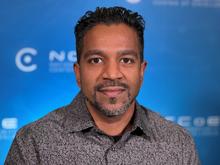
Ronald Pulivarti poses for a picture in front of an NCCoE backdrop.

How Secure Is Your DNA?

Is genomic data distinct from other data types? How should cybersecurity protection be tailored to genomic data? NIST is working to find the answers.

Cherilyn Pascoe

Cherilyn Pascoe is Senior Technology Policy Advisor at the National Institute of Standards and Technology (NIST), U.S. Department of Commerce. She advises NIST leadership on technology policy and strategy, including cybersecurity, privacy, and artificial intelligence. She also leads the NIST Cybersecurity Framework program and is active in the NIST AI Risk Management Framework development. Prior to joining NIST, she served more than a decade in staff leadership roles on the U.S. Senate Committee on Commerce, Science, and Transportation working for former Senator Hutchison (R-TX), Senator Thune (R-SD), and current Ranking Member Wicker (R-MS). Most recently, she served as Deputy Policy Director managing the Committee’s Space and Science Subcommittee, which has legislative and oversight jurisdiction over science, technology, standards, and civil space policy. During her time on the Hill, she led efforts to develop and advance several notable pieces of legislation, including the U.S. Innovation and Competition Act, the AV Start Act, as well as three surface transportation reauthorization laws and ten cybersecurity laws. Pascoe received her M.A. in International Science and Technology Policy from the George Washington University and her B.S. Chem. with Highest Honors in Chemistry from the University of Michigan.

Cherilyn Pascoe

Greg Fiumara

Greg Fiumara has been a computer scientist with NIST's Image Group since 2008, where he leads NIST's fingerprint technology evaluations. He is a prolific software developer, maintaining and contributing to open source projects such as NFIQ 2 and Biometric Evaluation framework. Greg established a new focus area for biometric forensic science in the NIST Special Programs Office, helping to advance metrology that directly impacts practitioners. When not writing code, Greg can be found baking masterpieces in the kitchen, manicuring the lawn, and doing his part to keep the region's craft breweries in business.

Gregory Fiumara
Was this page helpful?