

Official websites use .gov
A .gov website belongs to an official government organization in the United States.

Secure .gov websites use HTTPS
A lock (
) or https:// means you’ve safely connected to the .gov website. Share sensitive information only on official, secure websites.


Multifunctional 3D Printable Polymer-Metal Composites
Summary
Our goal is to support innovation and fundamental research in the additive manufacturing (AM) of multifunctional hybrid materials and to facilitate the transition of cutting-edge materials science into future AM technologies for 3D hierarchical metallic and composite structures.
Description
1. Phase-Change Polymer–Metal Composites with Tunable Thermal Conductivity
Recent advances in additive manufacturing (AM) have positioned metals and polymers as two key materials. Typically, AM of these two materials involves incompatible methods and conditions. This project addresses that challenge through novel multifunctional polymer–metal composites that combine low-melting-point alloys with thermoplastic elastomers (TPEs), enabling compatibility with widely used AM methods such as fused filament fabrication (FFF) and pellet extrusion. These composites bring together the merits of both material classes, including thermal and electrical conductivity, thermal processability, recyclability, and rubber-like elasticity. For example, phase-change composites based on Field’s metal embedded in a flexible triblock copolymer matrix provide high thermal conductivity in a compliant form, creating new opportunities for next-generation thermal interface materials (TIMs) in semiconductor packaging.
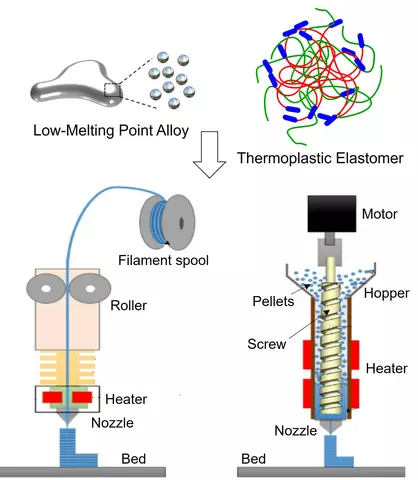
Credit: Weinan Xu
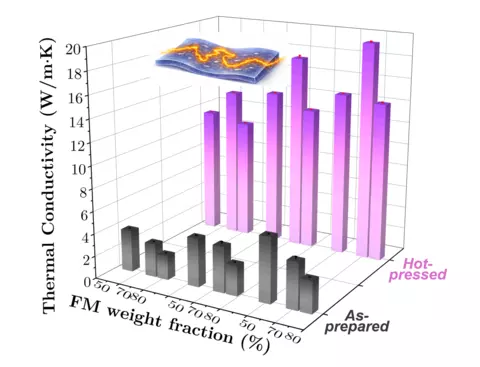
Despite the successful demonstration of 3D printing with multifunctional low-melting point alloy-polymer composites, important fundamental questions about their processing-structure-property relationships remain to be answered. Our research aims to understand the structure and material properties at all relevant stages of the printing process, from feedstock material generation to the final printed structures. This includes investigating the microstructures, molecular interactions at metal-polymer and metal-metal interfaces, and how phase transitions and processing pathways influence properties such as mechanical, thermal, rheological, and electrical characteristics. For example, our ongoing work leverages in situ synchrotron X-ray scattering at the Advanced Photon Source to probe phase transformations and reveal the formation of key intermetallic phases during processing. These insights will guide the design of controllable, tunable compositions and morphologies that achieve high 3D printability and multifunctional performance.
Read our new Cover Article here: ACS Applied Engineering Materials 2026, 4(2), 1037–1046.
2. Vat Photopolymerization Printing of Functional Hybrid Composites
Vat photopolymerization-based multi-material additive manufacturing (MMAM) is moving from “printing mixed materials” to engineering interfaces, gradients, and embedded functions, but progress is still constrained by interfacial reliability, co-processing limits, and insufficient property/process data for predictive design. This project seeks to establish the measurement science and manufacturing pathways needed to enable multi-material printed composites with targeted multifunctionality by connecting feedstock design, including polymers, ceramics, conductive and thermally functional additives, and hybrid reinforcements, to processing conditions, microstructure, and resulting performance. This scientific foundation will support the predictive design and reliable manufacturing of advanced multifunctional composites for emerging technology applications.