

Official websites use .gov
A .gov website belongs to an official government organization in the United States.

Secure .gov websites use HTTPS
A lock (
) or https:// means you’ve safely connected to the .gov website. Share sensitive information only on official, secure websites.


Building Digitization and Semantic Interoperability
Summary
The deployment of building microservices, such as controls, fault detection and diagnostics (FDD), commissioning, grid interaction, and indoor air quality, is critical to achieving cost-effective building operations that support occupant needs. These systems must respond dynamically to both service provider signals and occupants. However, these microservices face significant barriers due to limited access to automated, standardized machine-readable building data. These data come from diverse sources and span all phases of the building lifecycle, from design through operation. Although buildings are data-rich entities, harvesting that data remains labor-intensive, requiring manual mapping of data sources to the needs of each application. This process hinders scalability, increases costs, and delays deployment.
To overcome these limitations, there is a need for an interoperable digital infrastructure, a Digital Twin (DT), that is synchronized with the physical building and provides semantically rich digital representations of its systems and components. NIST will leverage subfields of artificial intelligence, including knowledge graphs and large language models, to support scalable, intelligent building services that reduce development costs, improve operational efficiency, and support grid-interactive performance.
This project will develop the science for a standard building DT and lead the effort to develop standard semantic models. This project will also support research on the semantics of grid integration and simulation of grid interaction, leading to the development of a grid digital twin that includes the transactive energy market.
Description
Objective
To develop the framework and tools for building and grid digitization and semantic interoperability, and to create standardized machine-readable semantic models that represent building systems information to advance AI-enabled analytics, automation, and control.
Technical Idea
NIST will create a Digital Twin (DT) framework with semantic interoperability that captures machine-readable metadata from design through operation. This framework will unify lifecycle data, automate system integration, and enable scalable, intelligent building services.
Semantic Web standards will be used to enable the interoperability component of the digital twin. We will create formal models of building system components, their relationships in various contexts, and the associated data and control points. Semantic Web technologies emerged as a means to effectively interlink and access data dispersed across the web. These technologies will be applied in this domain to:
- represent knowledge from building system data and other sources of information related to building operations in a machine-readable format;
- integrate diverse sources of data into a single model from various systems and applications; and
- enable description of logic-based reasoning to support decision making based on integrated data from heterogenous sources.
Building analytics and enterprise knowledge tools will be able to automatically find the necessary information from the semantic graphs in the building-specific models created with this technology. NIST is a key member of the ASHRAE Proposed Standard 223 team that is developing the standard to define common semantic information models for buildings.
The successful completion of this project will enhance major industries in building automation and analytics that currently recognize the need for these semantic models and have no other option but to use nonstandard solutions for their needs. Moreover, this project will foster industrial competitiveness among manufacturers to provide the standard compliant version of their equipment models to their clients.
Research Plan
The BDSI project has two complementary research thrusts: building digitization and semantic interoperability.
Building digitization requires research that establishes a framework for the development and assessment of building Digital Twins that enable building microservices. Establishing this framework will advance industrial competitiveness and provide greater transparency to customers purchasing these solutions. Moreover, our research will implement and validate this framework in at least one of our NIST laboratories for different microservices. NIST will also work with industry partners through a CRADA to enable deployment of NIST simulation tools for local grid digital twin models. This will enable demonstration of local energy market interactions for distribution utility grids and prove benefits to customers.
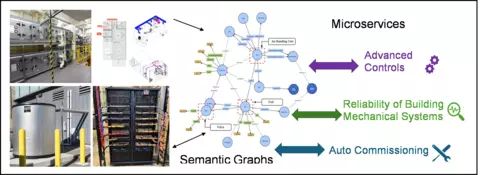
Semantic interoperability requires research that leads to the development of national and international standards. NIST will leverage subfields of artificial intelligence, including semantic graphs (ontologies), machine learning, and large language models, to define, generate, and apply semantic metadata for building data that advances building digitization and ultimately enhances building applications. This work will focus on creating and using interoperable, machine-readable semantic models that represent building systems information to enable advanced analytics, automation, and control. This involves:
- developing industry standard ASHRAE 223P, which has completed an initial public review and will be published in FY26;
- developing supporting infrastructure, including software tools for creating building-specific semantic models that conform to the standard using a combination of information available in BACnet systems, BIM models, and input from building operations staff;
- developing validation procedures (formal rules) to check if a specific model is compliant with the standard; and
- providing examples for the usage of such models for multiple building applications (grid integration, FDD, control, and commissioning).
Major Accomplishments
- Published the draft of ASHRAE 223P - Public Review Draft Semantic Data Model for Analytics and Automation Applications in Buildings - Comments are addressed and we are waiting for the committee to vote for the second public review.
- Integrated ASHRAE 223P model of NIST facilities, including the IBAL, with ASHRAE 231P on select laboratory equipment, demonstrating the interoperability between these two standards.
- Developed an open-source co-simulation platform enabling two-way communication for Digital twins