

Official websites use .gov
A .gov website belongs to an official government organization in the United States.

Secure .gov websites use HTTPS
A lock (
) or https:// means you’ve safely connected to the .gov website. Share sensitive information only on official, secure websites.


Assessment of High-Temperature and Innovative Insulation Thermal Performance
Summary
The use of thermal insulation in the building envelope is a primary approach for reducing heating and cooling loads in buildings, which account for approximately 43% and 36 % of energy consumption in residential and commercial buildings, respectively [1]. In addition to the use of insulation for reducing heat flow into and out of buildings, other innovative thermal control technologies such as phase change materials (PCMs) are being increasingly deployed in buildings to capture and store excess heat flow that penetrates through insulation to further reduce building energy costs. Phase change materials can also be used to shift peak load to reduce strain on the electrical grid. This project focuses on developing the measurement science needed to accurately determine the thermal properties of building insulation materials, and to disseminate the measured data to stakeholders by providing thermal insulation standard reference materials (SRMs) and calibration services. Furthermore, thermal efficiencies of PCMs as a component of the building envelope will be investigated with regard to the need for improved measurements and standards. The primary focus for FY26 is the operation assessment of the upgraded NIST 1016 mm Guarded Hot Plate (GHP) apparatus which is mainly used for SRMs and calibration services. Furthermore, development of measurement science for assessing thermal properties of raw PCMs and encapsulated PCMs is also planned. Outcomes of these tasks are used for calibrating commercial insulation test instruments and demonstrating the thermal management of PCMs as an envelope component in cooling and heating seasons [2].
Description
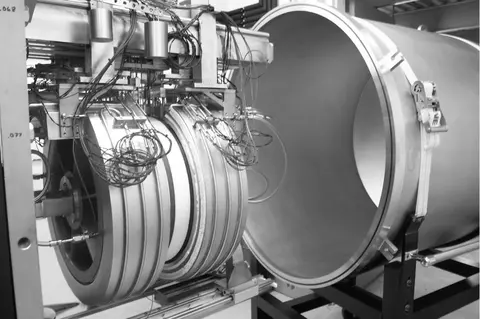
Figure 1. NIST 500 mm diameter guarded-hot-plate apparatus: plate and edge guard (foreground), vacuum bell jar (background). The edge guards are partially separated revealing a white insulation specimen.
Objective
To achieve reductions in residential, commercial, and industrial building energy costs by improving consumer confidence in the performance of traditional and novel thermal insulation solutions. This is done by decreasing measurement uncertainties of the thermal resistance of insulating materials and developing measurement techniques for innovative thermal insulations and thermal storage envelopes using PCMs.
Technical Idea
One of the most cost-effective ways of reducing building energy consumption is through thermal insulation. Insulation in the building envelope greatly reduces the energy demand for space conditioning. Accurate determination of the insulating capability of these materials is critical to achieving the building performance goals, including reducing energy costs, maintaining thermal comfort and good indoor air quality.
NIST will address these goals by 1) continuously developing data sets that provide accurate thermal transmission values of the insulations in wider ranges of temperatures, 2) developing and maintaining rigorous quality systems for thermal insulation measurements consistent with standard practices; and 3) investigating new thermal measurement approaches for innovative insulation materials and systems using PCMs. After achieving high confidence in measurements and promulgating test data, NIST will develop measurement services and reference materials for use by industry in calibrating equipment used to determine the thermal performance of insulation.
A new measurement challenge is determining thermal conductivity and specific heat capacity of innovative insulating materials and PCMs. Innovative insulating materials such as vacuum insulation panels and aerogels have been proposed to reduce heating and cooling loads in buildings, but the measurement challenges, including thermal conductivity measurement, have not been fully addressed. Factors such as heat flow, material geometry, or other material properties have complicated measurement science efforts. Furthermore, promising results of new insulation concepts integrated with PCMs needs to be studied for future measurement challenges.
In FY25, a new heat flow meter (HFM) and a newly acquired transient plane source instruments were used to measure thermal conductivities and thermal storage capabilities of various insulation boards and encapsulated PCMs. Among the results, the measured thermal conductivity values of insulation samples obtained from the transient method showed reasonable agreements with HFM. In FY26, NIST will expand usage of the transient plane source and hot wire instruments to measure raw PCMs in solid and liquid phases to compare measurements with the data of the encapsulated PCMs obtained by HFM.
Research Plan
The current year's research plan covers three related areas: 1) comparisons of the transient thermal measurements with the HFM measurements using various insulations and PCMs, and 2) developing new measurement approaches for the encapsulated PCMs. Concurrently, NIST staff will continue to participate in ASTM activities to ensure a path to promulgate products of their research.
The 500 mm GHP provides a unique measurement capability at NIST to test insulation specimens over wider ranges of temperature and air pressure compared to the 1016 mm GHP. Although measurement principles of the two GHP apparatuses are the same, a different mechanical design to guard the specimens are applied for the 500 mm GHP. In FY25, for the cold plate operation, a new coolant was selected to control the temperatures of the cold plate assemblies. In FY26, control systems of the 500 mm GHP, and thermal conductivity data obtained from the 500 mm GHP with the new coolants will be investigated. Furthermore, the two NIST GHP apparatuses will be compared against each other using the SRM 1450e at mean specimen temperatures below 60 °C to assess the level agreement between the two systems. The purpose in doing these tests is to better assess the uncertainty of the next version of the SRM 1450 series by capturing data from two different apparatuses.
Following successful intercomparisons of the 500 mm GHP with the Laboratoire National de Metrologie et d’Essais and the National Physical Laboratory of the UK, NIST is preparing data from these intercomparisons and other experiments to populate the datasets intended for release as part of Standard Reference Database 813. The database provides heat transmission properties – thermal conductivity, resistivity, conductance, and resistance – for building and insulating materials. These data are useful for building designers, material manufacturers, and researchers in the thermal design of building components and equipment.
Innovative insulation materials and PCMs have gained significant research interest to increase building envelope performance. Several commercial PCM products have been applied in thermal management of various buildings. Depending on encapsulation methods of PCMs, these products form a pouch or tile pattern on a single flexible or rigid board. In FY26, NIST will use transient measurement and steady-state methods (e.g., HFM) to measure thermal properties of raw PCMs and encapsulated PCMs. Outcomes would result in a draft test method or draft reference material for evaluating these products in future years. Additionally, the performance of these materials is sensitive to installation locations in wall and roof assemblies. A small-scale experiment for studying an effect of PCMs on the internal air temperature of the model roof has been started in FY25, and continuous monitoring of temperature variations in FY26 will help understand how laboratory measurements for thermal properties of phase change materials can be used to assess in-field energy efficiency performance over the course of a year.
REFERENCES:
[1] 2010 Buildings Energy Data Book, Table 2.1.6 and 3.1.5, respectively.