An official website of the United States government
Here’s how you know
Official websites use .gov
A .gov website belongs to an official government organization in the United States.
Secure .gov websites use HTTPS
A lock (
) or https:// means you’ve safely connected to the .gov website. Share sensitive information only on official, secure websites.

Rajavardhan Talashila, William Watterson, Benjamin Moser, Joshua Gordon, Alexandra Artusio-Glimpse, Nikunjkumar Prajapati, Noah Schlossberger, Matthew Simons, Christopher Holloway
Deep subwavelength RF imaging with atomic Rydberg sensors has overcome fundamental limitations of traditional antennas and enabled ultra-wideband detection of...
Robotic antenna ranges are highly configurable, but traditional pose selection methods do not utilize the collaborative capability presented by these...
We present on a novel gain extrapolation antenna range, the Compact Homodyne Extrapolation System (CHEXS), that can achieve absolute antenna gain measurements...
This data set is for the figures in the paper titled, "Improved Broadband Antenna Gain Measurements Through Multipath Mitigation Using Combined Robot Motion Stirring". In this paper we describe a
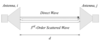
In this paper we describe an enhanced three-antenna gain extrapolation technique that allows one to determine antenna gain with significantly fewer data points and at closer distances than with the
This invention introduces a non-contact measuring tool designed for precise measurement of objects without physically touching them. It uses advanced optical and sensor technologies to capture accurate data on an object's dimensions and surface characteristics. The tool enhances measurement
This invention is an enhanced three-antenna gain extrapolation technique that allows one to determine absolute antenna gain with significantly fewer data points, as few as 10 data points, and at much closer distances, as much as six times closer than the traditional gain extrapolation technique, yet
Christopher L. Holloway
,
Josh Gordon
and
Matt Simons
A SI-traceable Rydberg atom radiofrequency power meter determines power of reference radiofrequency radiation and includes: a reference radiofrequency source that provides reference radiofrequency radiation; a vapor cell including: a pair of parallel-plate waveguides; a vapor cell wall including
A non-contact coordinate measuring machine includes: a noncontact metrology probe including: first and second cameras, wherein the second camera has a second field of view that overlaps a first field of view in a prime focal volume; a third camera has a third field of view that overlaps the prime
The invention is a new type of receiving antenna that uses optically excited atoms confined to a vapor cell to sense the strength, direction, and polarization of incoming RF radiation over the frequency range of under 1 GHz to about 1 THz (heretofore this frequency range will be referred to as RF i