

Official websites use .gov
A .gov website belongs to an official government organization in the United States.

Secure .gov websites use HTTPS
A lock (
) or https:// means you’ve safely connected to the .gov website. Share sensitive information only on official, secure websites.


Registry Approval Process
OSAC works to ensure the highest-quality SDO-published and OSAC Proposed Standards are posted to the OSAC Registry. Beginning October 1, 2025, OSAC implemented several organizational and process changes to streamline the Registry approval process.
Walk through the current Registry approval process using the overview graphic and detailed steps below.
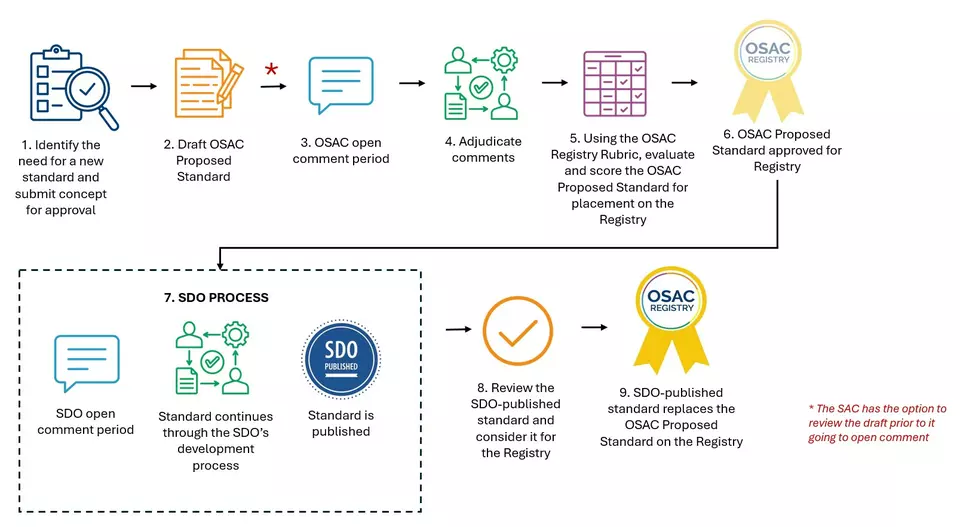
- An OSAC subcommittee identifies the need for a standard and submits the concept to the Forensic Science Standards Board (FSSB) for review and approval.
- If the FSSB approves the new concept, the subcommittee (or task group) drafts the OSAC Proposed Standard, following the FSSB’s Mandatory Requirements for Standards Development, and addressing the OSAC Registry Rubric questions.
- OSAC opens a 30-day comment period where the public is invited to submit feedback. During the same time, OSAC’s Resource Task Groups and Standards Review Panel (SRP) will review the draft and provide input.
- The subcommittee reviews and adjudicates the comments from OSAC’s open comment period and revises the OSAC Proposed Standard.
- The SAC and SRP evaluate and score the OSAC Proposed Standard using the OSAC Registry Rubric.
- The SRP has the final approving authority to place the OSAC Proposed Standard on the Registry. They can, however, solicit the FSSB for an additional review and vote, if needed.
- The OSAC Proposed Standard is sent to a standards developing organization (SDO), where it completes their specific development process. While at the SDO, the public, RTGs, and other interested stakeholders have another opportunity to provide feedback on the standard. The SDO process may take several years and, in the end, results in a published standard. To help fill the standards gap while the SDO completes the standards development process, OSAC encourages forensic science service providers to implement the OSAC Proposed Standard on the Registry.
- After the SDO publishes the standard, it is returned to the OSAC drafting subcommittee, which will review the published version and consider it for the Registry.
- Using the rubric, the SAC evaluates the SDO-published standard and has the final approving authority to replace the OSAC Proposed Standard with the SDO-published version on the Registry.
associated links
- Standards Resources
- Legacy Registry Approval Process (effective February 2020 - September 30, 2025)
- Scientific & Technical Review (STR) Process (effective October 1, 2020 - September 30, 2025)