

Official websites use .gov
A .gov website belongs to an official government organization in the United States.

Secure .gov websites use HTTPS
A lock (
) or https:// means you’ve safely connected to the .gov website. Share sensitive information only on official, secure websites.


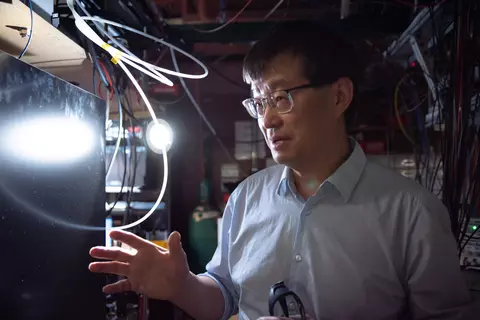
BOULDER, Colo. — Physicist Jun Ye of the U.S. Department of Commerce’s National Institute of Standards and Technology (NIST) has been awarded the 2026 Wolf Prize in Physics. The award, often considered the second most prestigious award in the physical sciences, after the Nobel Prize in Physics, cited Ye’s achievement in “transformative, widely applicable advances in the control of ultracold atomic systems.”
Ye, a physicist at JILA, a joint institute of NIST and the University of Colorado Boulder, shares the prize with Immanuel Bloch, the scientific director at the Max Planck Institute of Quantum Optics in Garching, Germany. The two will split the $100,000 award.
“Honored and humbled, I wish to express my sincere gratitude to the Wolf Prize Committee,” Ye said. “I am very fortunate to have worked with so many brilliant scientists, from my mentors and close colleagues to the world's best students and postdocs in our lab."
Ye has pioneered the development of the world’s most accurate and stable optical atomic clocks, which have unprecedented precision and are paving the way to redefine the international standard for time and frequency measurements. He and his collaborators achieved those record-breaking results using ultrastable lasers and precise control of the interactions between laser-trapped atoms.
His research has also opened new possibilities for tests of fundamental physics, including the most sensitive search for the electron’s electric dipole moment, relativistic geodesy, and searches for variations in fundamental constants.
Born in Shanghai in 1967, Ye often stayed with his paternal grandmother while his parents pursued demanding careers. Although his grandmother could neither read nor write, she gave Ye his first tools, a bundle of pencils and a stack of paper, advising him to write down or draw anything that interested him. During Ye’s freshman year in high school, a physics teacher noticed his aptitude for science and encouraged him to enter a physics competition. He won.
After earning a physics degree at Shanghai Jiao-Tong University, Ye immigrated to the United States in 1989. He joined JILA in 1992, studying under NIST physicist John Hall.
Ye is a fellow of the American Physical Society as well as a member of the National Academy of Sciences and the American Academy of Arts and Sciences. In 2022, he shared the Breakthrough Prize in Fundamental Physics for his work on atomic clocks and also received a Vannevar Bush Fellowship, the Herbert Walther Award, and the Niels Bohr Institute Medal of Honour.
The Wolf Prize is an international award granted in Israel that has been presented most years since 1978 to living scientists and artists for “achievements in the interest of mankind and friendly relations among people ... irrespective of nationality, race, color, religion, sex or political views.”