

Official websites use .gov
A .gov website belongs to an official government organization in the United States.

Secure .gov websites use HTTPS
A lock (
) or https:// means you’ve safely connected to the .gov website. Share sensitive information only on official, secure websites.


NIST’s Critical Minerals and Materials (CMM) Activities
NIST’s CMM activities advance the fundamental measurement science, reference materials, data infrastructure, and standards required to secure a resilient, efficient, and circular domestic value chain. By establishing objective benchmarks traceable to the International System of Units (SI), NIST reduces technical and financial risks, empowering U.S. manufacturers to substitute, recover, and utilize critical materials with precision and confidence.
What are Critical Minerals & Materials?
Critical minerals and materials (CMMs) are substances vital to modern economies, energy technologies, and national security, yet they are defined by significant supply chain vulnerabilities.
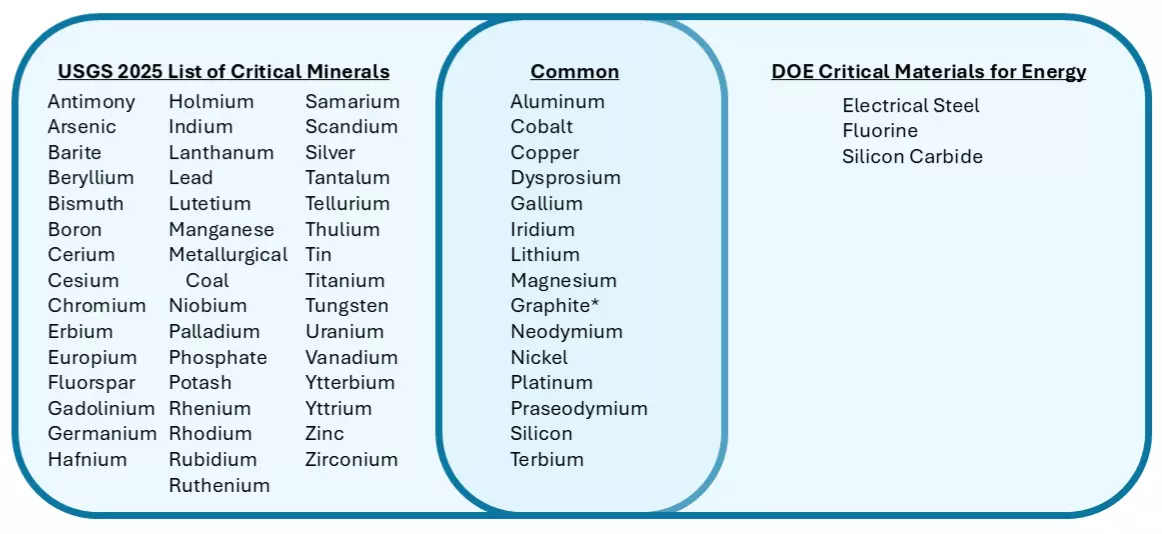
In the United States, these resources are dynamically defined and updated by two federal entities under the Energy Act of 2020:
- The U.S. Geological Survey (USGS, Department of the Interior) identifies critical minerals by assessing current and historical supply risks to national security and the broader economy
- The Department of Energy (DOE) looks forward, forecasting raw minerals and engineered materials essential specifically to the energy sector
Because criticality shifts with global markets, these lists are updated periodically. The Venn diagram below illustrates the latest designations, highlighting where their strategic priorities overlap.
Why Focus on Critical Minerals & Materials?
Modern technology, clean energy, and national security rely heavily on a stable supply of Critical Minerals and Materials (CMMs). Currently, the United States Geological Survey (USGS) and Department of Energy (DOE) identify 65 unique CMMs – ranging from rare earth elements (REEs) and platinum group metals (PGMs) to engineered substances like silicon carbide and electrical steel – that are subject to supply-chain vulnerabilities and regional dependencies.
To shore up domestic CMM supply chains, the federal government is addressing supply vulnerabilities through various agency initiatives, such as the U.S. DOE’s Critical Minerals and Materials Strategy. These strategic efforts generally focus on four key pillars:
- Diversifying supplies of critical minerals and materials
- Developing alternatives to reduce reliance on high-risk sources
- Improving materials and manufacturing efficiency to increase yields
- Investing in recycling and reuse approaches to extend product and material lifespans.
How Does NIST Help?
NIST provides the foundational measurement science, reference materials, and data infrastructure necessary to support these pillars through four strategic focus areas:
- Substitution and Alternatives: Integrating high-throughput experiments with computational modeling to accelerate the design of alternative alloys and performance-matched substitutes that reduce reliance on high-risk CMMs.
- Traceability and Supply Chain Resilience: Developing reference materials, data exchange mapping protocols, and targeted measurement methods to securely track CMM provenance and quality from extraction to derivative products.
- Identification, Characterization, and Quantification: Leveraging deep expertise in analytical chemistry and precision metrology to develop advanced methods that detect and quantify CMMs within complex matrices, including primary ores and secondary feedstocks (e.g., electronic waste).
- Separation and Recovery: Utilizing legacy strengths in thermodynamic and kinetic modeling to optimize chemical separation processes and establish robust recovery metrics that help industry turn waste into reliable inputs.