

Official websites use .gov
A .gov website belongs to an official government organization in the United States.

Secure .gov websites use HTTPS
A lock (
) or https:// means you’ve safely connected to the .gov website. Share sensitive information only on official, secure websites.


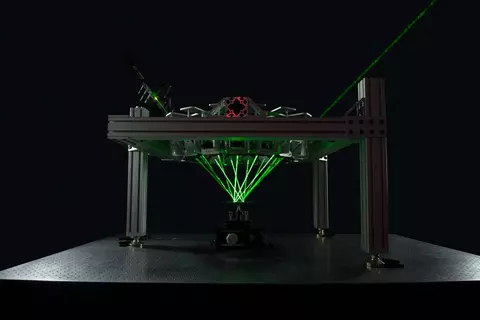
We see lasers in the fictional universes of sci-fi movies and in real life when trying to entertain our pet cats. We also use them when designing and testing new materials. But how do we measure their power?
There are different ways, but at NIST’s Boulder campus, researchers measure laser power using a device called the high amplification laser-pressure optic (HALO).
By measuring laser power, scientists can help improve safety, quality control and performance over time. All of these factors are key for companies that use high-powered lasers for 3D printing, manufacturing and defense applications.
So, how does HALO work? A mirror is attached to a force-sensing balance, and a laser light is reflected off that mirror 14 times. The large number of reflections increases the sensitivity of the measurement. Researchers then measure the total force of the laser’s reflections to determine its power. HALO can measure laser power of up to 10 kilowatts, which is more powerful than 10 million laser pointers.
It’s also incredibly sensitive. When researchers first built HALO’s prototype, they noticed the data had a spike or blip that was occurring at random intervals.
Eventually, a researcher figured out that the blip was likely due to a door opening or closing in the hallway, even if the door causing the disturbance was many rooms away.
Researchers hypothesized that the air pressure created from the doors closing and opening traveled through the HVAC system to the lab. The device was so sensitive to air pressure disturbances because the mirror would act like a sail, picking up on small air currents in the lab.
Since then, the HALO prototype and the surrounding lab space have been modified, and researchers account for these environmental disturbances in their measurements.
Follow us on social media for more like this from all across NIST!