

Official websites use .gov
A .gov website belongs to an official government organization in the United States.

Secure .gov websites use HTTPS
A lock (
) or https:// means you’ve safely connected to the .gov website. Share sensitive information only on official, secure websites.


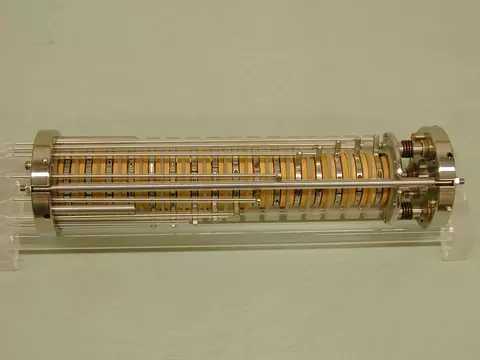
Just how long do free-floating neutrons live on average? This electromagnetic proton trap at the NIST Center for Neutron Research (NCNR) is part of an effort to answer that question.
Free neutrons break down into other particles — a proton, an electron and an antineutrino — in about 15 minutes on average. This process gives us insight into the weak nuclear force, which governs radioactive decay as well as fusion inside stars. And if neutrons decayed a bit more quickly, the chemical makeup of the universe might be so different that life on Earth would not exist. A better measurement of the neutron lifetime would give physicists greater clarity about the way our universe works.
One measurement method is to send a beam of cold neutrons through the electromagnetic trap, which traps protons that emerge from the neutrons’ decay. The trap’s interior is kept at a nearly perfect vacuum, meaning nothing else should be inside. In theory, counting the protons in the trap would reveal how many neutrons had decayed in a given time period. However, different experiments that attempt to measure the neutron lifetime exactly with different experimental methods have come up with answers that vary by nearly 10 seconds.
Scientists want to figure out where the difference is coming from, as it could be the sign of newfound physics. Could it be that some unwanted substance is sneaking into the proton trap somehow?
The physicists considered the possibility that a few hydrogen molecules — two linked hydrogen atoms — might be contaminating the trap. If a proton bumps into one of these molecules just the right way, it can steal one of the molecule’s electrons, becoming an atom of hydrogen lacking the strong positive charge that the trap’s electromagnetic field uses to hold the protons inside. The new-formed atom can escape the trap, leaving behind a molecular hydrogen ion. So the team examined the experimental data again for any evidence that hydrogen ions might be present.
After a close look, the team found a very low likelihood that hydrogen ions were in the trap, and even if some protons had stolen electrons and escaped, it would have produced a negligible effect on the lifetime measurement.
So that rules out one possibility. We still don’t know the reason why the discrepancy exists. But we know one reason it doesn’t, and that gets us closer to the answer.
Follow us on social media for more like this from all across NIST!