

Official websites use .gov
A .gov website belongs to an official government organization in the United States.

Secure .gov websites use HTTPS
A lock (
) or https:// means you’ve safely connected to the .gov website. Share sensitive information only on official, secure websites.


The NCNR guide network transports neutrons to the facility’s cold neutron instruments (with the exception of MACS, which has its own dedicated moderator). These guides are conceptually analogous to fiber optics, reflecting neutrons toward their destination using surfaces coated with mirror thin films with a large refractive index, and are a major factor in instrument performance. NCNR is engaged in a multi-year project to upgrade neutron guides NG5, NG6, and NG7, as well as most of the instruments served by those guides. These guides were the oldest in the facility, having been installed as part of construction of the first NCNR guide hall. The reflection coating for those guides was 58Ni, which is no longer state-of-the-art, and the guides suffered radiation damage over more than 30 years of use. The new guides use modern multilayer supermirrors, and they are tailored to optimize performance of the instruments being served. For example, the new NG6 is curved to prevent line of sight between the source and the cold neutron imaging station at the end of the guide, and the new NG5 is designed to transport a very large beam onto a double focusing monochromator which will serve the new NG5 cold 3-axis instrument.
This project started in August 2024, to take advantage of downtime associated with concurrent reactor vessel cleaning. By June 2025, guide installation was complete in the confinement building, and though the wall separating confinement and the guide hall. The new NG7 is on schedule to be operable by mid-2026, followed by the new NG6 in 2027, and the new NG5 near the end of the decade (when construction of the new cold 3-Axis instrument is complete). All told, this project will yield gains of approximately 2-10 in data rate for the nine individual instruments served by these new neutron guides.
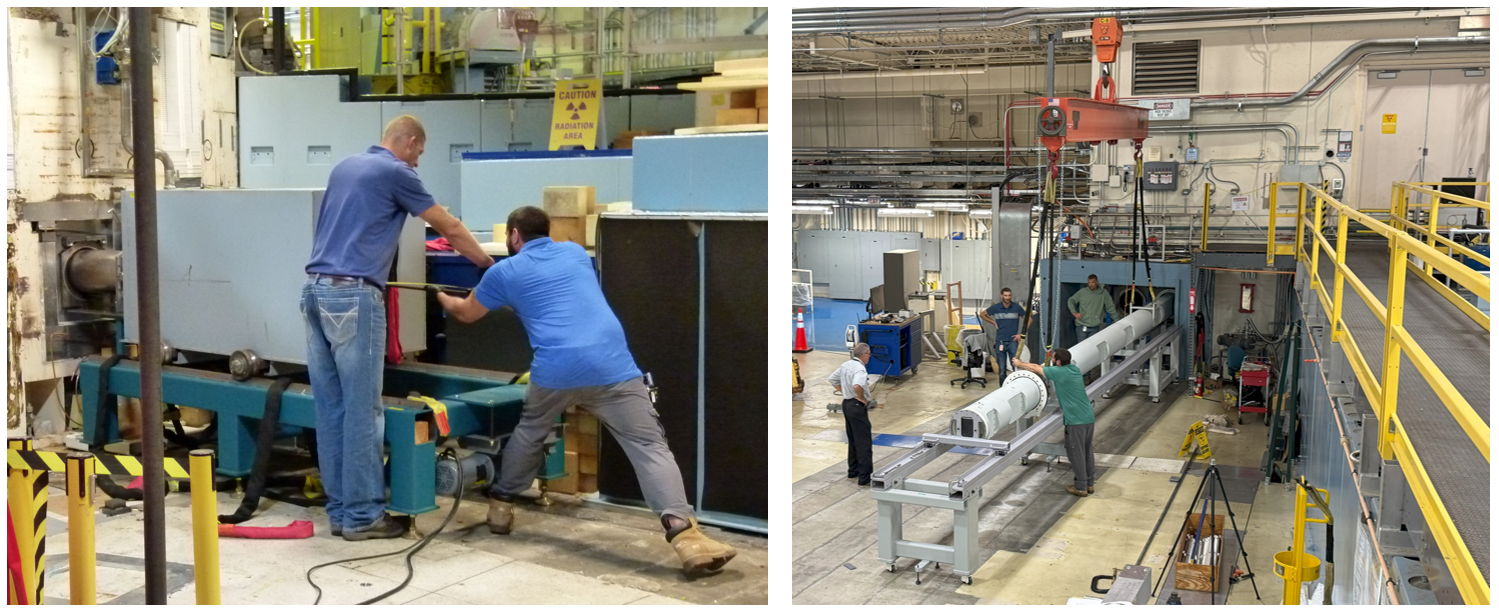
NCNR staff removing in-pile guide sections (left) and installing the NG5 penetration casing (right).